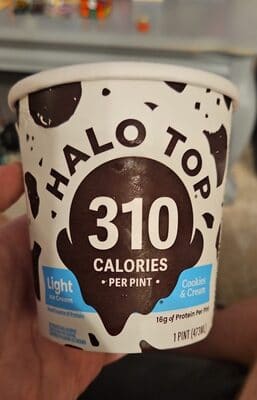
Ice creams
Halo Top Light Ice Cream Cookies & Cream
1 PT/473 mL
Score
- Ultra-processed
- Contains non-nutritive sweeteners
- Contains added sugars
- Contains sugar alcohols
- Contains emulsifiers studied for gut effects
- Contains palm oil
- Seed-oil free
- No synthetic dyes
Why it scores 21
Halo Top Light Ice Cream Cookies & Cream scores 21 out of 100 (Poor) under GoodSwap’s published rules. What moved the score most:
- minus 20 points Sugar: An added sugar. Strong
- minus 20 points Caramel color: The FDA says classes III and IV, which can contain 4-MEI, are the most commonly used food color additives by volume. Regulatory
- minus 18 points Ultra-processed (NOVA 4): Classified NOVA 4: made with industrial ingredients and additives. Strong
Every line of the math is on The Receipt below, with its evidence tier and sources.
Better ice cream
-
 Cookies & Cream Flavor Light Ice Cream N!ck's · 1 PT/473 mL No added sugars · No palm oil Score 49 out of 100 , 28 points higher
 -
 Double Chocolate Gelato Frappuccino lite chilled coffee drink Starbucks No added sugars · No sugar alcohols Score 62 out of 100 , 41 points higher
 -
 Nick's No Added Sugar Vanilla Bean Light Ice Cream Nick's · 1 PINT/473 mL No added sugars · No gut-studied emulsifiers Score 53 out of 100 , 32 points higher
 -
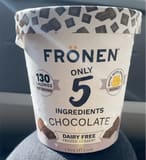 Only 5 Ingredients Chocolate Frönen · 1 pt Not ultra-processed · No non-nutritive sweeteners Score 67 out of 100 , 46 points higher
 -
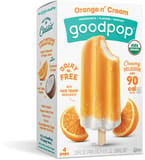 Orange n' Cream Goodpop · 4 pops No non-nutritive sweeteners · No sugar alcohols Score 59 out of 100 , 38 points higher
The same kind of product, at least 10 points higher, sold in the US. Never paid placements.
The Receipt
Light Ice Cream Cookies & Cream
Ingredients
- Sugar minus 20 points
- Caramel color minus 20 points
- Erythritol minus 7.5 points
- Cellulose gum (carboxymethylcellulose) minus 2.5 points
Processing
- Ultra-processed (NOVA 4) minus 18 points
- 10 kinds of ultra-processing markers minus 8 points
Nutrition per 100 g
- Sugars 9.3 g / 100 g minus 5 points
- Saturated fat 1.2 g / 100 g minus 1 points
- Salt 0.3 g / 100 g minus 1 points
- Fiber 7 g / 100 g plus 4 points
100 − 79 = 21
Can’t score above 79. Contains sugar, an ingredient of high concern. [1][2][3][4][5][6][7]
Nutrition per 100 g
| Energy | 116 kcal |
|---|---|
| Fat | 2.3 g |
| Saturated fat | 1.2 g |
| Trans fat | 0 g |
| Carbohydrates | 26.7 g |
| Sugars | 9.3 g |
| Added sugars | 4.7 g |
| Fiber | 7 g |
| Protein | 7 g |
| Salt | 0.3 g |
Serving: 1 pint (473 ml)
Ingredients
- ULTRAFILTERED SKIM MILK
- SKIM MILK
- SOLUBLE CORN FIBER
- ERYTHRITOL (moderate concern)
- CREAM
- SUGAR (high concern)
- VEGETABLE GLYCERIN
- WHEAT FLOUR
- NATURAL FLAVORS
- ISOMALT
- PALM OIL
- SORBITOL
- COCOA PROCESSED WITH ALKALI
- INULIN
- FOOD STARCH-MODIFIED
- SALT
- BAKING SODA
- STEVIA LEAF EXTRACT (REB M)
- STEVIA LEAF EXTRACT (REB A)
- VITAMIN A PALMITATE
- MONO AND DIGLYCERIDES
- CELLULOSE GEL
- CELLULOSE GUM (moderate concern)
- CARAMEL COLOR (high concern)
Label text, as published
ULTRAFILTERED SKIM MILK*, SKIM MILK, SOLUBLE CORN FIBER, ERYTHRITOL, CREAM, SUGAR, VEGETABLE GLYCERIN, CONTAINS 2% OR LESS OF WHEAT FLOUR, NATURAL FLAVORS, ISOMALT, PALM OIL, SORBITOL, COCOA PROCESSED WITH ALKALI, INULIN, FOOD STARCH-MODIFIED, SALT, BAKING SODA, STEVIA LEAF EXTRACT (REB M), STEVIA LEAF EXTRACT (REB A), VITAMIN A PALMITATE, MONO AND DIGLYCERIDES, CELLULOSE GEL, CELLULOSE GUM, CARAMEL COLOR.
Allergens and diets
Contains: Milk, Wheat, Gluten, Egg
- Not vegan
- Not gluten-free
- Not palm-oil-free
Always check the package: recipes change.
More ice creams on GoodSwap
-
 Homemade Vanilla Blue Bell Ice Cream · 473 mL Dye with an EU warning labelContains synthetic dyesUltra-processedHigh in sugar Score 7 out of 100 Bad
 -
 Gelato - Madagascan Vanilla Bean Talenti · 473 mL Ultra-processedHigh in sugarHigh in saturated fatContains added sugars Score 12 out of 100 Bad
 -
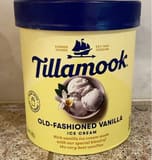 Old-Fashioned Vanilla Ice Cream Tillamook · 1.5 qt Ultra-processedHigh in saturated fatContains added sugars Score 35 out of 100 Poor
 -
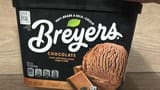 Ice Cream Breyers · 1.5 Quart/1.41 L Ultra-processedHigh in sugarHigh in saturated fatContains added sugars Score 37 out of 100 Poor
 -
 Darkest Chocolate Jeni’s Ice Cream · 1 PT/473 mL High in saturated fatContains added sugarsNo additives Score 35 out of 100 Poor
 -
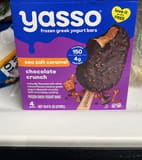 Sea Salt Caramel Chocolate Crunch Frozen Greek Yogurt Bars Yasso · 4 pack - 10.6 fl oz (313 mL) Ultra-processedContains added sugarsContains seed oilsContains whole grains Score 16 out of 100 Bad
More from Halo Top
Sources
-
Guideline: sugars intake for adults and children
“In both adults and children, WHO recommends reducing the intake of free sugars to less than 10% of total energy intake”
who.int
-
Dietary Guidelines for Americans, 2025–2030
“Limit foods and beverages that include artificial flavors, petroleum-based dyes, artificial preservatives, and low-calorie non-nutritive sweeteners.”
cdn.realfood.gov
-
Added and free sugars should be as low as possible
“Sugar consumption is a known cause of dental caries.”
efsa.europa.eu
-
Questions & Answers About 4-MEI
“Based on current science, the FDA has no reason to believe that there are any immediate or short-term health risks presented by 4-MEI at the levels expected in food.”
fda.gov
-
Agents Classified by the IARC Monographs, Volumes 1–142 (List of Classifications)
monographs.iarc.who.int
-
Proposition 65 List of Chemicals Known to the State to Cause Cancer or Reproductive Toxicity
“The date refers to the initial appearance of the chemical on the list.”
oehha.ca.gov
-
The artificial sweetener erythritol and cardiovascular event risk
“Our findings reveal that erythritol is both associated with incident MACE risk and fosters enhanced thrombosis. Studies assessing the long-term safety of erythritol are warranted.”
doi.org
-
Re-evaluation of erythritol (E 968) as a food additive (plain language summary)
“In all groups of people, both acute and chronic exposure to erythritol is above the newly set ADI.”
efsa.europa.eu
-
“Relative to control subjects, CMC consumption modestly increased postprandial abdominal discomfort and perturbed gut microbiota composition in a way that reduced its diversity.”
doi.org
-
Dietary emulsifiers impact the mouse gut microbiota promoting colitis and metabolic syndrome
“carboxymethylcellulose and polysorbate-80, induced low-grade inflammation and obesity/metabolic syndrome in wild-type hosts and promoted robust colitis in mice predisposed to this disorder.”
doi.org
-
“This study found positive associations between risk of CVD and intake of five individual and two groups of food additive emulsifiers widely used in industrial foods.”
doi.org
-
“The Panel concluded that there was no need for a numerical ADI and that there would be no safety concern at the reported uses and use levels for the unmodified and modified celluloses”
doi.org
-
Saturated fatty acid and trans-fatty acid intake for adults and children: WHO guideline
“WHO recommends that adults and children reduce saturated fatty acid intake to 10% of total energy intake (strong recommendation).”
who.int
-
“For adults, WHO recommends less than 2000 mg/day of sodium (equivalent to less than 5 g/day salt), or just under a teaspoon.”
who.int
-
“Greater exposure to ultra-processed food was associated with a higher risk of adverse health outcomes, especially cardiometabolic, common mental disorder, and mortality outcomes.”
doi.org
-
WHO advises not to use non-sugar sweeteners for weight control in newly released guideline
“The recommendation is based on the findings of a systematic review of the available evidence which suggests that use of NSS does not confer any long-term benefit in reducing body fat in adults or children.”
who.int
-
Regulation (EU) No 1169/2011, Annex III point 2.4 (foods with more than 10 % added polyols)
“‘excessive consumption may produce laxative effects’.”
eur-lex.europa.eu
-
“Glycidyl fatty acid esters, expressed as glycidol”
eur-lex.europa.eu