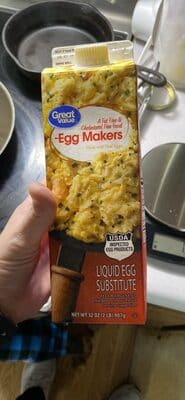
Eggs
Great Value Egg Makers Liquid Egg Substitute
32 oz
Score
- Ultra-processed
- No synthetic dyes
Why it scores 73
Great Value Egg Makers Liquid Egg Substitute scores 73 out of 100 (Good) under GoodSwap’s published rules. What moved the score most:
- minus 18 points Ultra-processed (NOVA 4): Classified NOVA 4: made with industrial ingredients and additives. Strong
- minus 3 points 3 kinds of ultra-processing markers: Industrial additive classes found: color (added), flavoring and thickener, stabilizer or gelling agent. Emerging
- minus 2.5 points Guar gum: An ingredient class typical of ultra-processed foods (NOVA group 4). Info
Every line of the math is on The Receipt below, with its evidence tier and sources.
Better liquid eggs and egg substitutes
-
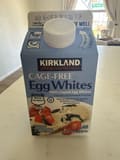 Egg Whites Kirkland Signature · 16 oz (1 lb) Not ultra-processed · No guar gum Score 100 out of 100 , 27 points higher
 -
 Egg Whites Bob Evans · 16 oz Not ultra-processed · No guar gum Score 100 out of 100 , 27 points higher
 -
 Egg Whites Great Value · 32 oz Not ultra-processed · No guar gum Score 100 out of 100 , 27 points higher
 -
 100% Liquid Egg Whites Bob Evans · 32 oz (908 g) Not ultra-processed · No guar gum Score 100 out of 100 , 27 points higher
 -
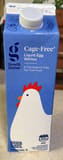 Liquid Egg Whites Good & Gather · 32 oz Not ultra-processed · No guar gum Score 100 out of 100 , 27 points higher
The same kind of product, at least 10 points higher, sold in the US. Never paid placements.
The Receipt
Egg Makers Liquid Egg Substitute
Ingredients
- Guar gum minus 2.5 points
- Xanthan gum minus 2.5 points
- Natural flavors minus 2.5 points
Processing
- Ultra-processed (NOVA 4) minus 18 points
- 3 kinds of ultra-processing markers minus 3 points
Nutrition per 100 g
- Salt 0.5 g / 100 g minus 1 points
- Protein 10.9 g / 100 g plus 2 points
100 − 27.5 = 72.5 → 73
Nutrition per 100 g
| Energy | 54 kcal |
|---|---|
| Fat | 0 g |
| Saturated fat | 0 g |
| Trans fat | 0 g |
| Carbohydrates | 2.2 g |
| Sugars | 0 g |
| Added sugars | 0 g |
| Fiber | 0 g |
| Protein | 10.9 g |
| Salt | 0.5 g |
Serving: 3 tbsp. (46 g)
Ingredients
- EGG WHITES
- GUAR GUM
- XANTHAN GUM
- SPICES
- SALT
- ONION POWDER
- NATURAL FLAVOR
- COLOR (INCLUDES BETA-CAROTENE) (not recognized)
- VITAMINS AND MINERALS: CALCIUM SULFATE
- IRON (FERRIC ORTHOPHOSPHATE)
- VITAMIN E (ALPHA-TOCOPHEROL ACETATE)
- ZINC SULFATE
- CALCIUM PANTOTHENATE
- VITAMIN B12
- VITAMIN B2 (RIBOFLAVIN)
- VITAMIN B1 (THIAMINE MONONITRATE)
- VITAMIN B6 (PYRIDOXINE HYDROCHLORIDE)
- FOLIC ACID
- BIOTIN
- VITAMIN D3
Label text, as published
EGG WHITES, CONTAINS 1% OR LESS OF THE FOLLOWING: GUAR GUM, XANTHAN GUM, SPICES, SALT, ONION POWDER, NATURAL FLAVOR, COLOR (INCLUDES BETA-CAROTENE). VITAMINS AND MINERALS: CALCIUM SULFATE, IRON (FERRIC ORTHOPHOSPHATE), VITAMIN E (ALPHA-TOCOPHEROL ACETATE), ZINC SULFATE, CALCIUM PANTOTHENATE, VITAMIN B12, VITAMIN B2 (RIBOFLAVIN), VITAMIN B1 (THIAMINE MONONITRATE), VITAMIN B6 (PYRIDOXINE HYDROCHLORIDE), FOLIC ACID, BIOTIN, VITAMIN D3.
Allergens and diets
Contains: Egg
- Not vegan
- Palm-oil-free
Always check the package: recipes change.
More eggs on GoodSwap
-
 Cage-Free Eggs Grade Aa Large Kirkland Signature · 48 oz No additives Score 100 out of 100 Excellent
 -
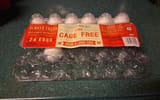 Cage Free Grade A Large Eggs Member's Mark · 48 oz No additives Score 100 out of 100 Excellent
 -
 Organic Eggs Kirkland Signature · 48 oz Certified organicNo additives Score 100 out of 100 Excellent
 -
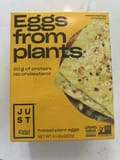 Folded plant eggs Just Egg · 227 g Ultra-processedContains seed oils Score 72 out of 100 Good
 -
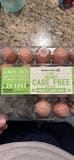 Organic Cage Free Eggs Member's Mark · 48 oz Certified organicNo additives Score 100 out of 100 Excellent
 -
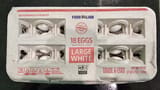 18 Eggs Large White Food Lion · 36 oz No additives Score 100 out of 100 Excellent
More from Great Value
-
 Purified Drinking Water Great Value · 16.9 fl oz (500 mL) Score 100 out of 100 Excellent
 -
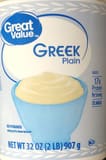 Greek Plain Great Value · 907 g Score 100 out of 100 Excellent
 -
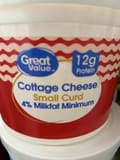 Cottage Cheese Small Curd 4% Milkfat Minimum Great Value · 48 oz Score 64 out of 100 Good
 -
 Hamburger Dill Chips Great Value · 32 fl oz/1 Quart/946 mL Score 50 out of 100 Okay
Sources
-
21 CFR 101.22 Foods; labeling of spices, flavorings, colorings and chemical preservatives
“whose significant function in food is flavoring rather than nutritional.”
ecfr.gov
-
“For adults, WHO recommends less than 2000 mg/day of sodium (equivalent to less than 5 g/day salt), or just under a teaspoon.”
who.int
-
Dietary Guidelines for Americans, 2025–2030
“Limit foods and beverages that include artificial flavors, petroleum-based dyes, artificial preservatives, and low-calorie non-nutritive sweeteners.”
cdn.realfood.gov
-
“Greater exposure to ultra-processed food was associated with a higher risk of adverse health outcomes, especially cardiometabolic, common mental disorder, and mortality outcomes.”
doi.org