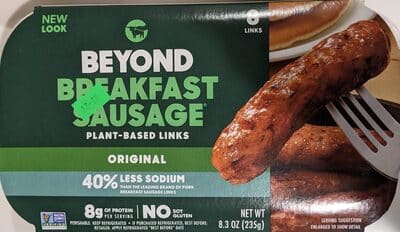
Meat analogues
Beyond Breakfast Sausage Plant-Based Links
8.3 oz
Score
- Ultra-processed
- Contains added sugars
- Contains seed oils
- No synthetic dyes
Why it scores 38
Beyond Breakfast Sausage Plant-Based Links scores 38 out of 100 (Poor) under GoodSwap’s published rules. What moved the score most:
- minus 20 points Corn syrup: An added sugar. Strong
- minus 18 points Ultra-processed (NOVA 4): Classified NOVA 4: made with industrial ingredients and additives. Strong
- minus 8 points 8 kinds of ultra-processing markers: Industrial additive classes found: bulking agent, color (added), emulsifier, flavor enhancer, flavoring, industrial protein, industrial sugar or starch hydrolysate and thickener, stabilizer or gelling agent. Emerging
Every line of the math is on The Receipt below, with its evidence tier and sources.
Better sausages
-
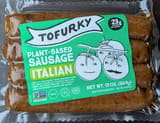 Plant-Based Sausage Italian Tofurky · 13 oz No added sugars · No corn syrup Score 80 out of 100 , 42 points higher
 -
 Chicken Breakfast Links Amylu · 40 oz Not ultra-processed · No added sugars Score 89 out of 100 , 51 points higher
 -
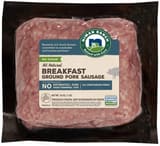 Breakfast Ground Pork Sausage Niman Ranch · 16 oz Not ultra-processed · No added sugars Score 79 out of 100 , 41 points higher
 -
 Original breakfast sausage Giant Eagle · 16 oz/1 lb/453 g Not ultra-processed · No added sugars Score 79 out of 100 , 41 points higher
 -
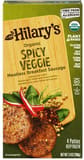 Organic spicy veggie meatless breakfast sausage Hilary's · 7.3 oz/208 g Not ultra-processed · No added sugars Score 91 out of 100 , 53 points higher
The same kind of product, at least 10 points higher, sold in the US. Never paid placements.
The Receipt
Breakfast Sausage Plant-Based Links
Ingredients
- Corn syrup minus 20 points
- Canola oil minus 2.5 points
- Calcium alginate minus 2.5 points
- Natural flavors minus 1.5 points
- Rice protein minus 1.5 points
- Inulin (chicory root fiber) minus 1.5 points
- Methylcellulose minus 0.5 points
- Yeast extract minus 0.5 points
- Sunflower lecithin minus 0.5 points
Processing
- Ultra-processed (NOVA 4) minus 18 points
- 8 kinds of ultra-processing markers minus 8 points
Nutrition per 100 g
- Saturated fat 3.5 g / 100 g minus 3 points
- Salt 0.7 g / 100 g minus 3 points
- Energy 283 kcal / 100 g minus 1 points
- Protein 8 g / 100 g plus 2 points
100 − 62 = 38
Can’t score above 79. Contains corn syrup, an ingredient of high concern. [1][2][3]
Nutrition per 100 g
| Energy | 283 kcal |
|---|---|
| Fat | 10 g |
| Saturated fat | 3.5 g |
| Trans fat | 0 g |
| Carbohydrates | 3 g |
| Sugars | 0 g |
| Added sugars | 0 g |
| Fiber | 2 g |
| Protein | 8 g |
| Salt | 0.7 g |
Serving: 59 g
Ingredients
- WATER
- PEA PROTEINT (not recognized)
- EXPELLER-PRESSED CANOLA OIL
- REFINED COCONUT OIL
- CALCIUM ALGINATE CASING
- NATURAL FLAVORS
- YEAST
- RICE PROTEIN
- CHICORY ROOT FIBER
- METHYLCELLULOSE
- SALT
- TAPIOCA SYRUP SOLIDS (high concern)
- TAPIOCA DEXTROSE
- APPLE EXTRACT
- PSYLLIUM HUSK FIBER
- YEAST EXTRACT
- POTASSIUM CHLORIDE
- POMEGRANATE EXTRACT
- VINEGAR
- LEMON JUICE CONCENTRATE
- PEA FIBER
- SUNFLOWER LECITHIN
- BEET POWDER (FOR COLOR)
- SPICES
- CARROT
Label text, as published
WATER, PEA PROTEINT, EXPELLER-PRESSED CANOLA OIL, REFINED COCONUT OIL, CALCIUM ALGINATE CASING, NATURAL FLAVORS, YEAST, RICE PROTEIN, CHICORY ROOT FIBER, METHYLCELLULOSE, SALT, TAPIOCA SYRUP SOLIDS, TAPIOCA DEXTROSE, APPLE EXTRACT, PSYLLIUM HUSK FIBER, YEAST EXTRACT, POTASSIUM CHLORIDE, POMEGRANATE EXTRACT, VINEGAR, LEMON JUICE CONCENTRATE, PEA FIBER, SUNFLOWER LECITHIN, BEET POWDER (FOR COLOR), SPICES, CARROT.
Allergens and diets
- Vegan
- Vegetarian
- Palm-oil-free
Always check the package: recipes change.
More meat analogues on GoodSwap
-
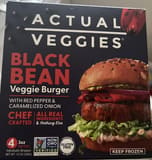 Black Bean Veggie Burger Actual Veggies · 1 unit Ultra-processedNo additivesContains whole grains Score 83 out of 100 Excellent
 -
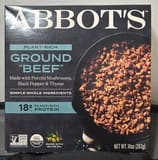 Ground "Beef" Abbot's · 10 oz High in saltNo additivesSeed-oil free Score 79 out of 100 Good
 -
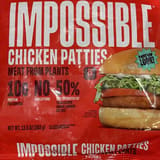 Impossible Chicken Patties Impossible Ultra-processedContains added sugarsContains seed oilsNo synthetic dyes Score 22 out of 100 Poor
 - Naked chik'n cutlets Quorn · 9.7 oz/276 g Ultra-processedHigh in saltContains added sugars Score 50 out of 100 Okay
-
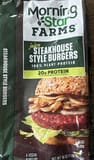 juicy STEAKHOUSE STYLE BURGERS Morningstar Farms · 113 g Ultra-processedContains added sugarsContains seed oilsNo synthetic dyes Score 44 out of 100 Okay
 -
 Chorizo Crumbles Morningstar Farms · 165 g Ultra-processedHigh in saltContains added sugarsContains seed oils Score 46 out of 100 Okay
More from Beyond
-
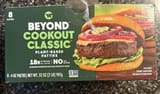 Cookout Classic Plant-Based Patties Beyond · 32 oz Score 73 out of 100 Good
 -
 Breakfast Sausage Plant-Based Patties Original Beyond · 7.4 oz/210 g Score 61 out of 100 Good
 -
 Beyond Meatballs Italian Style Plant-Based Meatballs Beyond · 10 oz Score 57 out of 100 Okay
 -
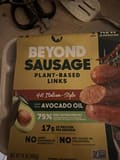 Beyond Sausage Plant-based Links Hot Italian-style Made With Avocado Oil Beyond · 14 oz Score 42 out of 100 Okay
Sources
-
Guideline: sugars intake for adults and children
“In both adults and children, WHO recommends reducing the intake of free sugars to less than 10% of total energy intake”
who.int
-
Dietary Guidelines for Americans, 2025–2030
“Limit foods and beverages that include artificial flavors, petroleum-based dyes, artificial preservatives, and low-calorie non-nutritive sweeteners.”
cdn.realfood.gov
-
Added and free sugars should be as low as possible
“Sugar consumption is a known cause of dental caries.”
efsa.europa.eu
-
“replacement of saturated fat in the diet with linoleic acid effectively lowers serum cholesterol but does not support the hypothesis that this translates to a lower risk of death from coronary heart disease or all causes.”
doi.org
-
“These data provide support for current recommendations to replace saturated fat with polyunsaturated fat for primary prevention of CHD.”
doi.org
-
21 CFR 101.22 Foods; labeling of spices, flavorings, colorings and chemical preservatives
“whose significant function in food is flavoring rather than nutritional.”
ecfr.gov
-
Saturated fatty acid and trans-fatty acid intake for adults and children: WHO guideline
“WHO recommends that adults and children reduce saturated fatty acid intake to 10% of total energy intake (strong recommendation).”
who.int
-
“For adults, WHO recommends less than 2000 mg/day of sodium (equivalent to less than 5 g/day salt), or just under a teaspoon.”
who.int
-
“Greater exposure to ultra-processed food was associated with a higher risk of adverse health outcomes, especially cardiometabolic, common mental disorder, and mortality outcomes.”
doi.org