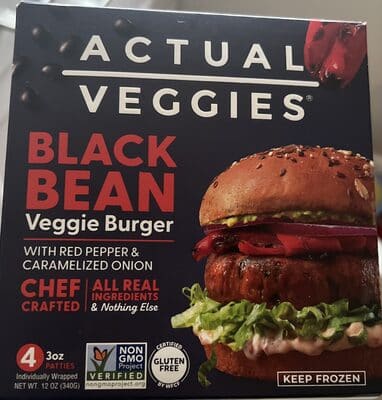
Meat analogues
Actual Veggies Black Bean Veggie Burger
1 unit
Score
- Ultra-processed
- No additives
- Contains whole grains
Why it scores 83
Actual Veggies Black Bean Veggie Burger scores 83 out of 100 (Excellent) under GoodSwap’s published rules. What moved the score most:
- minus 18 points Ultra-processed (NOVA 4): Classified NOVA 4: made with industrial ingredients and additives. Strong
- plus 4 points Fiber 7.1 g / 100 g: A good source of fiber. Strong
- minus 3 points Salt 0.7 g / 100 g: High in salt. Strong
Every line of the math is on The Receipt below, with its evidence tier and sources.
Better burgers and patties
-
 Organic California Veggie Burgers Dr. Praeger's Sensible Foods Not ultra-processed Score 100 out of 100 , 17 points higher
 -
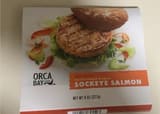 Sockeye Salmon garden veggie burgers Orca Bay · 8 oz Not ultra-processed Score 100 out of 100 , 17 points higher
 -
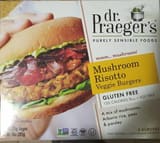 Mushroom Risotto Veggie Burgers Dr. Praeger's Sensible Foods · 10 oz/283 g Not ultra-processed Score 99 out of 100 , 16 points higher
 -
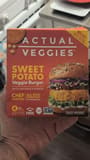 Sweet Potato Veggie Burger | The Actual Orange Burger Actual Veggies Not ultra-processed Score 99 out of 100 , 16 points higher
 -
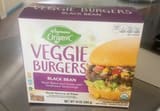 Veggie burgers black bean Wegmans Organic · 10 oz Not ultra-processed Score 100 out of 100 , 17 points higher
The same kind of product, at least 10 points higher, sold in the US. Never paid placements.
The Receipt
Black Bean Veggie Burger
Processing
- Ultra-processed (NOVA 4) minus 18 points
Nutrition per 100 g
- Salt 0.7 g / 100 g minus 3 points
- Fiber 7.1 g / 100 g plus 4 points
100 − 17 = 83
Nutrition per 100 g
| Energy | 141 kcal |
|---|---|
| Fat | 1.8 g |
| Saturated fat | 0 g |
| Trans fat | 0 g |
| Carbohydrates | 24.7 g |
| Sugars | 2.4 g |
| Added sugars | 0 g |
| Fiber | 7.1 g |
| Protein | 7.1 g |
| Salt | 0.7 g |
Serving: 1 burger (85 g)
Ingredients
- Black Bean
- Carrot
- Parsnip
- Oat
- Yellow Onion
- Red Pepper
- Red Onion
- Chickpea Flour
- Ovata Seed (Psyllium) (not recognized)
- Oat Flour
- Lemon
- Purple Carrot
- Kosher Salt
- Garlic Powder
- Chili Powder
- Paprika
- Cumin
- Onion Powder
- Black Pepper
Label text, as published
Black Bean, Carrot, Parsnip, Oat, Yellow Onion, Red Pepper, Red Onion, Chickpea Flour, Ovata Seed (Psyllium), Oat Flour, Lemon, Purple Carrot, Kosher Salt, Garlic Powder, Chili Powder, Paprika, Cumin, Onion Powder, Black Pepper
Allergens and diets
Contains: Gluten
- Vegan
- Vegetarian
- Not gluten-free
- Palm-oil-free
Always check the package: recipes change.
More meat analogues on GoodSwap
-
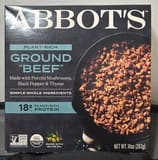 Ground "Beef" Abbot's · 10 oz High in saltNo additivesSeed-oil free Score 79 out of 100 Good
 -
 Impossible Chicken Patties Impossible Ultra-processedContains added sugarsContains seed oilsNo synthetic dyes Score 22 out of 100 Poor
 -
 Burger Patties Impossible · 8 oz Ultra-processedHigh in saturated fatContains added sugarsContains seed oils Score 42 out of 100 Okay
 -
 Plant-Based Deli Slices Hickory Smoked Tofurky · 52 g Ultra-processedHigh in saltContains seed oils Score 67 out of 100 Good
 -
 Korean Tofu and Vegetable Seaweed Rice Roll Trader Joe's · 8.11 oz Contains added sugarsContains seed oils Score 44 out of 100 Okay
 -
 Soy Curls Butler Foods Llc · 8 oz No additives Score 100 out of 100 Excellent
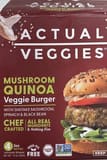
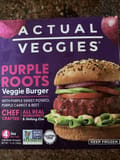
More from Actual Veggies
Sources
-
“For adults, WHO recommends less than 2000 mg/day of sodium (equivalent to less than 5 g/day salt), or just under a teaspoon.”
who.int
-
Dietary Guidelines for Americans, 2025–2030
“Limit foods and beverages that include artificial flavors, petroleum-based dyes, artificial preservatives, and low-calorie non-nutritive sweeteners.”
cdn.realfood.gov
-
“Greater exposure to ultra-processed food was associated with a higher risk of adverse health outcomes, especially cardiometabolic, common mental disorder, and mortality outcomes.”
doi.org