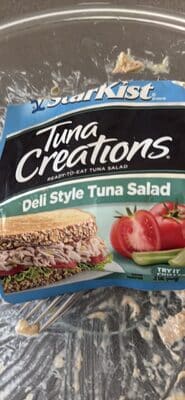
Canned tunas
Starkist Tuna Creations Deli Style Tuna Salad
3 oz
Score
- Ultra-processed
- Contains added sugars
- Contains emulsifiers studied for gut effects
- No synthetic dyes
Why it scores 22
Starkist Tuna Creations Deli Style Tuna Salad scores 22 out of 100 (Poor) under GoodSwap’s published rules. What moved the score most:
- minus 20 points Sugar: An added sugar. Strong
- minus 20 points Dextrose: An added sugar. Strong
- minus 18 points Ultra-processed (NOVA 4): Classified NOVA 4: made with industrial ingredients and additives. Strong
Every line of the math is on The Receipt below, with its evidence tier and sources.
Better canned salmon, sardines and other seafood
-
 wild AHI YELLOWFIN TUNA Safe Catch · 5 oz Not ultra-processed · No added sugars Score 98 out of 100 , 76 points higher
 -
 Ahi Yellowfin Tuna Safe Catch Not ultra-processed · No added sugars Score 96 out of 100 , 74 points higher
 -
 Wild Alaska Pink Salmon Kirkland · 6 cans Not ultra-processed · No added sugars Score 96 out of 100 , 74 points higher
 -
 Pink Salmon Chicken Of The Sea · 1 can Not ultra-processed · No added sugars Score 98 out of 100 , 76 points higher
 -
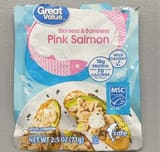 Skinless & Boneless Pink Salmon Great Value · 2.5 oz/71 g Not ultra-processed · No added sugars Score 100 out of 100 , 78 points higher
The same kind of product, at least 10 points higher, sold in the US. Never paid placements.
The Receipt
Tuna Creations Deli Style Tuna Salad
Ingredients
- Sugar minus 20 points
- Dextrose minus 20 points
- Carrageenan minus 7.5 points
- Cellulose gum (carboxymethylcellulose) minus 2.5 points
Processing
- Ultra-processed (NOVA 4) minus 18 points
- 6 kinds of ultra-processing markers minus 7.5 points
Nutrition per 100 g
- Salt 1.4 g / 100 g minus 5 points
- Protein 15.3 g / 100 g plus 2 points
100 − 78.5 = 21.5 → 22
Can’t score above 79. Contains sugar, an ingredient of high concern. [1][2][3]
Nutrition per 100 g
| Energy | 94 kcal |
|---|---|
| Fat | 1.8 g |
| Saturated fat | 0.6 g |
| Trans fat | 0 g |
| Carbohydrates | 3.5 g |
| Sugars | 1.2 g |
| Added sugars | 1.2 g |
| Fiber | 1.2 g |
| Protein | 15.3 g |
| Salt | 1.4 g |
Serving: 1 pouch (85 g)
Ingredients
- LIGHT TUNA
- WATER
- WATER CHESTNUTS
- VINEGAR
- CELERY
- CURED CUCUMBERS
- EGG YOLK
- ONION POWDER
- MUSTARD FLOUR
- MODIFIED FOOD STARCH (CORN)
- SALT
- SUGAR (high concern)
- DEXTROSE (high concern)
- CARRAGEENAN (moderate concern)
- XANTHAN GUM
- CELLULOSE GEL
- GUAR GUM
- NATURAL FLAVORS
- SODIUM CARBOXYMETHYLCELLULOSE (moderate concern)
- CALCIUM CHLORIDE
- COLOR ADDED
Label text, as published
LIGHT TUNA, WATER, WATER CHESTNUTS, VINEGAR, CONTAINS 2% OR LESS OF THE FOLLOWING: CELERY, CURED CUCUMBERS, EGG YOLK, ONION POWDER, MUSTARD FLOUR, MODIFIED FOOD STARCH (CORN), SALT, SUGAR, DEXTROSE, CARRAGEENAN, XANTHAN GUM, CELLULOSE GEL, GUAR GUM, NATURAL FLAVORS, SODIUM CARBOXYMETHYLCELLULOSE, CALCIUM CHLORIDE, COLOR ADDED. CONTAINS: FISH (TUNA), EGGS
Allergens and diets
Contains: Soy, Egg, Fish, Mustard, Celery
- Not vegan
- Not vegetarian
- Palm-oil-free
Always check the package: recipes change.
More canned tunas on GoodSwap
-
 Albacore Tuna Wild Planet · 5 oz (142 g) No additives Score 97 out of 100 Excellent
 -
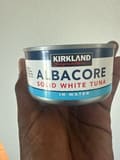 Albacore Solid White Tuna in Water Kirkland · 153 g Ultra-processed Score 81 out of 100 Excellent
 -
 Chunk Light Tuna Chicken Of The Sea · 7 oz No additives Score 96 out of 100 Excellent
 -
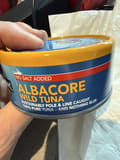 Albacore Wild Tuna Wild Planet · 5 oz No additives Score 100 out of 100 Excellent
 -
 Chunk Light Skipjack Tuna in water Trader Joe's No additives Score 96 out of 100 Excellent
 -
 Solid White Tuna Albacore Bumble Bee · 20 oz/567 g Ultra-processedNo additives Score 86 out of 100 Excellent
More from Starkist
-
 Tuna Creations Lemon Pepper Starkist · 2.6 oz Score 61 out of 100 Good
 -
 Chunk Light Tuna Starkist · 142 g Score 96 out of 100 Excellent
 -
 Wild Caught Light Tuna in Water Starkist · 6.4 oz Score 96 out of 100 Excellent
 -
 Smart Bowls Rice & Beans with Tuna Spicy Pepper Starkist · 4.5 oz Score 68 out of 100 Good
Sources
-
Guideline: sugars intake for adults and children
“In both adults and children, WHO recommends reducing the intake of free sugars to less than 10% of total energy intake”
who.int
-
Dietary Guidelines for Americans, 2025–2030
“Limit foods and beverages that include artificial flavors, petroleum-based dyes, artificial preservatives, and low-calorie non-nutritive sweeteners.”
cdn.realfood.gov
-
Added and free sugars should be as low as possible
“Sugar consumption is a known cause of dental caries.”
efsa.europa.eu
-
“We found direct associations between the risk of type 2 diabetes and exposures to various food additive emulsifiers widely used in industrial foods, in a large prospective cohort of French adults.”
doi.org
-
Dietary emulsifiers impact the mouse gut microbiota promoting colitis and metabolic syndrome
“carboxymethylcellulose and polysorbate-80, induced low-grade inflammation and obesity/metabolic syndrome in wild-type hosts and promoted robust colitis in mice predisposed to this disorder.”
doi.org
-
Re-evaluation of carrageenan (E 407) and processed Eucheuma seaweed (E 407a) as food additives
“However, the Panel noted uncertainties as regards the chemistry, the exposure assessment and biological and toxicological data.”
doi.org
-
Agents Classified by the IARC Monographs, Volumes 1–142 (List of Classifications)
monographs.iarc.who.int
-
“Relative to control subjects, CMC consumption modestly increased postprandial abdominal discomfort and perturbed gut microbiota composition in a way that reduced its diversity.”
doi.org
-
“This study found positive associations between risk of CVD and intake of five individual and two groups of food additive emulsifiers widely used in industrial foods.”
doi.org
-
“The Panel concluded that there was no need for a numerical ADI and that there would be no safety concern at the reported uses and use levels for the unmodified and modified celluloses”
doi.org
-
“For adults, WHO recommends less than 2000 mg/day of sodium (equivalent to less than 5 g/day salt), or just under a teaspoon.”
who.int
-
“Greater exposure to ultra-processed food was associated with a higher risk of adverse health outcomes, especially cardiometabolic, common mental disorder, and mortality outcomes.”
doi.org