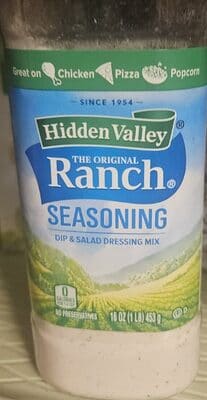
Dips
Hidden Valley The Original Ranch Seasoning Dip & Salad Dressing Mix
16 oz
Score
- Ultra-processed
- High in salt
- Contains emulsifiers studied for gut effects
- Contains artificial flavors
Why it scores 45
Hidden Valley The Original Ranch Seasoning Dip & Salad Dressing Mix scores 45 out of 100 (Okay) under GoodSwap’s published rules. What moved the score most:
- minus 18 points Ultra-processed (NOVA 4): Classified NOVA 4: made with industrial ingredients and additives. Strong
- minus 9 points Salt 18.8 g / 100 g: Very high in salt. Strong
- minus 7.5 points Cellulose gum (carboxymethylcellulose): In a small randomized feeding trial, carboxymethylcellulose modestly increased abdominal discomfort and reduced gut microbiota diversity; in mice it promoted low-grade inflammation. Strong
Every line of the math is on The Receipt below, with its evidence tier and sources.
The Receipt
The Original Ranch Seasoning Dip & Salad Dressing Mix
Ingredients
- Cellulose gum (carboxymethylcellulose) minus 7.5 points
- Maltodextrin minus 2.5 points
- Monosodium glutamate (MSG) minus 2.5 points
- Calcium lactate minus 1.5 points
- Artificial flavors minus 1.5 points
- Xanthan gum minus 1.5 points
- Guar gum minus 0.5 points
- Natural flavors minus 0.5 points
Processing
- Ultra-processed (NOVA 4) minus 18 points
- 6 kinds of ultra-processing markers minus 7.5 points
Nutrition per 100 g
- Salt 18.8 g / 100 g minus 9 points
- Energy 625 kcal / 100 g minus 3 points
100 − 55.5 = 44.5 → 45
Can’t score above 79. High in salt (above the front-of-pack "high" level). [12]
Nutrition per 100 g
| Energy | 625 kcal |
|---|---|
| Fat | 0 g |
| Added sugars | 16.4 g |
| Protein | 0 g |
| Salt | 18.8 g |
Serving: 0.25 tsp (0.8 g)
Ingredients
- MALTODEXTRIN
- BUTTERMILK
- SALT
- MONOSODIUM GLUTAMATE
- GARLIC
- ONION
- LACTIC ACID
- CALCIUM LACTATE
- SPICES
- CITRIC ACID
- CALCIUM STEARATE
- ARTIFICIAL FLAVOR
- XANTHAN GUM
- CARBOXYMETHYLCELLULOSE (moderate concern)
- GUAR GUM
- NATURAL FLAVORS
Label text, as published
MALTODEXTRIN, BUTTERMILK, SALT, MONOSODIUM GLUTAMATE, GARLIC*, ONION*, LACTIC ACID, CALCIUM LACTATE, SPICES, CITRIC ACID, LESS THAN 1% OF: CALCIUM STEARATE, ARTIFICIAL FLAVOR, XANTHAN GUM, CARBOXYMETHYLCELLULOSE, GUAR GUM, NATURAL FLAVORS.
Allergens and diets
Contains: Milk, Soy
- Not vegan
- Palm-oil-free
Always check the package: recipes change.
Packaging
Plastic
Context only: no points in v1.
More dips on GoodSwap
-
 Gourmet Salsa Medium Mateo's · 32 oz High in saltNo additives Score 79 out of 100 Good
 -
 Jack's Cantina Organic Salsa Garden Fresh Gourmet · 48 oz High in saltContains added sugarsCertified organic Score 67 out of 100 Good
 -
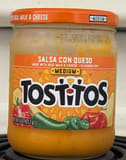 Chunky Salsa Medium Tostitos · 15 oz (425.2 g) Dye with an EU warning labelContains synthetic dyesUltra-processedHigh in salt Score 14 out of 100 Bad
 -
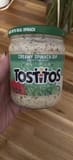 Creamy Spinach Dip Tostitos · 425 g Ultra-processedContains added sugarsContains emulsifiers studied for gut effectsContains seed oils Score 42 out of 100 Okay
 -
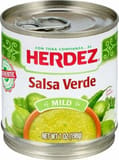 Salsa Verde Herdez · 7 oz Ultra-processedHigh in salt Score 73 out of 100 Good
 -
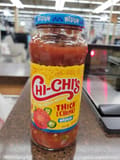 Chi-Chi's Thick & Chunky Medium Salsa Chi-Chi's · 16 oz Ultra-processed Score 68 out of 100 Good
More from Hidden Valley
-
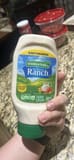 The Original Ranch Condiment & Dressing Hidden Valley · 16 fl oz Score 27 out of 100 Poor
 -
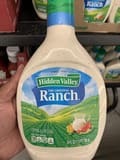 THE ORIGINAL Ranch ORIGINAL RANCH Hidden Valley · 709 mL Score 27 out of 100 Poor
 -
 Original Ranch Dip Hidden Valley · 1.0 oz/28 g Score 57 out of 100 Okay
 -
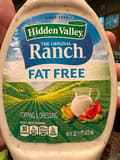 Ranch Fat Free Condiment & Dressing Hidden Valley · 473 mL Score 10 out of 100 Bad
Sources
-
“Relative to control subjects, CMC consumption modestly increased postprandial abdominal discomfort and perturbed gut microbiota composition in a way that reduced its diversity.”
doi.org
-
Dietary emulsifiers impact the mouse gut microbiota promoting colitis and metabolic syndrome
“carboxymethylcellulose and polysorbate-80, induced low-grade inflammation and obesity/metabolic syndrome in wild-type hosts and promoted robust colitis in mice predisposed to this disorder.”
doi.org
-
“This study found positive associations between risk of CVD and intake of five individual and two groups of food additive emulsifiers widely used in industrial foods.”
doi.org
-
“The Panel concluded that there was no need for a numerical ADI and that there would be no safety concern at the reported uses and use levels for the unmodified and modified celluloses”
doi.org
-
Questions and Answers on Monosodium glutamate (MSG)
“FDA considers the addition of MSG to foods to be “generally recognized as safe” (GRAS).”
fda.gov
-
EFSA reviews safety of glutamates added to food
“EFSA re-assessed the safety of glutamates used as food additives and derived a group acceptable daily intake (ADI) of 30 mg/kg body weight per day for all six of these additives.”
efsa.europa.eu
-
Dietary Guidelines for Americans, 2025–2030
“Limit foods and beverages that include artificial flavors, petroleum-based dyes, artificial preservatives, and low-calorie non-nutritive sweeteners.”
cdn.realfood.gov
-
21 CFR 101.22 Foods; labeling of spices, flavorings, colorings and chemical preservatives
“whose significant function in food is flavoring rather than nutritional.”
ecfr.gov
-
“For adults, WHO recommends less than 2000 mg/day of sodium (equivalent to less than 5 g/day salt), or just under a teaspoon.”
who.int
-
“Table 3: Criteria for drinks (per 100ml)”
assets.publishing.service.gov.uk
-
“Greater exposure to ultra-processed food was associated with a higher risk of adverse health outcomes, especially cardiometabolic, common mental disorder, and mortality outcomes.”
doi.org