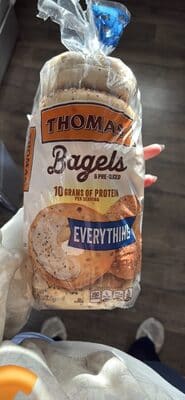
Bagel breads
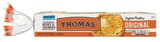
Thomas' Everything Bagels
4pcs
Score
- Ultra-processed
- Contains added sugars
- Contains emulsifiers studied for gut effects
- Contains seed oils
Why it scores 36
Thomas' Everything Bagels scores 36 out of 100 (Poor) under GoodSwap’s published rules. What moved the score most:
- minus 20 points Sugar: An added sugar. Strong
- minus 18 points Ultra-processed (NOVA 4): Classified NOVA 4: made with industrial ingredients and additives. Strong
- minus 7.5 points Cellulose gum (carboxymethylcellulose): In a small randomized feeding trial, carboxymethylcellulose modestly increased abdominal discomfort and reduced gut microbiota diversity; in mice it promoted low-grade inflammation. Strong
Every line of the math is on The Receipt below, with its evidence tier and sources.
Better bagels
-
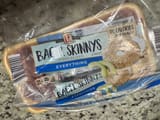 Bagel Skinnys Everything LF · 13 oz Not ultra-processed · No added sugars Score 82 out of 100 , 46 points higher
 -
 Everything Bagels Silver Hills · 14 oz/400 g Not ultra-processed · No gut-studied emulsifiers Score 76 out of 100 , 40 points higher
 -
 Everything bagles Gabriel’s Bakery Not ultra-processed · No gut-studied emulsifiers Score 75 out of 100 , 39 points higher
 -
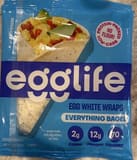 Egg White Wraps Everything Bagel Egglife · 6 oz No added sugars · No gut-studied emulsifiers Score 74 out of 100 , 38 points higher
 -
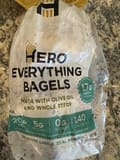 Hero Everything Bagels Hero · 75 g No added sugars · No gut-studied emulsifiers Score 73 out of 100 , 37 points higher
The same kind of product, at least 10 points higher, sold in the US. Never paid placements.
The Receipt
Everything Bagels
Ingredients
- Sugar minus 20 points
- Cellulose gum (carboxymethylcellulose) minus 7.5 points
- Wheat gluten minus 2.5 points
- Calcium propionate minus 1.5 points
- Mono- and diglycerides minus 1.5 points
- Guar gum minus 1.5 points
- Maltodextrin minus 0.5 points
- Soybean oil minus 0.5 points
- Sodium alginate minus 0.5 points
- Soy lecithin minus 0.5 points
Processing
- Ultra-processed (NOVA 4) minus 18 points
- 4 kinds of ultra-processing markers minus 4.5 points
Nutrition per 100 g
- Sugars 6.3 g / 100 g minus 3 points
- Salt 1.1 g / 100 g minus 3 points
- Energy 305 kcal / 100 g minus 1 points
- Protein 9.5 g / 100 g plus 2 points
100 − 64 = 36
Can’t score above 79. Contains sugar, an ingredient of high concern. [1][2][3]
Nutrition per 100 g
| Energy | 305 kcal |
|---|---|
| Fat | 3.7 g |
| Saturated fat | 0.5 g |
| Trans fat | 0 g |
| Carbohydrates | 55.8 g |
| Sugars | 6.3 g |
| Added sugars | 5.3 g |
| Fiber | 2.1 g |
| Protein | 9.5 g |
| Salt | 1.1 g |
Serving: 1 serving (95 g)
Ingredients
- ENRICHED WHEAT FLOUR (FLOUR, MALTED BARLEY FLOUR, REDUCED IRON, NIACIN, THIAMIN MONONITRATE (VITAMIN B1), RIBOFLAVIN (VITAMIN B2), FOLIC ACID)
- WATER
- SUGAR (high concern)
- SUNFLOWER SEEDS
- YEAST
- WHEAT GLUTEN
- SESAME SEEDS
- ONION
- SALT
- CORNMEAL
- CALCIUM PROPIONATE AND SORBIC ACID (TO PRESERVE FRESHNESS)
- POPPY SEEDS
- MONO- AND DIGLYCERIDES
- GARLIC
- CITRIC ACID
- GUAR GUM
- MALTODEXTRIN
- VEGETABLE OIL (SOYBEAN)
- CELLULOSE GUM (moderate concern)
- CORNSTARCH
- ALGIN
- SOY LECITHIN
Label text, as published
ENRICHED WHEAT FLOUR [FLOUR, MALTED BARLEY FLOUR, REDUCED IRON, NIACIN, THIAMIN MONONITRATE (VITAMIN B1), RIBOFLAVIN (VITAMIN B2), FOLIC ACID], WATER, SUGAR, SUNFLOWER SEEDS, YEAST, WHEAT GLUTEN, SESAME SEEDS, ONION, SALT, CORNMEAL, CALCIUM PROPIONATE AND SORBIC ACID (TO PRESERVE FRESHNESS), POPPY SEEDS, MONO- AND DIGLYCERIDES, GARLIC, CITRIC ACID, GUAR GUM, MALTODEXTRIN, VEGETABLE OIL (SOYBEAN), CELLULOSE GUM, CORNSTARCH, ALGIN, SOY LECITHIN
Allergens and diets
Contains: Soy, Wheat, Gluten, Sesame
May contain: Milk, Tree nuts, Egg
- Vegan
- Vegetarian
- Not gluten-free
- Palm-oil-free
Always check the package: recipes change.
Packaging
Plastic
Context only: no points in v1.
More bagel breads on GoodSwap
-
 Organic Bagels Plain Awesome Dave's Killer Bread · 6.75 oz Ultra-processedContains added sugarsContains seed oilsCertified organic Score 59 out of 100 Okay
 -
 Plain Bagels Thomas' · 567 g Ultra-processedContains added sugarsContains seed oils Score 44 out of 100 Okay
 -
 Zephyrhills Zephyrhills · 500 mL Score 98 out of 100 Excellent
 -
 Boomin' Berry Organic Bagels Dave's Killer Bread · 475 g Ultra-processedContains added sugarsContains seed oilsCertified organic Score 53 out of 100 Okay
 -
 Bagels Cinnamon Raisin Thomas' · 567 g Ultra-processedContains non-nutritive sweetenersContains added sugarsContains emulsifiers studied for gut effects Score 21 out of 100 Poor
 -
 Mini Bagels Thomas' Ultra-processedContains added sugarsContains emulsifiers studied for gut effectsContains seed oils Score 42 out of 100 Okay
More from Thomas'
Sources
-
Guideline: sugars intake for adults and children
“In both adults and children, WHO recommends reducing the intake of free sugars to less than 10% of total energy intake”
who.int
-
Dietary Guidelines for Americans, 2025–2030
“Limit foods and beverages that include artificial flavors, petroleum-based dyes, artificial preservatives, and low-calorie non-nutritive sweeteners.”
cdn.realfood.gov
-
Added and free sugars should be as low as possible
“Sugar consumption is a known cause of dental caries.”
efsa.europa.eu
-
“Relative to control subjects, CMC consumption modestly increased postprandial abdominal discomfort and perturbed gut microbiota composition in a way that reduced its diversity.”
doi.org
-
Dietary emulsifiers impact the mouse gut microbiota promoting colitis and metabolic syndrome
“carboxymethylcellulose and polysorbate-80, induced low-grade inflammation and obesity/metabolic syndrome in wild-type hosts and promoted robust colitis in mice predisposed to this disorder.”
doi.org
-
“This study found positive associations between risk of CVD and intake of five individual and two groups of food additive emulsifiers widely used in industrial foods.”
doi.org
-
“The Panel concluded that there was no need for a numerical ADI and that there would be no safety concern at the reported uses and use levels for the unmodified and modified celluloses”
doi.org
-
11. List of Permitted Preservatives (Lists of Permitted Food Additives)
“B.2 Butylated Hydroxyanisole n/a (a) Active dry yeasts (a) Preservative (a) 1,000 ppm n/a”
canada.ca
-
Re-evaluation of mono- and di-glycerides of fatty acids (E 471) as food additives
“The available studies did not raise any concern with regard to genotoxicity.”
doi.org
-
“replacement of saturated fat in the diet with linoleic acid effectively lowers serum cholesterol but does not support the hypothesis that this translates to a lower risk of death from coronary heart disease or all causes.”
doi.org
-
“These data provide support for current recommendations to replace saturated fat with polyunsaturated fat for primary prevention of CHD.”
doi.org
-
“For adults, WHO recommends less than 2000 mg/day of sodium (equivalent to less than 5 g/day salt), or just under a teaspoon.”
who.int
-
“Greater exposure to ultra-processed food was associated with a higher risk of adverse health outcomes, especially cardiometabolic, common mental disorder, and mortality outcomes.”
doi.org