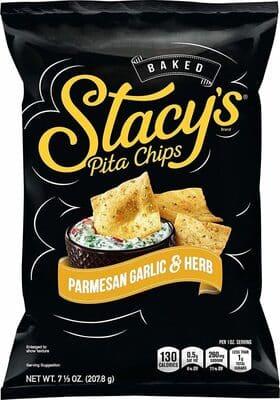
Salty snacks
Stacy's Pita Chips Parmesan Garlic & Herb
7.33 oz/207.8 g
Score
- High in salt
- Contains added sugars
- Contains seed oils
- Contains whole grains
Why it scores 61
Stacy's Pita Chips Parmesan Garlic & Herb scores 61 out of 100 (Good) under GoodSwap’s published rules. What moved the score most:
- minus 20 points Sugar: An added sugar. Strong
- minus 8 points Processed (NOVA 3): Classified NOVA 3: processed with added salt, sugar or oil. Emerging
- minus 7 points Salt 2.3 g / 100 g: Very high in salt. Strong
Every line of the math is on The Receipt below, with its evidence tier and sources.
Better pita and bagel chips
-
 Pita Crisps Oasis · 6 oz Less salt · No added sugars Score 100 out of 100 , 39 points higher
 -
 Baba small batch pita chips Baba Small Batch · 7 oz Less salt · No added sugars Score 99 out of 100 , 38 points higher
 -
 Millet & Flax Pita Chips Plain Sami's Bakery Less salt · No added sugars Score 89 out of 100 , 28 points higher
 -
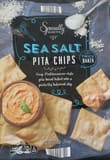 Sea Salt Pita Chips Aldi No added sugars · No sugar Score 79 out of 100 , 18 points higher
 -
 Sea Salt Pita Chips Clancy's No added sugars · No sugar Score 79 out of 100 , 18 points higher
The same kind of product, at least 10 points higher, sold in the US. Never paid placements.
The Receipt
Pita Chips Parmesan Garlic & Herb
Ingredients
- Sugar minus 20 points
- Sunflower oil minus 2.5 points
- Canola oil minus 2.5 points
Processing
- Processed (NOVA 3) minus 8 points
Nutrition per 100 g
- Saturated fat 1.8 g / 100 g minus 1 points
- Salt 2.3 g / 100 g minus 7 points
- Energy 464 kcal / 100 g minus 2 points
- Fiber 3.6 g / 100 g plus 2 points
- Protein 14.3 g / 100 g plus 2 points
100 − 39 = 61
Can’t score above 79. Contains sugar, an ingredient of high concern. [1][2][3]
Can’t score above 79. High in fat and salt (above the front-of-pack "high" level). [11]
Nutrition per 100 g
| Energy | 464 kcal |
|---|---|
| Fat | 17.9 g |
| Saturated fat | 1.8 g |
| Trans fat | 0 g |
| Carbohydrates | 64.3 g |
| Sugars | 3.6 g |
| Added sugars | 0 g |
| Fiber | 3.6 g |
| Protein | 14.3 g |
| Salt | 2.3 g |
Serving: 9 chips (28 g)
Ingredients
- ENRICHED WHEAT FLOUR (WHEAT FLOUR, NIACIN, REDUCED IRON, THIAMIN MONONITRATE, RIBOFLAVIN, FOLIC ACID)
- SUNFLOWER OIL
- CANOLA OIL
- PARMESAN CHEESE (PASTEURIZED COW'S MILK, CHEESE CULTURES, SALT, ENZYMES)
- SEA SALT
- WHOLE WHEAT FLOUR
- ORGANIC CANE SUGAR (high concern)
- DRIED GARLIC
- PARMESAN CHEESE (PART-SKIM MILK, CHEESE CULTURES, SALT, ENZYMES)
- SALT
- OAT FIBER
- YEAST
- PARSLEY
- MALTED BARLEY FLOUR
- ROSEMARY EXTRACT (ANTIOXIDANT)
- ASCORBIC ACID (ANTIOXIDANT)
Label text, as published
ENRICHED WHEAT FLOUR (WHEAT FLOUR, NIACIN, REDUCED IRON, THIAMIN MONONITRATE, RIBOFLAVIN, FOLIC ACID), SUNFLOWER OIL AND/OR CANOLA OIL, PARMESAN CHEESE (PASTEURIZED COW'S MILK, CHEESE CULTURES, SALT, ENZYMES), SEA SALT, AND LESS THAN 2% OF THE FOLLOWING: WHOLE WHEAT FLOUR, ORGANIC CANE SUGAR, DRIED GARLIC, PARMESAN CHEESE (PART-SKIM MILK, CHEESE CULTURES, SALT, ENZYMES), SALT, OAT FIBER, YEAST, PARSLEY, MALTED BARLEY FLOUR, ROSEMARY EXTRACT (ANTIOXIDANT), AND ASCORBIC ACID (ANTIOXIDANT).
Allergens and diets
Contains: Milk, Wheat, Gluten
- Not vegan
- Not gluten-free
- Palm-oil-free
Always check the package: recipes change.
More salty snacks on GoodSwap
-
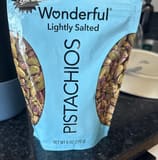 Lightly Salted Pistachios Wonderful · 30 g High in saturated fatNo additives Score 79 out of 100 Good
 -
 Totopos El Milagro · 453 g Contains seed oils Score 79 out of 100 Good
 -
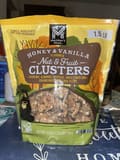 Honey and vanilla, flavored nuts, and fruit clusters Member's Mark · 24 oz Ultra-processedHigh in saturated fatContains added sugarsContains seed oils Score 19 out of 100 Bad
 -
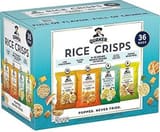 Rice crisps Quaker Ultra-processedHigh in sugarHigh in saltContains non-nutritive sweeteners Score 3 out of 100 Bad
 -
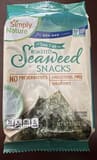 Roasted Seaweed Snacks Simply Nature High in saltContains seed oilsNo additives Score 79 out of 100 Good
 -
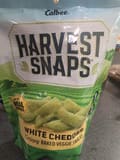 WHITE CHEDDAR Crispy Baked Veggie Snacks Harvest Snaps · 3.0 oz Ultra-processedContains seed oils Score 64 out of 100 Good
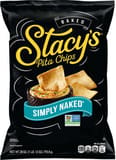
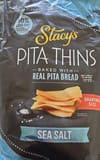
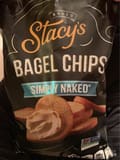
More from Stacy's
Sources
-
Guideline: sugars intake for adults and children
“In both adults and children, WHO recommends reducing the intake of free sugars to less than 10% of total energy intake”
who.int
-
Dietary Guidelines for Americans, 2025–2030
“Limit foods and beverages that include artificial flavors, petroleum-based dyes, artificial preservatives, and low-calorie non-nutritive sweeteners.”
cdn.realfood.gov
-
Added and free sugars should be as low as possible
“Sugar consumption is a known cause of dental caries.”
efsa.europa.eu
-
“replacement of saturated fat in the diet with linoleic acid effectively lowers serum cholesterol but does not support the hypothesis that this translates to a lower risk of death from coronary heart disease or all causes.”
doi.org
-
“These data provide support for current recommendations to replace saturated fat with polyunsaturated fat for primary prevention of CHD.”
doi.org
-
Saturated fatty acid and trans-fatty acid intake for adults and children: WHO guideline
“WHO recommends that adults and children reduce saturated fatty acid intake to 10% of total energy intake (strong recommendation).”
who.int
-
“For adults, WHO recommends less than 2000 mg/day of sodium (equivalent to less than 5 g/day salt), or just under a teaspoon.”
who.int
-
“Table 3: Criteria for drinks (per 100ml)”
assets.publishing.service.gov.uk