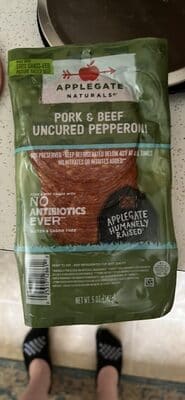
Prepared meats
Applegate Naturals Pork & Beef Uncured Pepperoni
5 oz
Score
- Ultra-processed
- High in salt
- High in saturated fat
- Contains nitrites or nitrates
- Contains added sugars
- No synthetic dyes
Why it scores 44
Applegate Naturals Pork & Beef Uncured Pepperoni scores 44 out of 100 (Okay) under GoodSwap’s published rules. What moved the score most:
- minus 20 points Sugar: An added sugar. Strong
- minus 18 points Ultra-processed (NOVA 4): Classified NOVA 4: made with industrial ingredients and additives. Strong
- minus 9 points Salt 4.8 g / 100 g: Very high in salt. Strong
Every line of the math is on The Receipt below, with its evidence tier and sources.
Better salami and pepperoni
-
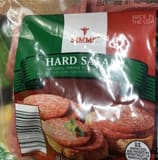 Hard Salami Simms Not ultra-processed · No nitrites or nitrates Score 79 out of 100 , 35 points higher
 -
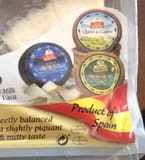 Spanish Cheese Plate: Manchego, Semi-Soft Goat & Iberico Cheese Garcia Baquero Not ultra-processed · No nitrites or nitrates Score 79 out of 100 , 35 points higher
 -
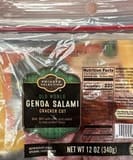 Genoa salami Private Select · 12 oz Not ultra-processed · Less saturated fat Score 79 out of 100 , 35 points higher
 -
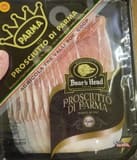 Boar's head prosciutto diparma Boar's Head Brand Not ultra-processed · Less saturated fat Score 79 out of 100 , 35 points higher
 -
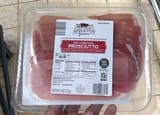 Dry-Cured Ham Prosciutto Appleton Farms · 118 g Not ultra-processed · No nitrites or nitrates Score 79 out of 100 , 35 points higher
The same kind of product, at least 10 points higher, sold in the US. Never paid placements.
The Receipt
Pork & Beef Uncured Pepperoni
Ingredients
- Sugar minus 20 points
- Cultured celery powder (natural nitrite source) minus 7.5 points
Processing
- Ultra-processed (NOVA 4) minus 18 points
Nutrition per 100 g
- Saturated fat 16.1 g / 100 g minus 4.5 points
- Salt 4.8 g / 100 g minus 9 points
- Energy 393 kcal / 100 g minus 1 points
- Protein 28.6 g / 100 g plus 4 points
100 − 56 = 44
Can’t score above 79. Contains sugar, an ingredient of high concern. [1][2][3]
Can’t score above 79. High in fat, saturated fat and salt (above the front-of-pack "high" level). [9]
Nutrition per 100 g
| Energy | 393 kcal |
|---|---|
| Fat | 32.1 g |
| Saturated fat | 16.1 g |
| Trans fat | 0 g |
| Carbohydrates | 0 g |
| Sugars | 0 g |
| Added sugars | 0 g |
| Fiber | 0 g |
| Protein | 28.6 g |
| Salt | 4.8 g |
Serving: 4 slices (28 g)
Ingredients
- PORK
- BEEF
- SEA SALT
- TURBINADO SUGAR (high concern)
- WATER
- SPICES
- CULTURED CELERY POWDER (moderate concern)
- GRANULATED GARLIC
- CHERRY POWDER
- LACTIC ACID STARTER CULTURE (NOT FROM MILK)
- ROSEMARY EXTRACT
- OLEORESIN OF PAPRIKA
- LIME JUICE CONCENTRATE
Label text, as published
PORK***, BEEF***, SEA SALT. CONTAINS LESS THAN 2% OF THE FOLLOWING: TURBINADO SUGAR, WATER, SPICES, CULTURED CELERY POWDER, GRANULATED GARLIC, CHERRY POWDER, LACTIC ACID STARTER CULTURE (NOT FROM MILK), ROSEMARY EXTRACT, OLEORESIN OF PAPRIKA, LIME JUICE CONCENTRATE.
Allergens and diets
Contains: Celery
- Not vegan
- Not vegetarian
- Palm-oil-free
Always check the package: recipes change.
More prepared meats on GoodSwap
-
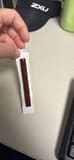 Smoked Snack Stick Slim Jim · 8 g Ultra-processedHigh in saltHigh in saturated fatContains nitrites or nitrates Score 11 out of 100 Bad
 -
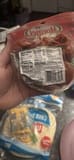 Turkey Pepperoni Hormel · 6 oz Ultra-processedHigh in saltContains nitrites or nitratesContains added sugars Score 21 out of 100 Poor
 -
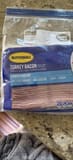 Turkey Bacon Butterball · 12 oz Ultra-processedContains nitrites or nitratesContains added sugarsContains seed oils Score 30 out of 100 Poor
 -
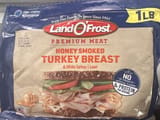 Honey Smoked Turkey Breast & White Turkey | Lean Land O'Frost · 16 oz Ultra-processedHigh in saltContains nitrites or nitratesContains added sugars Score 25 out of 100 Poor
 -
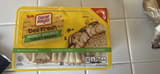 Honey Smoked Turkey Breast Oscar Mayer · 9 oz Ultra-processedHigh in saltContains added sugarsContains emulsifiers studied for gut effects Score 28 out of 100 Poor
 -
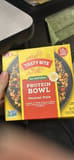 Protein Bowl Mexican Style Tasty Bite · 8.8 oz (250 g) Contains added sugarsContains seed oils Score 70 out of 100 Good
More from Applegate Naturals
-
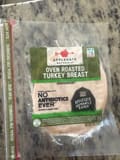 Oven Roasted Turkey Breast Applegate Naturals · 7 oz Score 93 out of 100 Excellent
 -
 Natural Uncured Beef Hot Dog Applegate Naturals · 10 oz Score 74 out of 100 Good
 -
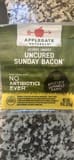 Hickory Smoked Uncured Sunday Bacon Applegate Naturals · 14 g Score 61 out of 100 Good
 -
 Chicken & Maple Breakfast Sausage Applegate Naturals · 20 oz/1.25 lb/567 g Score 32 out of 100 Poor
Sources
-
Guideline: sugars intake for adults and children
“In both adults and children, WHO recommends reducing the intake of free sugars to less than 10% of total energy intake”
who.int
-
Dietary Guidelines for Americans, 2025–2030
“Limit foods and beverages that include artificial flavors, petroleum-based dyes, artificial preservatives, and low-calorie non-nutritive sweeteners.”
cdn.realfood.gov
-
Added and free sugars should be as low as possible
“Sugar consumption is a known cause of dental caries.”
efsa.europa.eu
-
Agents Classified by the IARC Monographs, Volumes 1–142 (List of Classifications)
monographs.iarc.who.int
-
“the presence of nitrites and nitrates in foods can give rise to the formation of nitrosamines some of which are carcinogenic.”
eur-lex.europa.eu
-
Saturated fatty acid and trans-fatty acid intake for adults and children: WHO guideline
“WHO recommends that adults and children reduce saturated fatty acid intake to 10% of total energy intake (strong recommendation).”
who.int
-
“For adults, WHO recommends less than 2000 mg/day of sodium (equivalent to less than 5 g/day salt), or just under a teaspoon.”
who.int
-
“Table 3: Criteria for drinks (per 100ml)”
assets.publishing.service.gov.uk
-
“Greater exposure to ultra-processed food was associated with a higher risk of adverse health outcomes, especially cardiometabolic, common mental disorder, and mortality outcomes.”
doi.org