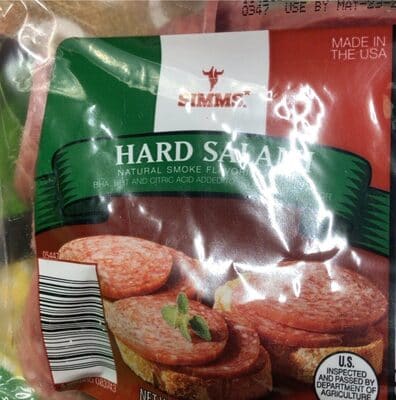
Salami
Simms Hard Salami
Score
- High in salt
- High in saturated fat
Why it scores 79
Simms Hard Salami scores 79 out of 100 (Good) under GoodSwap’s published rules. What moved the score most:
- minus 9 points Saturated fat 12.5 g / 100 g: Very high in saturated fat. Strong
- minus 9 points Salt 4.5 g / 100 g: Very high in salt. Strong
- plus 4 points Protein 21.4 g / 100 g: A good source of protein. Info
Every line of the math is on The Receipt below, with its evidence tier and sources.
The Receipt
Hard Salami
Ingredients
- Natural flavors minus 2.5 points
- BHT (butylated hydroxytoluene) minus 2.5 points
Nutrition per 100 g
- Saturated fat 12.5 g / 100 g minus 9 points
- Salt 4.5 g / 100 g minus 9 points
- Energy 393 kcal / 100 g minus 2 points
- Protein 21.4 g / 100 g plus 4 points
100 − 21 = 79
Can’t score above 79. High in fat, saturated fat and salt (above the front-of-pack "high" level). [9]
Nutrition per 100 g
| Energy | 393 kcal |
|---|---|
| Fat | 32.1 g |
| Saturated fat | 12.5 g |
| Carbohydrates | 3.6 g |
| Sugars | 3.6 g |
| Added sugars | 0 g |
| Fiber | 0 g |
| Protein | 21.4 g |
| Salt | 4.5 g |
Serving: 6 slices (28 g)
Ingredients
- pork
- beef
- salt dextrose
- flavorings lactic acd starter culture
- natural smoke flavor sodium nitrite
- spices vitaminc sodum ascorbate) bha
- bht
- citriciadíd (not recognized)
Label text, as published
pork, beef, salt dextrose contains 2% or less of flavorings lactic acd starter culture, natural smoke flavor sodium nitrite, spices vitaminc sodum ascorbate) bha, bht, citriciadíd
Allergens and diets
- Not vegan
- Not vegetarian
Always check the package: recipes change.
More salami on GoodSwap
More from Simms
Sources
-
21 CFR 101.22 Foods; labeling of spices, flavorings, colorings and chemical preservatives
“whose significant function in food is flavoring rather than nutritional.”
ecfr.gov
-
List of Select Chemicals in the Food Supply Under FDA Review
“The table below includes select food ingredients (including food and color additives), food contact substances, and contaminants under FDA review as of May 12, 2026 .”
fda.gov
-
Agents Classified by the IARC Monographs, Volumes 1–142 (List of Classifications)
monographs.iarc.who.int
-
Scientific Opinion on the re-evaluation of butylated hydroxytoluene BHT (E 321) as a food additive
“Based on the NOAEL of 25 mg/kg bw/day and an uncertainty factor of 100, the Panel derived an ADI of 0.25 mg/kg bw/day.”
doi.org
-
Saturated fatty acid and trans-fatty acid intake for adults and children: WHO guideline
“WHO recommends that adults and children reduce saturated fatty acid intake to 10% of total energy intake (strong recommendation).”
who.int
-
“For adults, WHO recommends less than 2000 mg/day of sodium (equivalent to less than 5 g/day salt), or just under a teaspoon.”
who.int
-
Dietary Guidelines for Americans, 2025–2030
“Limit foods and beverages that include artificial flavors, petroleum-based dyes, artificial preservatives, and low-calorie non-nutritive sweeteners.”
cdn.realfood.gov
-
“Table 3: Criteria for drinks (per 100ml)”
assets.publishing.service.gov.uk