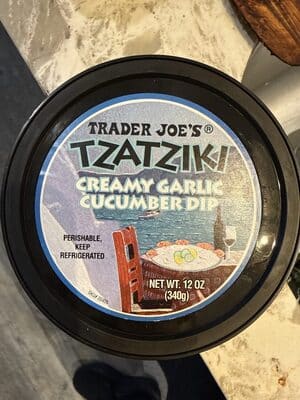
Dips
Trader Joe's Tzatziki Creamy Garlic Cucumber Dip
340 g
Score
- Not permitted in some countries
- Ultra-processed
- Contains emulsifiers studied for gut effects
- No synthetic dyes
Why it scores 25
Trader Joe's Tzatziki Creamy Garlic Cucumber Dip scores 25 out of 100 (Poor) under GoodSwap’s published rules. What moved the score most:
- minus 20 points Titanium dioxide: EFSA (2021) could not rule out genotoxicity and could not set a safe daily intake, so the EU removed E171 from the list of permitted food additives in 2022. Regulatory
- minus 18 points Ultra-processed (NOVA 4): Classified NOVA 4: made with industrial ingredients and additives. Strong
- minus 7.5 points Carrageenan: In the NutriNet-Santé cohort, higher carrageenan intake was associated with a higher risk of type 2 diabetes; cause and effect is not established. Strong
Capped at 25: Contains titanium dioxide, which is banned in food in the EU.
Every line of the math is on The Receipt below, with its evidence tier and sources.
Better dips and spreads
-
 Tzatziki Cucumber Garlic Dill Dip 365 Whole Foods Market · 12 oz/340 g No banned ingredients · No gut-studied emulsifiers Score 64 out of 100 , 39 points higher
 -
 Tzatziki Cucumber Garlic Dill Cedar's · 12 oz No banned ingredients · No gut-studied emulsifiers Score 61 out of 100 , 36 points higher
 -
 Tzatziki Greek Yogurt, Cucumber & Dill Dip Haig's Delicacies · 8 oz No banned ingredients · Not ultra-processed Score 79 out of 100 , 54 points higher
 -
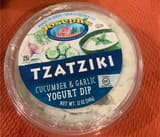 Tzatziki Cucumber & Garlic Yogurt Dip Joseph's No banned ingredients · No gut-studied emulsifiers Score 57 out of 100 , 32 points higher
 -
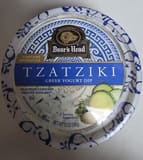 Tzatziki Greek Yogurt Dip Boar's Head · 12 oz No banned ingredients · No gut-studied emulsifiers Score 68 out of 100 , 43 points higher
The same kind of product, at least 10 points higher, sold in the US. Never paid placements.
The Receipt
Tzatziki Creamy Garlic Cucumber Dip
Ingredients
- Titanium dioxide minus 20 points
- Carrageenan minus 7.5 points
- Modified starch minus 2.5 points
- Guar gum minus 1.5 points
- Locust bean gum minus 1.5 points
Processing
- Ultra-processed (NOVA 4) minus 18 points
- 3 kinds of ultra-processing markers minus 3 points
Nutrition per 100 g
- Saturated fat 3.3 g / 100 g minus 3 points
- Salt 0.8 g / 100 g minus 3 points
100 − 60 = 40 → capped at 25
Capped at 25. Contains titanium dioxide, which is banned in food in the EU. [1]
Can’t score above 79. Contains titanium dioxide, an ingredient of high concern. [1][2][3][4][5][6][7]
Nutrition per 100 g
| Energy | 100 kcal |
|---|---|
| Fat | 6.7 g |
| Saturated fat | 3.3 g |
| Trans fat | 0 g |
| Carbohydrates | 6.7 g |
| Sugars | 3.3 g |
| Added sugars | 0 g |
| Fiber | 0 g |
| Protein | 3.3 g |
| Salt | 0.8 g |
Serving: 2 tbsp (30 g)
Ingredients
- Cucumbers
- Kefir Cheese (cultured Cream, Milk, Nonfat Milk, Ultrafiltered Nonfat Dry Milk, Enzyme)
- Nonfat Sour Cream (cultured Pasteurized Nonfat Milk, Milk, Modified Corn Starch, Kosher Gelatin, Titanium Dioxide [for Color], Guar Gum, Carrageenan)
- Water
- Lemon Juice
- Garlic (garlic, Citric Acid)
- Sea Salt
- Spearmint
- Dill
- White Pepper
- Locust Bean Gum
- Carrageenan (carrageenan, Salt) (moderate concern)
Label text, as published
Cucumbers, Kefir Cheese (cultured Cream, Milk, Nonfat Milk, Ultrafiltered Nonfat Dry Milk, Enzyme), Nonfat Sour Cream (cultured Pasteurized Nonfat Milk, Milk, Modified Corn Starch, Kosher Gelatin, Titanium Dioxide [for Color], Guar Gum, Carrageenan), Water, Lemon Juice, Garlic (garlic, Citric Acid), Sea Salt, Spearmint, Dill, White Pepper, Locust Bean Gum, Carrageenan (carrageenan, Salt)
Allergens and diets
Contains: Milk
- Not vegan
- Not vegetarian
- Palm-oil-free
Always check the package: recipes change.
More dips on GoodSwap
-
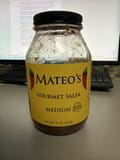 Gourmet Salsa Medium Mateo's · 32 oz High in saltNo additives Score 79 out of 100 Good
 -
 Jack's Cantina Organic Salsa Garden Fresh Gourmet · 48 oz High in saltContains added sugarsCertified organic Score 67 out of 100 Good
 -
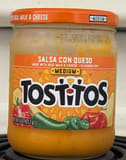 Chunky Salsa Medium Tostitos · 15 oz (425.2 g) Dye with an EU warning labelContains synthetic dyesUltra-processedHigh in salt Score 14 out of 100 Bad
 -
 Chunky Salsa Mild Pace · 16 oz Ultra-processedHigh in saltNo additives Score 77 out of 100 Good
 -
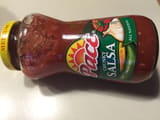 Chunky Salsa Medium Pace · 16 oz Ultra-processedHigh in saltNo additives Score 77 out of 100 Good
 -
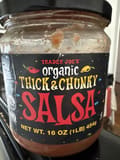 Organic Thick & Chunky Salsa Trader Joe's · 16 oz Certified organic Score 94 out of 100 Excellent
More from Trader Joe's

Sources
-
“titanium dioxide (E 171) can no longer be considered safe when used as a food additive.”
eur-lex.europa.eu
-
Titanium dioxide: E171 no longer considered safe when used as a food additive
“the Panel concluded that titanium dioxide can no longer be considered safe as a food additive.”
efsa.europa.eu
-
“Considering the very low oral absorption of INS 171, and in the absence of any identifiable hazard associated with INS 171 in the diet, the Committee reaffirmed the ADI “not specified” established at the Thirteenth meeting.”
who.int
-
Titanium dioxide (TiO2) as a food additive: Current science report
“In summary, the Food Directorate's position is that there is no conclusive scientific evidence that the food additive TiO2 is a concern for human health.”
canada.ca
-
Statement on the safety of Titanium Dioxide (E171) as a Food Additive (COT/2024/05)
“The Committee concludes that it is unlikely that there would be a risk to health from exposures of E171 TiO2 from the diet in any of the age groups or scenarios assessed.”
cot.food.gov.uk
-
Titanium Dioxide as a Color Additive in Foods
“Other international regulatory bodies including the United Kingdom’s Food Standards Agency (FSA), Health Canada, and Food Standards Australia New Zealand (FSANZ) have not agreed with EFSA’s assessment.”
fda.gov
-
Agents Classified by the IARC Monographs, Volumes 1–142 (List of Classifications)
monographs.iarc.who.int
-
“We found direct associations between the risk of type 2 diabetes and exposures to various food additive emulsifiers widely used in industrial foods, in a large prospective cohort of French adults.”
doi.org
-
Dietary emulsifiers impact the mouse gut microbiota promoting colitis and metabolic syndrome
“carboxymethylcellulose and polysorbate-80, induced low-grade inflammation and obesity/metabolic syndrome in wild-type hosts and promoted robust colitis in mice predisposed to this disorder.”
doi.org
-
Re-evaluation of carrageenan (E 407) and processed Eucheuma seaweed (E 407a) as food additives
“However, the Panel noted uncertainties as regards the chemistry, the exposure assessment and biological and toxicological data.”
doi.org
-
Saturated fatty acid and trans-fatty acid intake for adults and children: WHO guideline
“WHO recommends that adults and children reduce saturated fatty acid intake to 10% of total energy intake (strong recommendation).”
who.int
-
“For adults, WHO recommends less than 2000 mg/day of sodium (equivalent to less than 5 g/day salt), or just under a teaspoon.”
who.int
-
Revocation of Authorization for Use of Brominated Vegetable Oil in Food (89 FR 55040)
“This action is being taken because there is no longer a reasonable certainty of no harm from the continued use of BVO in food.”
federalregister.gov
-
“This order is effective January 15, 2027, except for amendatory instruction 4, which is effective January 18, 2028.”
federalregister.gov
-
Regulation (EC) No 1223/2009 of 30 November 2009 on cosmetic products
“cosmetic products shall not contain any of the following: (a) prohibited substances — prohibited substances listed in Annex II”
eur-lex.europa.eu
-
“Greater exposure to ultra-processed food was associated with a higher risk of adverse health outcomes, especially cardiometabolic, common mental disorder, and mortality outcomes.”
doi.org
-
“Relative to control subjects, CMC consumption modestly increased postprandial abdominal discomfort and perturbed gut microbiota composition in a way that reduced its diversity.”
doi.org
-
“This study found positive associations between risk of CVD and intake of five individual and two groups of food additive emulsifiers widely used in industrial foods.”
doi.org