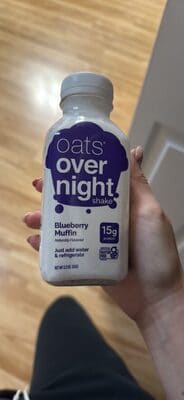
Beverages
Oats Overnight Blueberry Muffin Oats Overnight shake
2.2 oz/62 g
Score
- High in sugar
- Contains non-nutritive sweeteners
- Contains added sugars
- Contains whole grains
Why it scores 32
Oats Overnight Blueberry Muffin Oats Overnight shake scores 32 out of 100 (Poor) under GoodSwap’s published rules. What moved the score most:
- minus 20 points Maple syrup: An added sugar. Strong
- minus 18 points Ultra-processed (NOVA 4, estimated): No NOVA group on file; estimated from 4 kinds of ultra-processing markers. Strong
- minus 14 points Sugars 14.5 g / 100 ml: Very high in sugar. Strong
Every line of the math is on The Receipt below, with its evidence tier and sources.
Better protein shakes
-
 Gundry MD Proplant Complete Shake Less sugar · No added sugars Score 74 out of 100 , 42 points higher
 -
 Boobie Body Organic Superfood Plant-Based Protein Shake Boobie Body Less sugar · No added sugars Score 71 out of 100 , 39 points higher
 -
 Huel V3.0 Huel · 60 oz Less sugar · No non-nutritive sweeteners Score 68 out of 100 , 36 points higher
 -
 Eden Shake Sesame & Sea Vegetable Seasoning Eden Less sugar · No non-nutritive sweeteners Score 79 out of 100 , 47 points higher
 -
 The MealBetix Lifestyle MealBetix · 15 oz Less sugar · No added sugars Score 79 out of 100 , 47 points higher
The same kind of product, at least 10 points higher, sold in the US. Never paid placements.
The Receipt
Blueberry Muffin Oats Overnight shake
Ingredients
- Maple syrup minus 20 points
- Pea protein minus 2.5 points
- Guar gum minus 2.5 points
- Natural flavors minus 1.5 points
- Monk fruit extract minus 1.5 points
Processing
- Ultra-processed (NOVA 4, estimated) minus 18 points
- 4 kinds of ultra-processing markers minus 4.5 points
Nutrition per 100 ml
- Sugars 14.5 g / 100 ml minus 14 points
- Saturated fat 1.6 g / 100 ml minus 1 points
- Salt 0.6 g / 100 ml minus 3 points
- Energy 371 kcal / 100 ml minus 4 points
- Fiber 8.1 g / 100 ml plus 4 points
100 − 68.5 = 31.5 → 32
Can’t score above 79. Contains maple syrup, an ingredient of high concern. [1][2][3]
Can’t score above 79. High in sugars (above the front-of-pack "high" level). [9]
Nutrition per 100 ml
| Energy | 371 kcal |
|---|---|
| Fat | 7.3 g |
| Saturated fat | 1.6 g |
| Trans fat | 0 g |
| Carbohydrates | 56.5 g |
| Sugars | 14.5 g |
| Added sugars | 6.5 g |
| Fiber | 8.1 g |
| Protein | 24.2 g |
| Salt | 0.6 g |
Serving: 1 serving (62 g)
Ingredients
- CERTIFIED GLUTEN FREE WHOLE GRAIN ROLLED OATS
- PEA PROTEIN ISOLATE
- OAT MYLK (OAT FLOUR, GUAR GUM, NATURAL FLAVOR) (not recognized)
- POWDERED DATES
- MAPLE SUGAR (high concern)
- BLUEBERRIES (POWDER, WHOLE)
- CHIA SEEDS
- HEMP HEARTS
- NATURAL FLAVORS
- HIMALAYAN PINK SALT
- MONK FRUIT
Label text, as published
CERTIFIED GLUTEN FREE WHOLE GRAIN ROLLED OATS, PEA PROTEIN ISOLATE, OAT MYLK (OAT FLOUR, GUAR GUM, NATURAL FLAVOR), POWDERED DATES, MAPLE SUGAR, BLUEBERRIES (POWDER, WHOLE), CHIA SEEDS, HEMP HEARTS, NATURAL FLAVORS, HIMALAYAN PINK SALT, MONK FRUIT.
Allergens and diets
Contains: Gluten
- Vegan
- Vegetarian
- Not gluten-free
Always check the package: recipes change.
More beverages on GoodSwap
-
 OWYN Pro Elite Dairy-Free Protein Chocolate Flavored OWYN · 330 mL Ultra-processedContains non-nutritive sweetenersContains seed oils Score 63 out of 100 Good
 -
 Organic Protein Delicious Protein Shake Garden of Life · 18.0 oz Ultra-processedHigh in saltContains non-nutritive sweetenersContains sugar alcohols Score 54 out of 100 Okay
 -
 Puna Coconut Pineapple Bai Ultra-processedContains non-nutritive sweetenersContains caffeine Score 69 out of 100 Good
 -
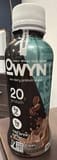 Non-Dairy Protein Shake OWYN · 12 fl oz Ultra-processedContains non-nutritive sweetenersContains added sugarsContains seed oils Score 39 out of 100 Poor
 -
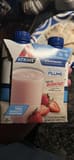 Protein-Rich Shake Strawberry Atkins · 44 fl oz/1.3 L Not permitted in some countriesContains synthetic dyesUltra-processedContains non-nutritive sweeteners Score 20 out of 100 Poor
 -
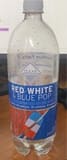 Red White & Blue Pop Cold Sparkling Water Beverage Clear American · 33.8 fl oz/1 L Ultra-processedContains non-nutritive sweeteners Score 44 out of 100 Okay
More from Oats Overnight
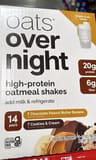
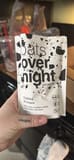
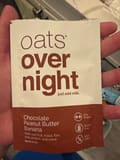

Sources
-
Guideline: sugars intake for adults and children
“In both adults and children, WHO recommends reducing the intake of free sugars to less than 10% of total energy intake”
who.int
-
Dietary Guidelines for Americans, 2025–2030
“Limit foods and beverages that include artificial flavors, petroleum-based dyes, artificial preservatives, and low-calorie non-nutritive sweeteners.”
cdn.realfood.gov
-
Added and free sugars should be as low as possible
“Sugar consumption is a known cause of dental caries.”
efsa.europa.eu
-
21 CFR 101.22 Foods; labeling of spices, flavorings, colorings and chemical preservatives
“whose significant function in food is flavoring rather than nutritional.”
ecfr.gov
-
WHO advises not to use non-sugar sweeteners for weight control in newly released guideline
“The recommendation is based on the findings of a systematic review of the available evidence which suggests that use of NSS does not confer any long-term benefit in reducing body fat in adults or children.”
who.int
-
Saturated fatty acid and trans-fatty acid intake for adults and children: WHO guideline
“WHO recommends that adults and children reduce saturated fatty acid intake to 10% of total energy intake (strong recommendation).”
who.int
-
“For adults, WHO recommends less than 2000 mg/day of sodium (equivalent to less than 5 g/day salt), or just under a teaspoon.”
who.int
-
“Table 3: Criteria for drinks (per 100ml)”
assets.publishing.service.gov.uk