
English muffins
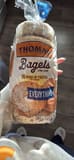
Thomas' Light Multi Grain English Muffins
12 oz (340 g)
Score
- Ultra-processed
- Contains added sugars
- Contains whole grains
Why it scores 47
Thomas' Light Multi Grain English Muffins scores 47 out of 100 (Okay) under GoodSwap’s published rules. What moved the score most:
- minus 20 points Malt syrup: An added sugar. Strong
- minus 18 points Ultra-processed (NOVA 4): Classified NOVA 4: made with industrial ingredients and additives. Strong
- minus 8 points 7 kinds of ultra-processing markers: Industrial additive classes found: anti-caking agent, bulking agent, emulsifier, flavoring, industrial protein, modified starch and thickener, stabilizer or gelling agent. Emerging
Every line of the math is on The Receipt below, with its evidence tier and sources.
Better english muffins
-
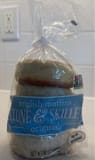 English Muffins Stone & Skillet · 10 oz Not ultra-processed · No added sugars Score 90 out of 100 , 43 points higher
 -
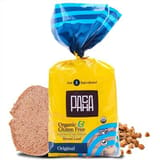 English Muffins Pacha Not ultra-processed · No added sugars Score 95 out of 100 , 48 points higher
 -
 Ezekiel 4:9 Sprouted Whole Grain Flax English Muffins Food For Life · 16 oz Not ultra-processed · No modified starch Score 77 out of 100 , 30 points higher
 -
 Original English muffins Lidl Not ultra-processed · No added sugars Score 83 out of 100 , 36 points higher
 -
 Gluten Free English Muffins - Multi Seed Food For Life · 18 oz/510 g No added sugars · No malt syrup Score 69 out of 100 , 22 points higher
The same kind of product, at least 10 points higher, sold in the US. Never paid placements.
The Receipt
Light Multi Grain English Muffins
Ingredients
- Malt syrup minus 20 points
- Modified starch minus 2.5 points
- Powdered cellulose minus 2.5 points
- Wheat gluten minus 1.5 points
- Soluble corn fiber (resistant dextrin) minus 1.5 points
- Calcium propionate minus 1.5 points
- Natural flavors minus 0.5 points
- Xanthan gum minus 0.5 points
- Soy lecithin minus 0.5 points
Processing
- Ultra-processed (NOVA 4) minus 18 points
- 7 kinds of ultra-processing markers minus 8 points
Nutrition per 100 g
- Salt 0.4 g / 100 g minus 1 points
- Energy 175 kcal / 100 g minus 1 points
- Fiber 14 g / 100 g plus 4 points
- Protein 10.5 g / 100 g plus 2 points
100 − 53 = 47
Can’t score above 79. Contains malt syrup, an ingredient of high concern. [1][2][3]
Nutrition per 100 g
| Energy | 175 kcal |
|---|---|
| Fat | 1.8 g |
| Saturated fat | 0 g |
| Trans fat | 0 g |
| Carbohydrates | 45.6 g |
| Sugars | 1.8 g |
| Added sugars | 0 g |
| Fiber | 14 g |
| Protein | 10.5 g |
| Salt | 0.4 g |
Serving: 1 muffin (57 g)
Ingredients
- ENRICHED WHEAT FLOUR (FLOUR, MALTED BARLEY FLOUR, REDUCED IRON, NIACIN, THIAMIN MONONITRATE (VITAMIN B1), RIBOFLAVIN (VITAMIN B2), FOLIC ACID)
- WATER
- MODIFIED WHEAT STARCH
- CELLULOSE FIBER FARINA
- WHEAT GLUTEN
- POLYDEXTROSE
- YEAST
- WHOLE GRAINS (WHEAT, RYE, CORN, OATS, MILLET, TRITICALE, BROWN RICE, BARLEY) (not recognized)
- CALCIUM PROPIONATE AND SORBIC ACID (TO PRESERVE FRESHNESS)
- WHEAT STARCH
- WHEY
- GRAIN VINEGAR
- SALT
- MALT (high concern)
- FLAXSEED
- NATURAL FLAVORS
- XANTHAN GUM
- SOY
- SOY LECITHIN
Label text, as published
ENRICHED WHEAT FLOUR [FLOUR, MALTED BARLEY FLOUR, REDUCED IRON, NIACIN, THIAMIN MONONITRATE (VITAMIN B1), RIBOFLAVIN (VITAMIN B2), FOLIC ACID], WATER, MODIFIED WHEAT STARCH, CELLULOSE FIBER FARINA, WHEAT GLUTEN, POLYDEXTROSE, YEAST, WHOLE GRAINS (WHEAT, RYE, CORN, OATS, MILLET, TRITICALE, BROWN RICE, BARLEY), CALCIUM PROPIONATE AND SORBIC ACID (TO PRESERVE FRESHNESS), WHEAT STARCH, WHEY, GRAIN VINEGAR, SALT, MALT, FLAXSEED, NATURAL FLAVORS, XANTHAN GUM, SOY, SOY LECITHIN. CONTAINS WHEAT, SOY, MILK. MADE IN A BAKERY THAT MAY ALSO USE TREE NUTS.
Allergens and diets
Contains: Milk, Soy, Wheat, Gluten
- Not vegan
- Vegetarian
- Not gluten-free
- Palm-oil-free
Always check the package: recipes change.
More English muffins on GoodSwap
-
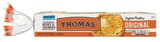 English Muffins Thomas' · 13 oz, 6 muffins Ultra-processedHigh in saltContains added sugarsContains seed oils Score 47 out of 100 Okay
 -
 English Muffin Dave's Killer Bread · 13.2 oz/374 g Ultra-processedContains added sugarsContains seed oilsCertified organic Score 35 out of 100 Poor
 -
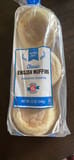 Classic English Muffins Trader Joe's · 12 oz Contains added sugarsContains seed oils Score 67 out of 100 Good
 -
 English Muffins Ezekiel 4:9 · 454 g Ultra-processedContains added sugarsCertified organicNo additives Score 72 out of 100 Good
 -
 English Muffins Bays · 12 oz (340 g) Ultra-processedHigh in saltContains added sugarsContains seed oils Score 45 out of 100 Okay
 -
 English Muffins Cinnamon Raisin Thomas' · 13 oz (369 g) - 6 muffins Ultra-processedContains added sugarsContains seed oils Score 43 out of 100 Okay
More from Thomas'
Sources
-
Guideline: sugars intake for adults and children
“In both adults and children, WHO recommends reducing the intake of free sugars to less than 10% of total energy intake”
who.int
-
Dietary Guidelines for Americans, 2025–2030
“Limit foods and beverages that include artificial flavors, petroleum-based dyes, artificial preservatives, and low-calorie non-nutritive sweeteners.”
cdn.realfood.gov
-
Added and free sugars should be as low as possible
“Sugar consumption is a known cause of dental caries.”
efsa.europa.eu
-
11. List of Permitted Preservatives (Lists of Permitted Food Additives)
“B.2 Butylated Hydroxyanisole n/a (a) Active dry yeasts (a) Preservative (a) 1,000 ppm n/a”
canada.ca
-
21 CFR 101.22 Foods; labeling of spices, flavorings, colorings and chemical preservatives
“whose significant function in food is flavoring rather than nutritional.”
ecfr.gov
-
“For adults, WHO recommends less than 2000 mg/day of sodium (equivalent to less than 5 g/day salt), or just under a teaspoon.”
who.int
-
“Greater exposure to ultra-processed food was associated with a higher risk of adverse health outcomes, especially cardiometabolic, common mental disorder, and mortality outcomes.”
doi.org