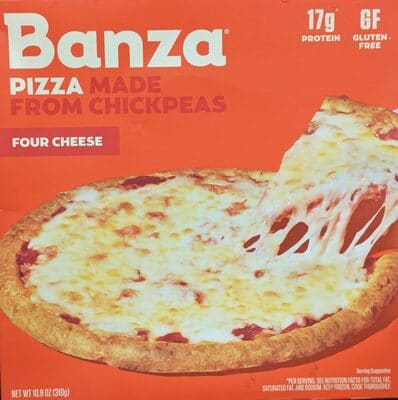
Pizzas
Banza Four Cheese Pizza
10.9 oz
Score
- Ultra-processed
- High in saturated fat
- Seed-oil free
Why it scores 67
Banza Four Cheese Pizza scores 67 out of 100 (Good) under GoodSwap’s published rules. What moved the score most:
- minus 18 points Ultra-processed (NOVA 4): Classified NOVA 4: made with industrial ingredients and additives. Strong
- minus 7 points Saturated fat 6.5 g / 100 g: Very high in saturated fat. Strong
- plus 4 points Fiber 6.5 g / 100 g: A good source of fiber. Strong
Every line of the math is on The Receipt below, with its evidence tier and sources.
Better pizza
-
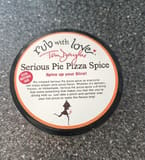 Rub With Love - Serious Pie Pizza Spice Rub With Love Not ultra-processed · Less saturated fat Score 100 out of 100 , 33 points higher
 -
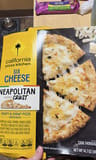 Six cheese Neapolitan pizza California Pizza Kitchen · 14.7 oz Not ultra-processed · Less saturated fat Score 86 out of 100 , 19 points higher
 -
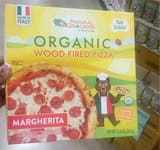 Wood fired margarita pizza Not ultra-processed · Less saturated fat Score 99 out of 100 , 32 points higher
 -
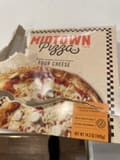 Four Cheese Pizza Midtown Pizza Co By Heb · 14.3 oz/405 g Not ultra-processed · Less saturated fat Score 85 out of 100 , 18 points higher
 -
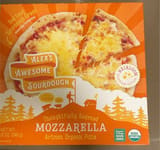 Mozzarella Pizza Alex's Awesome Sourdough · 12 oz, 340 g Not ultra-processed · Less saturated fat Score 93 out of 100 , 26 points higher
The same kind of product, at least 10 points higher, sold in the US. Never paid placements.
The Receipt
Four Cheese Pizza
Ingredients
- Sunflower lecithin minus 2.5 points
- Xanthan gum minus 2.5 points
- Sodium acid pyrophosphate minus 2.5 points
- Calcium phosphate minus 1.5 points
Processing
- Ultra-processed (NOVA 4) minus 18 points
- 2 kinds of ultra-processing markers minus 1.5 points
Nutrition per 100 g
- Saturated fat 6.5 g / 100 g minus 7 points
- Salt 1 g / 100 g minus 3 points
- Energy 309 kcal / 100 g minus 1 points
- Fiber 6.5 g / 100 g plus 4 points
- Protein 11 g / 100 g plus 2 points
100 − 33.5 = 66.5 → 67
Can’t score above 79. High in saturated fat (above the front-of-pack "high" level). [6]
Nutrition per 100 g
| Energy | 309 kcal |
|---|---|
| Fat | 12.3 g |
| Saturated fat | 6.5 g |
| Trans fat | 0 g |
| Carbohydrates | 29 g |
| Sugars | 3.2 g |
| Added sugars | 0 g |
| Fiber | 6.5 g |
| Protein | 11 g |
| Salt | 1 g |
Serving: 0.5 pizza (155 g)
Ingredients
- Crust: Chickpeas
- Water
- Tapioca
- Cocoa Butter
- Olive Oil
- Yeast
- Oregano
- Garlic Powder
- Salt
- Date Powder
- Sunflower Lecithin
- Xanthan Gum
- Baking Powder (Calcium Carbonate, Sodium Acid Pyrophosphate, Sodium Bicarbonate, Monocalcium Phosphate)
- Toppings: Mozzarella Cheese (Pasteurized Part-Skim Milk, Cheese Cultures, Salt, Enzymes)
- White Cheddar Cheese (Pasteurized Milk, Cheese Cultures, Salt, Enzymes)
- Provolone Cheese (Pasteurized Milk, Cheese Cultures, Salt, Enzymes)
- Parmesan Cheese (Pasteurized Milk, Cheese Cultures, Salt, Enzymes)
- Sauce: Tomatoes
- Date Powder
- Salt
- Basil
- Garlic Powder
- Oregano
Label text, as published
Crust: Chickpeas, Water, Tapioca, Cocoa Butter, Olive Oil, Less Than 2% Of: Yeast, Oregano, Garlic Powder, Salt, Date Powder, Sunflower Lecithin, Xanthan Gum, Baking Powder (Calcium Carbonate, Sodium Acid Pyrophosphate, Sodium Bicarbonate, Monocalcium Phosphate), Toppings: Mozzarella Cheese (Pasteurized Part-Skim Milk, Cheese Cultures, Salt, Enzymes), White Cheddar Cheese (Pasteurized Milk, Cheese Cultures, Salt, Enzymes), Provolone Cheese (Pasteurized Milk, Cheese Cultures, Salt, Enzymes), Parmesan Cheese (Pasteurized Milk, Cheese Cultures, Salt, Enzymes), Sauce: Tomatoes, Date Powder, Salt, Basil, Garlic Powder, Oregano
Allergens and diets
Contains: Milk, Wheat
- Not vegan
- Not gluten-free
- Palm-oil-free
Always check the package: recipes change.
More pizzas on GoodSwap
-
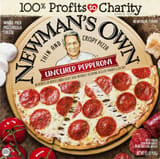 Thin & Crispy Crust Uncured Pepperoni Newman's Own · 15.1 oz Ultra-processedHigh in saltHigh in saturated fatContains nitrites or nitrates Score 20 out of 100 Poor
 - Thin and crispy pizza Newman's Own · 15.4 oz Contains added sugarsContains seed oilsContains whole grains Score 60 out of 100 Good
-
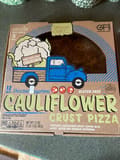 Cauliflower Crust Pizza Mama Cozzi's · 17 oz Ultra-processedHigh in saltHigh in saturated fatContains added sugars Score 47 out of 100 Okay
 -
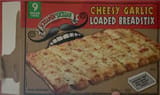 Cheesy Garlic Loaded Breadsticks Screamin' Sicilian · 15.65 oz/444 g High in saturated fatContains added sugarsContains seed oilsNo synthetic dyes Score 33 out of 100 Poor
 -
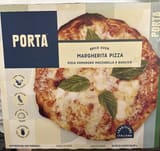 Margherita Pizza Porta Ultra-processedContains added sugarsSeed-oil free Score 47 out of 100 Okay
 -
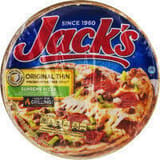 Original thin crust supreme pizza Jack's · 15.8 oz/448 g Ultra-processedContains nitrites or nitratesContains added sugarsContains seed oils Score 17 out of 100 Bad
More from Banza
Sources
-
EFSA issues new advice on phosphates
“We estimated that dietary exposure to phosphates may exceed the new ADI for infants, toddlers and children with average consumption of phosphates in their diet.”
efsa.europa.eu
-
Saturated fatty acid and trans-fatty acid intake for adults and children: WHO guideline
“WHO recommends that adults and children reduce saturated fatty acid intake to 10% of total energy intake (strong recommendation).”
who.int
-
“For adults, WHO recommends less than 2000 mg/day of sodium (equivalent to less than 5 g/day salt), or just under a teaspoon.”
who.int
-
Dietary Guidelines for Americans, 2025–2030
“Limit foods and beverages that include artificial flavors, petroleum-based dyes, artificial preservatives, and low-calorie non-nutritive sweeteners.”
cdn.realfood.gov
-
“Table 3: Criteria for drinks (per 100ml)”
assets.publishing.service.gov.uk
-
“Greater exposure to ultra-processed food was associated with a higher risk of adverse health outcomes, especially cardiometabolic, common mental disorder, and mortality outcomes.”
doi.org