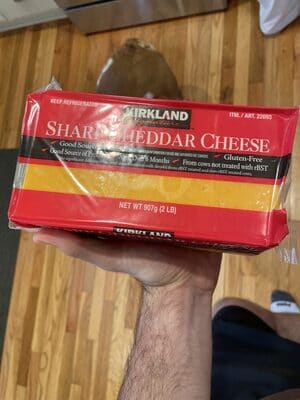
Cheeses
Kirkland Signature Sharp Cheddar Cheese
907 g
Score
- Ultra-processed
- High in salt
- High in saturated fat
- No synthetic dyes
Why it scores 76
Kirkland Signature Sharp Cheddar Cheese scores 76 out of 100 (Good) under GoodSwap’s published rules. What moved the score most:
- minus 18 points Ultra-processed (NOVA 4): Classified NOVA 4: made with industrial ingredients and additives. Strong
- minus 5 points Salt 1.6 g / 100 g: High in salt. Strong
- minus 4.5 points Saturated fat 17.9 g / 100 g: High in saturated fat. Counted at half for this whole-food category. Strong
Every line of the math is on The Receipt below, with its evidence tier and sources.
Better cheese
-
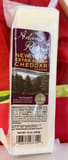 New York Extra Sharp Cheddar Adams Reserve · 10 oz Not ultra-processed · Less salt Score 97 out of 100 , 21 points higher
 -
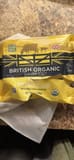 Sharp Cheddar Cheese British Organic Dairy Co. · 7 oz Not ultra-processed · Less salt Score 97 out of 100 , 21 points higher
 -
 Sharp Cheddar Deli-Sliced Cheese Happy Farms by ALDI · 8 oz Not ultra-processed · Less salt Score 94 out of 100 , 18 points higher
 -
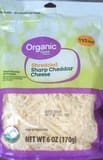 Shredded sharp cheddar cheese Great Value · 6 oz Not ultra-processed · Less salt Score 90 out of 100 , 14 points higher
 -
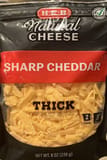 Heb natural cheese sharp cheddar thick H-E-B · 8 oz Not ultra-processed · Less salt Score 93 out of 100 , 17 points higher
The same kind of product, at least 10 points higher, sold in the US. Never paid placements.
The Receipt
Sharp Cheddar Cheese
Processing
- Ultra-processed (NOVA 4) minus 18 points
Nutrition per 100 g
- Saturated fat 17.9 g / 100 g minus 4.5 points
- Salt 1.6 g / 100 g minus 5 points
- Energy 393 kcal / 100 g minus 1 points
- Protein 25 g / 100 g plus 4 points
100 − 24.5 = 75.5 → 76
Can’t score above 79. High in fat, saturated fat and salt (above the front-of-pack "high" level). [5]
Nutrition per 100 g
| Energy | 393 kcal |
|---|---|
| Fat | 32.1 g |
| Saturated fat | 17.9 g |
| Trans fat | 0 g |
| Carbohydrates | 3.6 g |
| Sugars | 0 g |
| Added sugars | 0 g |
| Fiber | 0 g |
| Protein | 25 g |
| Salt | 1.6 g |
Serving: 1 portion (28 g)
Ingredients
Label text, as published
Cultured Pasteurized Milk, Salt, Enzymes, and Annatto (Vegetable Color). Contains No Animal Rennet. CONTAINS: Milk.
Allergens and diets
Contains: Milk
- Not vegan
- Not vegetarian
- Palm-oil-free
Always check the package: recipes change.
More cheeses on GoodSwap
-
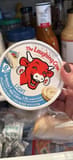 Light Laughing Cow Cheese Wedges The Laughing Cow · 8 × 19 g Ultra-processedHigh in saltHigh in saturated fat Score 66 out of 100 Good
 -
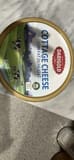 Low Fat Cottage Cheese Darigold · 113 g Ultra-processedContains emulsifiers studied for gut effectsMay contain traces of 1,4-dioxane Score 57 out of 100 Okay
 -
 String Cheese Frigo Cheese Heads · 28 g High in saltHigh in saturated fat Score 79 out of 100 Good
 -
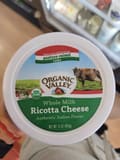 Organic Valley Ricotta Cheese CROPP Cooperative · 15 oz High in saturated fatCertified organicNo additives Score 79 out of 100 Good
 -
 Baby Swiss cheese slices Our Family · 8 oz No additives Score 94 out of 100 Excellent
 -
 Grated Parmigiano Reggiano Trader Joe's · 5 oz High in saltHigh in saturated fat Score 78 out of 100 Good
More from Kirkland Signature
-
 Unsalted Mixed Nuts Kirkland Signature · 1.13 kg Score 100 out of 100 Excellent
 -
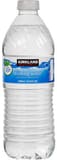 Purified Drinking Water Kirkland Signature · 500 mL Score 100 out of 100 Excellent
 -
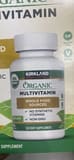 Organic Multivitamin Kirkland Signature Score 96 out of 100 Excellent
 -
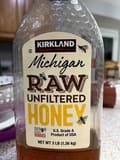 Michigan Raw Unfiltered Honey Kirkland Signature Score 65 out of 100 Good
Sources
-
Saturated fatty acid and trans-fatty acid intake for adults and children: WHO guideline
“WHO recommends that adults and children reduce saturated fatty acid intake to 10% of total energy intake (strong recommendation).”
who.int
-
“For adults, WHO recommends less than 2000 mg/day of sodium (equivalent to less than 5 g/day salt), or just under a teaspoon.”
who.int
-
Dietary Guidelines for Americans, 2025–2030
“Limit foods and beverages that include artificial flavors, petroleum-based dyes, artificial preservatives, and low-calorie non-nutritive sweeteners.”
cdn.realfood.gov
-
“Table 3: Criteria for drinks (per 100ml)”
assets.publishing.service.gov.uk
-
“Greater exposure to ultra-processed food was associated with a higher risk of adverse health outcomes, especially cardiometabolic, common mental disorder, and mortality outcomes.”
doi.org