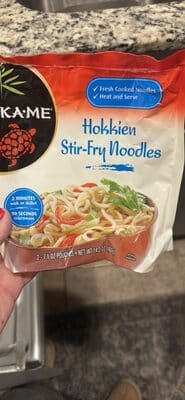
Noodles
Ka-Me Hokkien Stir-Fry Noodles
14.2 oz/400 g
Score
- Ultra-processed
- Contains seed oils
- No synthetic dyes
Why it scores 75
Ka-Me Hokkien Stir-Fry Noodles scores 75 out of 100 (Good) under GoodSwap’s published rules. What moved the score most:
- minus 18 points Ultra-processed (NOVA 4): Classified NOVA 4: made with industrial ingredients and additives. Strong
- minus 2.5 points Sunflower oil: High in omega-6 linoleic acid. Emerging
- minus 2.5 points Wheat gluten: An ingredient typical of ultra-processed foods (NOVA group 4). Info
Every line of the math is on The Receipt below, with its evidence tier and sources.
Better rice and Asian noodles
-
 UDON Stir-Fry Noodle Ka-Me · 100 g Not ultra-processed · No seed oils Score 94 out of 100 , 19 points higher
 -
 Stir-Fry Rice Noodles Thai Kitchen · 396 g Not ultra-processed · No seed oils Score 93 out of 100 , 18 points higher
 -
 Organic Soba Hakubaku · 9.5 oz Not ultra-processed · No seed oils Score 100 out of 100 , 25 points higher
 -
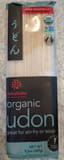 Organic Udon Noodle Hakubaku · 9.5 oz Not ultra-processed · No seed oils Score 100 out of 100 , 25 points higher
 -
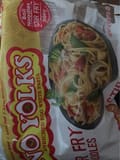 Stir fry noodles No Yolks · 12 oz Not ultra-processed · No seed oils Score 100 out of 100 , 25 points higher
The same kind of product, at least 10 points higher, sold in the US. Never paid placements.
The Receipt
Hokkien Stir-Fry Noodles
Ingredients
- Sunflower oil minus 2.5 points
- Wheat gluten minus 2.5 points
Processing
- Ultra-processed (NOVA 4) minus 18 points
- 2 kinds of ultra-processing markers minus 1.5 points
Nutrition per 100 g
- Salt 0.4 g / 100 g minus 1 points
100 − 25.5 = 74.5 → 75
Nutrition per 100 g
| Energy | 160 kcal |
|---|---|
| Fat | 1 g |
| Saturated fat | 0 g |
| Trans fat | 0 g |
| Carbohydrates | 31 g |
| Sugars | 0 g |
| Added sugars | 0 g |
| Fiber | 2 g |
| Protein | 6 g |
| Salt | 0.4 g |
Serving: 100g
Ingredients
- water
- wheat flour
- sunflower oil
- salt
- wheat gluten
- curcumin and beta carotene (for color)
- non-dairy lactic acid (vegetáble source). atey
Label text, as published
water, wheat flour, sunflower oil, salt, wheat gluten, curcumin and beta carotene (for color), non-dairy lactic acid (vegetáble source). atey contains: wheat. produced in a facility that handles peanuts and soy. uter several 90 with getables best by:
Allergens and diets
Contains: Soy, Wheat, Gluten
May contain: Peanuts
- Vegan
- Vegetarian
- Not gluten-free
- Palm-oil-free
Always check the package: recipes change.
More noodles on GoodSwap
-
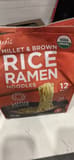 Millet & Brown Rice Ramen Noodles Lotus Foods Certified organicNo additivesContains whole grains Score 100 out of 100 Excellent
 -
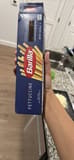 Fettuccine Barilla · 454 g No additives Score 100 out of 100 Excellent
 -
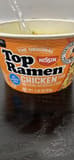 Top Ramen Chicken Flavor Nissin · 3.421 oz Ultra-processedHigh in saltHigh in saturated fatContains non-nutritive sweeteners Score 8 out of 100 Bad
 -
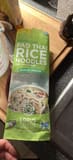 Traditional Pad Thai Rice Noodles Lotus Foods · 8 oz Certified organicNo additives Score 100 out of 100 Excellent
 -
 Organic Black Rice Noodles King Soba · 250 g Certified organicNo additivesContains whole grains Score 100 out of 100 Excellent
 -
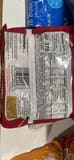 Roast Beef Ramen Noodle Soup Maruchan · 3 oz/85 g Not permitted in some countriesUltra-processedHigh in saltHigh in saturated fat Score 9 out of 100 Bad
Sources
-
“replacement of saturated fat in the diet with linoleic acid effectively lowers serum cholesterol but does not support the hypothesis that this translates to a lower risk of death from coronary heart disease or all causes.”
doi.org
-
“These data provide support for current recommendations to replace saturated fat with polyunsaturated fat for primary prevention of CHD.”
doi.org
-
“For adults, WHO recommends less than 2000 mg/day of sodium (equivalent to less than 5 g/day salt), or just under a teaspoon.”
who.int
-
“Greater exposure to ultra-processed food was associated with a higher risk of adverse health outcomes, especially cardiometabolic, common mental disorder, and mortality outcomes.”
doi.org