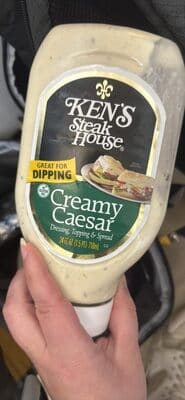
Salad dressings
Ken's Steak House Creamy Caesar Dressing, Topping & Spread
24 fl oz/1.5 PT/710 mL
Score
- Not permitted in some countries
- Ultra-processed
- High in salt
- High in saturated fat
- Contains added sugars
- Contains seed oils
- No synthetic dyes
Why it scores 7
Ken's Steak House Creamy Caesar Dressing, Topping & Spread scores 7 out of 100 (Bad) under GoodSwap’s published rules. What moved the score most:
- minus 20 points Sugar: An added sugar. Strong
- minus 20 points Titanium dioxide: EFSA (2021) could not rule out genotoxicity and could not set a safe daily intake, so the EU removed E171 from the list of permitted food additives in 2022. Regulatory
- minus 18 points Ultra-processed (NOVA 4): Classified NOVA 4: made with industrial ingredients and additives. Strong
Every line of the math is on The Receipt below, with its evidence tier and sources.
Better salad dressings
-
 Creamy Caesar Dressing & Dip Tessemae's Organic · 10 fl oz/296 mL No banned ingredients · Not ultra-processed Score 77 out of 100 , 70 points higher
 -
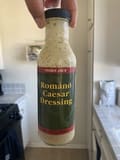 Romano Caesar Dressing Trader Joe's No banned ingredients · Not ultra-processed Score 79 out of 100 , 72 points higher
 -
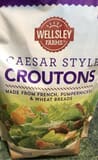 Caesar style Wellsley Farms No banned ingredients · Less saturated fat Score 51 out of 100 , 44 points higher
 -
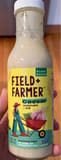 Super Plant Based Caesar Dressing Field & Farmer · 12 oz/355 mL No banned ingredients · Not ultra-processed Score 79 out of 100 , 72 points higher
 -
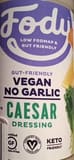 Caesar Dressing Fody · 8 fl oz/236 mL No banned ingredients · No added sugars Score 58 out of 100 , 51 points higher
The same kind of product, at least 10 points higher, sold in the US. Never paid placements.
The Receipt
Creamy Caesar Dressing, Topping & Spread
Ingredients
- Sugar minus 20 points
- Titanium dioxide minus 20 points
- Molasses minus 10 points
Processing
- Ultra-processed (NOVA 4) minus 18 points
- 5 kinds of ultra-processing markers minus 6 points
Nutrition per 100 g
- Saturated fat 10.3 g / 100 g minus 9 points
- Salt 2.2 g / 100 g minus 7 points
- Energy 586 kcal / 100 g minus 3 points
100 − 93 = 7
Can’t score above 25. Contains titanium dioxide, which is banned in food in the EU. [4]
Can’t score above 79. Contains sugar, an ingredient of high concern. [1][2][3][4][5][6][7][8][9][10][14][15][16]
Can’t score above 79. High in fat, saturated fat and salt (above the front-of-pack "high" level). [17]
Nutrition per 100 g
| Energy | 586 kcal |
|---|---|
| Fat | 62.1 g |
| Saturated fat | 10.3 g |
| Trans fat | 0 g |
| Carbohydrates | 3.5 g |
| Sugars | 0 g |
| Added sugars | 0 g |
| Fiber | 0 g |
| Protein | 3.5 g |
| Salt | 2.2 g |
Serving: 2 Tbsp (29 g)
Ingredients
- SOYBEAN OIL
- WATER
- DISTILLED VINEGAR
- EGG YOLK
- PARMESAN CHEESE (PASTEURIZED PART-SKIM MILK, CHEESE CULTURES, SALT, ENZYMES)
- SALT
- OLIVE OIL
- GARLIC
- SUGAR (high concern)
- LEMON JUICE CONCENTRATE
- SPICE
- NATURAL FLAVOR
- EGG
- TITANIUM DIOXIDE (COLOR) (high concern)
- ONION
- XANTHAN GUM
- POTASSIUM SORBATE AND SODIUM BENZOATE (PRESERVATIVES)
- PROPYLENE GLYCOL ALGINATE
- MOLASSES (high concern)
- LACTIC ACID
- CORN SYRUP (high concern)
- CARAMEL COLOR (high concern)
- GARLIC
- CALCIUM DISODIUM EDTA (TO PROTECT FLAVOR)
- TAMARIND
- CELERY SEED
- ANCHOVIES
- MALTODEXTRIN
Label text, as published
SOYBEAN OIL, WATER, DISTILLED VINEGAR, EGG YOLK, PARMESAN CHEESE (PASTEURIZED PART-SKIM MILK, CHEESE CULTURES, SALT, ENZYMES), SALT, CONTAINS LESS THAN 2% OF OLIVE OIL, GARLIC, SUGAR, LEMON JUICE CONCENTRATE, SPICE, NATURAL FLAVOR, EGG, TITANIUM DIOXIDE (COLOR), ONION,* XANTHAN GUM, POTASSIUM SORBATE AND SODIUM BENZOATE (PRESERVATIVES), PROPYLENE GLYCOL ALGINATE, MOLASSES, LACTIC ACID, CORN SYRUP, CARAMEL COLOR, GARLIC*, CALCIUM DISODIUM EDTA (TO PROTECT FLAVOR), TAMARIND, CELERY SEED, ANCHOVIES, MALTODEXTRIN.
Allergens and diets
Contains: Milk, Soy, Egg, Fish, Celery
- Not vegan
- Not vegetarian
- Palm-oil-free
Always check the package: recipes change.
More salad dressings on GoodSwap
-
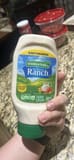 The Original Ranch Condiment & Dressing Hidden Valley · 16 fl oz Ultra-processedHigh in saltHigh in saturated fatContains added sugars Score 27 out of 100 Poor
 -
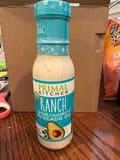 Ranch Dressing & Marinade Primal Kitchen · 8 oz Ultra-processedHigh in saltSeed-oil free Score 70 out of 100 Good
 -
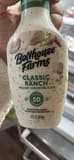 Classic Ranch Yogurt Dressing & Dip Bolthouse Farms · 12 fl oz/355 mL Ultra-processedHigh in saltContains added sugarsContains seed oils Score 34 out of 100 Poor
 -
 Italian Skinnygirl · 8 fl oz Ultra-processedHigh in saltContains non-nutritive sweetenersContains sugar alcohols Score 52 out of 100 Okay
 -
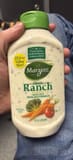 Classic Ranch Marzetti · 22 fl oz/650 mL Ultra-processedHigh in saltHigh in saturated fatContains added sugars Score 36 out of 100 Poor
 -
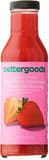 Strawberry Champagne Vinaigrette Bettergoods Ultra-processedHigh in saltContains added sugarsContains seed oils Score 27 out of 100 Poor
More from Ken's Steak House
-
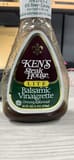 Lite Balsamic Vinaigrette Ken's Steak House · 30 g Score 33 out of 100 Poor
 -
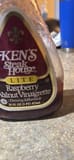 Lite Raspberry Walnut Vinaigrette Dressing & Marinade Ken's Steak House · 32 g Score 10 out of 100 Bad
 -
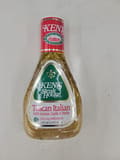 Ken's Tuscan Italian dressing & marinade Ken's Steak House · 30 g Score 33 out of 100 Poor
 -
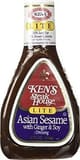 Asian Sesame with Ginger & Soy Dressing & Marinade Ken's Steak House · 16 fl oz Score 7 out of 100 Bad
Sources
-
Guideline: sugars intake for adults and children
“In both adults and children, WHO recommends reducing the intake of free sugars to less than 10% of total energy intake”
who.int
-
Dietary Guidelines for Americans, 2025–2030
“Limit foods and beverages that include artificial flavors, petroleum-based dyes, artificial preservatives, and low-calorie non-nutritive sweeteners.”
cdn.realfood.gov
-
Added and free sugars should be as low as possible
“Sugar consumption is a known cause of dental caries.”
efsa.europa.eu
-
“titanium dioxide (E 171) can no longer be considered safe when used as a food additive.”
eur-lex.europa.eu
-
Titanium dioxide: E171 no longer considered safe when used as a food additive
“the Panel concluded that titanium dioxide can no longer be considered safe as a food additive.”
efsa.europa.eu
-
“Considering the very low oral absorption of INS 171, and in the absence of any identifiable hazard associated with INS 171 in the diet, the Committee reaffirmed the ADI “not specified” established at the Thirteenth meeting.”
who.int
-
Titanium dioxide (TiO2) as a food additive: Current science report
“In summary, the Food Directorate's position is that there is no conclusive scientific evidence that the food additive TiO2 is a concern for human health.”
canada.ca
-
Statement on the safety of Titanium Dioxide (E171) as a Food Additive (COT/2024/05)
“The Committee concludes that it is unlikely that there would be a risk to health from exposures of E171 TiO2 from the diet in any of the age groups or scenarios assessed.”
cot.food.gov.uk
-
Titanium Dioxide as a Color Additive in Foods
“Other international regulatory bodies including the United Kingdom’s Food Standards Agency (FSA), Health Canada, and Food Standards Australia New Zealand (FSANZ) have not agreed with EFSA’s assessment.”
fda.gov
-
Agents Classified by the IARC Monographs, Volumes 1–142 (List of Classifications)
monographs.iarc.who.int
-
Saturated fatty acid and trans-fatty acid intake for adults and children: WHO guideline
“WHO recommends that adults and children reduce saturated fatty acid intake to 10% of total energy intake (strong recommendation).”
who.int
-
“For adults, WHO recommends less than 2000 mg/day of sodium (equivalent to less than 5 g/day salt), or just under a teaspoon.”
who.int
-
Questions & Answers About 4-MEI
“Based on current science, the FDA has no reason to believe that there are any immediate or short-term health risks presented by 4-MEI at the levels expected in food.”
fda.gov
-
Proposition 65 List of Chemicals Known to the State to Cause Cancer or Reproductive Toxicity
“The date refers to the initial appearance of the chemical on the list.”
oehha.ca.gov
-
“Table 3: Criteria for drinks (per 100ml)”
assets.publishing.service.gov.uk
-
Revocation of Authorization for Use of Brominated Vegetable Oil in Food (89 FR 55040)
“This action is being taken because there is no longer a reasonable certainty of no harm from the continued use of BVO in food.”
federalregister.gov
-
“This order is effective January 15, 2027, except for amendatory instruction 4, which is effective January 18, 2028.”
federalregister.gov
-
Regulation (EC) No 1223/2009 of 30 November 2009 on cosmetic products
“cosmetic products shall not contain any of the following: (a) prohibited substances — prohibited substances listed in Annex II”
eur-lex.europa.eu
-
“Greater exposure to ultra-processed food was associated with a higher risk of adverse health outcomes, especially cardiometabolic, common mental disorder, and mortality outcomes.”
doi.org
-
“replacement of saturated fat in the diet with linoleic acid effectively lowers serum cholesterol but does not support the hypothesis that this translates to a lower risk of death from coronary heart disease or all causes.”
doi.org
-
“These data provide support for current recommendations to replace saturated fat with polyunsaturated fat for primary prevention of CHD.”
doi.org