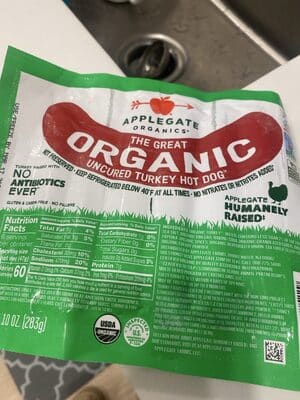
Sausages
Applegate Organics The Great Organic Uncured Turkey Hot Dog
10 oz
Score
- High in salt
- Contains nitrites or nitrates
- Certified organic
- No additives
Why it scores 76
Applegate Organics The Great Organic Uncured Turkey Hot Dog scores 76 out of 100 (Good) under GoodSwap’s published rules. What moved the score most:
- minus 9 points Salt 2.5 g / 100 g: Very high in salt. Strong
- minus 8 points Processed (NOVA 3): Classified NOVA 3: processed with added salt, sugar or oil. Emerging
- minus 7.5 points Cultured celery powder (natural nitrite source): Provides nitrite like synthetic curing salts. Regulatory
Every line of the math is on The Receipt below, with its evidence tier and sources.
The Receipt
The Great Organic Uncured Turkey Hot Dog
Ingredients
- Cultured celery powder (natural nitrite source) minus 7.5 points
Processing
- Processed (NOVA 3) minus 8 points
Nutrition per 100 g
- Saturated fat 2.1 g / 100 g minus 1.5 points
- Salt 2.5 g / 100 g minus 9 points
- Protein 14.9 g / 100 g plus 2 points
100 − 24 = 76
Can’t score above 79. High in salt (above the front-of-pack "high" level). [7]
Nutrition per 100 g
| Energy | 133 kcal |
|---|---|
| Fat | 6.4 g |
| Saturated fat | 2.1 g |
| Trans fat | 0 g |
| Carbohydrates | 2.1 g |
| Sugars | 0 g |
| Added sugars | 0 g |
| Fiber | 0 g |
| Protein | 14.9 g |
| Salt | 2.5 g |
Serving: 1 hot dog (47 g)
Ingredients
- Organic turkey
- water
- sea salt
- organic paprika
- organic dehydrated onion
- organic dehydrated garlic
- organic garlic
- organic spices
- cultured celery juice powder (moderate concern)
- organic cherry powder
Label text, as published
Organic turkey**, water. contains less than 2% of the following: sea salt, organic paprika, organic dehydrated onion, organic dehydrated garlic, organic garlic, organic spices, cultured celery juice powder, organic cherry powder.
Allergens and diets
Contains: Celery
- Not vegan
- Not vegetarian
- Gluten-free
- Palm-oil-free
Always check the package: recipes change.
More sausages on GoodSwap
-
 Chicken Breakfast Links Amylu · 40 oz Score 89 out of 100 Excellent
 -
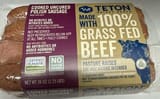 Cooked Uncured Polish Sausage Teton Waters Ranch · 10 oz High in saltHigh in saturated fatNo additives Score 79 out of 100 Good
 -
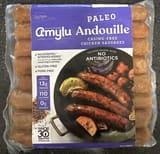 Andouille Chicken Sausages Amylu · 40 oz High in salt Score 79 out of 100 Good
 -
 Country Style Chicken Breakfast Sausage ALDI Twice as Nice · 8 oz High in saltContains added sugarsNo additives Score 68 out of 100 Good
 -
 Turkey Polska Kielbasa Hillshire Farm · 13 oz Ultra-processedContains nitrites or nitratesContains added sugars Score 27 out of 100 Poor
 -
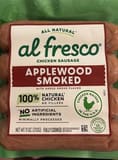 Applewood Smoked Chicken Sausage Al Fresco · 11 oz Ultra-processedHigh in saltContains nitrites or nitratesContains added sugars Score 40 out of 100 Okay
More from Applegate Organics
-
 Uncured Beef Hot Dog Applegate Organics · 10 oz Score 79 out of 100 Good
 -
 Hickory Smoked Uncured Turkey Bacon Applegate Organics · 8 oz/226 g Score 79 out of 100 Good
 - Hickory Smoked Undercured Sunday Bacon Applegate Organics · 8 oz/226 g Score 61 out of 100 Good
-
 The Great Organic Uncured Beef Hot Dog Applegate Organics · 10 oz Score 70 out of 100 Good
Sources
-
Agents Classified by the IARC Monographs, Volumes 1–142 (List of Classifications)
monographs.iarc.who.int
-
“the presence of nitrites and nitrates in foods can give rise to the formation of nitrosamines some of which are carcinogenic.”
eur-lex.europa.eu
-
Saturated fatty acid and trans-fatty acid intake for adults and children: WHO guideline
“WHO recommends that adults and children reduce saturated fatty acid intake to 10% of total energy intake (strong recommendation).”
who.int
-
“For adults, WHO recommends less than 2000 mg/day of sodium (equivalent to less than 5 g/day salt), or just under a teaspoon.”
who.int
-
Dietary Guidelines for Americans, 2025–2030
“Limit foods and beverages that include artificial flavors, petroleum-based dyes, artificial preservatives, and low-calorie non-nutritive sweeteners.”
cdn.realfood.gov
-
“Table 3: Criteria for drinks (per 100ml)”
assets.publishing.service.gov.uk