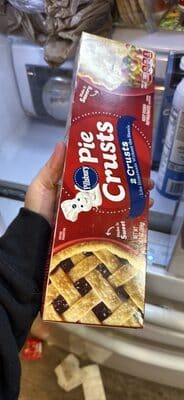
Pie dough
Pillsbury Pie Crusts
14.1 oz
Score
- Ultra-processed
- High in saturated fat
- No synthetic dyes
Why it scores 42
Pillsbury Pie Crusts scores 42 out of 100 (Okay) under GoodSwap’s published rules. What moved the score most:
- minus 20 points BHA (butylated hydroxyanisole): IARC classifies BHA as Group 2B (possibly carcinogenic to humans), based on animal studies. Regulatory
- minus 18 points Ultra-processed (NOVA 4): Classified NOVA 4: made with industrial ingredients and additives. Strong
- minus 7 points Saturated fat 10 g / 100 g: Very high in saturated fat. Strong
Every line of the math is on The Receipt below, with its evidence tier and sources.
The Receipt
Pie Crusts
Ingredients
- BHA (butylated hydroxyanisole) minus 20 points
- Xanthan gum minus 2.5 points
- Sodium propionate minus 2.5 points
Processing
- Ultra-processed (NOVA 4) minus 18 points
- 2 kinds of ultra-processing markers minus 1.5 points
Nutrition per 100 g
- Saturated fat 10 g / 100 g minus 7 points
- Salt 1.3 g / 100 g minus 5 points
- Energy 400 kcal / 100 g minus 2 points
100 − 58.5 = 41.5 → 42
Can’t score above 79. Contains BHA (butylated hydroxyanisole), an ingredient of high concern. [1][2][3][4][5]
Can’t score above 79. High in fat and saturated fat (above the front-of-pack "high" level). [11]
Nutrition per 100 g
| Energy | 400 kcal |
|---|---|
| Fat | 24 g |
| Saturated fat | 10 g |
| Trans fat | 0 g |
| Carbohydrates | 48 g |
| Sugars | 0 g |
| Added sugars | 0 g |
| Fiber | 0 g |
| Protein | 4 g |
| Salt | 1.3 g |
Serving: 1/8 crust (25 g) (25 g)
Ingredients
- Enriched Flour Bleached (wheat flour, niacin, ferrous sulfate, thiamin mononitrate, riboflavin, folic acid)
- Lard and Hydrogenated Lard with BHA and BHT Added to Protect Flavor (high concern)
- Water
- Wheat Starch
- Corn Starch
- Salt
- Rice Flour
- Xanthan Gum
- Sodium Propionate and Potassium Sorbate (preservatives)
- Citric Acid
- Annatto Extract (for color)
Label text, as published
Enriched Flour Bleached (wheat flour, niacin, ferrous sulfate, thiamin mononitrate, riboflavin, folic acid), Lard and Hydrogenated Lard with BHA and BHT Added to Protect Flavor, Water, Wheat Starch, Corn Starch. Contains 2% or less of: Salt, Rice Flour, Xanthan Gum, Sodium Propionate and Potassium Sorbate (preservatives), Citric Acid, Annatto Extract (for color).
Allergens and diets
Contains: Wheat, Gluten
- Not vegan
- Not vegetarian
- Not gluten-free
- Palm-oil-free
Always check the package: recipes change.
More pie dough on GoodSwap
-
 Puff Pastry Sheets Pepperidge Farm · 17.3 oz Ultra-processedHigh in saturated fatContains added sugarsContains emulsifiers studied for gut effects Score 35 out of 100 Poor
 -
 Cinnamon Rolls Pillsbury · 12.4 oz Dye with an EU warning labelContains synthetic dyesUltra-processedHigh in sugar Score 2 out of 100 Bad
 -
 Mama mary's, 2 pizza crusts, original Mama Ultra-processedContains added sugarsContains emulsifiers studied for gut effectsContains seed oils Score 38 out of 100 Poor
 -
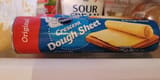 Crescent Dough Sheet Pillsbury · 8 oz Ultra-processedHigh in saltContains added sugarsContains emulsifiers studied for gut effects Score 8 out of 100 Bad
 -
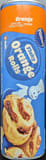 Flaky Orange Rolls Pillsbury · 13.9 oz Dye with an EU warning labelContains synthetic dyesUltra-processedHigh in salt Score 2 out of 100 Bad
 -
 Southern Homestyle Biscuits Pillsbury Grands! · 16.3 oz Ultra-processedHigh in saltHigh in saturated fatContains added sugars Score 10 out of 100 Bad
More from Pillsbury
Sources
-
Agents Classified by the IARC Monographs, Volumes 1–142 (List of Classifications)
monographs.iarc.who.int
-
Proposition 65 List of Chemicals Known to the State to Cause Cancer or Reproductive Toxicity
“The date refers to the initial appearance of the chemical on the list.”
oehha.ca.gov
-
Report on Carcinogens, 15th Edition: Butylated Hydroxyanisole
“Butylated hydroxyanisole (BHA) is reasonably anticipated to be a human carcinogen based on sufficient evidence of carcinogenicity from studies in experimental animals.”
ntp.niehs.nih.gov
-
List of Select Chemicals in the Food Supply Under FDA Review
“The table below includes select food ingredients (including food and color additives), food contact substances, and contaminants under FDA review as of May 12, 2026 .”
fda.gov
-
“The Panel concluded that exposure to BHA from its use as food additive based on new exposure estimates does not exceed the ADI of 1 mg/kg bw/day at the mean”
doi.org
-
11. List of Permitted Preservatives (Lists of Permitted Food Additives)
“B.2 Butylated Hydroxyanisole n/a (a) Active dry yeasts (a) Preservative (a) 1,000 ppm n/a”
canada.ca
-
Saturated fatty acid and trans-fatty acid intake for adults and children: WHO guideline
“WHO recommends that adults and children reduce saturated fatty acid intake to 10% of total energy intake (strong recommendation).”
who.int
-
“For adults, WHO recommends less than 2000 mg/day of sodium (equivalent to less than 5 g/day salt), or just under a teaspoon.”
who.int
-
Dietary Guidelines for Americans, 2025–2030
“Limit foods and beverages that include artificial flavors, petroleum-based dyes, artificial preservatives, and low-calorie non-nutritive sweeteners.”
cdn.realfood.gov
-
“Table 3: Criteria for drinks (per 100ml)”
assets.publishing.service.gov.uk
-
“Greater exposure to ultra-processed food was associated with a higher risk of adverse health outcomes, especially cardiometabolic, common mental disorder, and mortality outcomes.”
doi.org