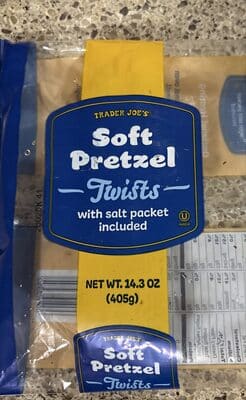
Breads
Trader Joe's Soft pretzel twist
67 g
Score
- High in salt
- Contains seed oils
Why it scores 79
Trader Joe's Soft pretzel twist scores 79 out of 100 (Good) under GoodSwap’s published rules. What moved the score most:
- minus 9 points Salt 4 g / 100 g: Very high in salt. Strong
- minus 8 points Processed (NOVA 3): Classified NOVA 3: processed with added salt, sugar or oil. Emerging
- minus 2.5 points Soybean oil: High in omega-6 linoleic acid. Emerging
Capped at 79: High in salt (above the front-of-pack "high" level).
Every line of the math is on The Receipt below, with its evidence tier and sources.
Better frozen snacks and appetizers
The same kind of product, at least 10 points higher, sold in the US. Never paid placements.
The Receipt
Soft pretzel twist
Ingredients
- Soybean oil minus 2.5 points
Processing
- Processed (NOVA 3) minus 8 points
Nutrition per 100 g
- Salt 4 g / 100 g minus 9 points
- Energy 284 kcal / 100 g minus 1 points
100 − 20.5 = 79.5 → 80 → capped at 79
Capped at 79. High in salt (above the front-of-pack "high" level). [8]
Nutrition per 100 g
| Energy | 284 kcal |
|---|---|
| Fat | 6 g |
| Saturated fat | 0.7 g |
| Trans fat | 0 g |
| Carbohydrates | 49.3 g |
| Sugars | 0 g |
| Added sugars | 0 g |
| Fiber | 1.5 g |
| Protein | 7.5 g |
| Salt | 4 g |
Serving: 67g
Ingredients
Label text, as published
Wheat flour, water, soybean oil, salt, malted barley flour, yeast, sodium hydroxide. Contains wheat.
Allergens and diets
Contains: Soy, Wheat, Gluten
- Vegan
- Vegetarian
- Not gluten-free
- Palm-oil-free
Always check the package: recipes change.
More breads on GoodSwap
-
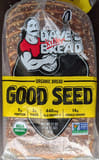 Organic Bread Good Seed Dave's Killer Bread · 27 oz Ultra-processedContains added sugarsCertified organicContains whole grains Score 42 out of 100 Okay
 -
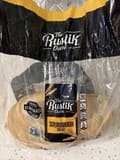 Sourdough Bread The Rustik Oven · 1 lb/454 g Ultra-processedSeed-oil free Score 73 out of 100 Good
 -
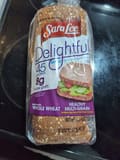 Delightful Bread Sara Lee · 567 g Ultra-processedContains non-nutritive sweetenersContains added sugarsContains emulsifiers studied for gut effects Score 23 out of 100 Poor
 -
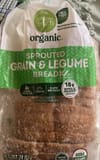 simple truth, or Galic and sprouted bread Kroger · 24 oz Contains whole grains Score 92 out of 100 Excellent
 -
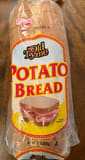 Potato bread Old Tyme · 22 oz Ultra-processedContains added sugarsContains emulsifiers studied for gut effectsContains seed oils Score 17 out of 100 Bad
 -
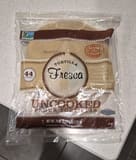 Uncooked Flour Tortillas Tortilla Fresca · 78 oz Contains added sugarsContains seed oilsNo additives Score 69 out of 100 Good
More from Trader Joe's
-
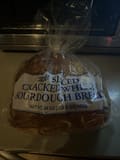 Cracked Wheat Sourdough Bread Trader Joe's · 24 oz Score 86 out of 100 Excellent
 -
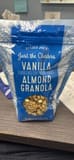 Vanilla Almond Granola Trader Joe's · 16 oz Score 22 out of 100 Poor
 -
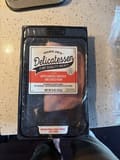 Applewood Smoked Uncured Ham Trader Joe's · 8 oz Score 29 out of 100 Poor
 -
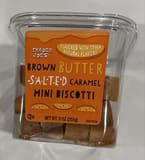 Brown butter salted caramel mini biscotti Trader Joe's · 10 unit Score 2 out of 100 Bad
Sources
-
“replacement of saturated fat in the diet with linoleic acid effectively lowers serum cholesterol but does not support the hypothesis that this translates to a lower risk of death from coronary heart disease or all causes.”
doi.org
-
“These data provide support for current recommendations to replace saturated fat with polyunsaturated fat for primary prevention of CHD.”
doi.org
-
“For adults, WHO recommends less than 2000 mg/day of sodium (equivalent to less than 5 g/day salt), or just under a teaspoon.”
who.int
-
Dietary Guidelines for Americans, 2025–2030
“Limit foods and beverages that include artificial flavors, petroleum-based dyes, artificial preservatives, and low-calorie non-nutritive sweeteners.”
cdn.realfood.gov
-
“Table 3: Criteria for drinks (per 100ml)”
assets.publishing.service.gov.uk