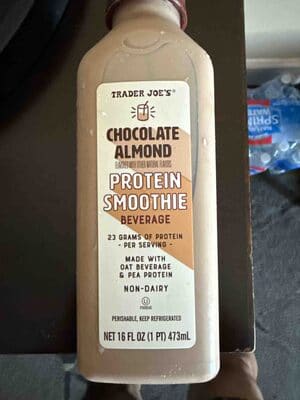
Protein shakes
Trader Joe's Chocolate Almond Protein Smoothie Beverage
16 fl oz (1 pt) 473 mL
Score
- Contains added sugars
- Contains seed oils
- Contains whole grains
Why it scores 85
Trader Joe's Chocolate Almond Protein Smoothie Beverage scores 85 out of 100 (Excellent) under GoodSwap’s published rules. What moved the score most:
- minus 12 points Sugar: An added sugar. Strong
- minus 1 points Pea protein: An ingredient typical of ultra-processed foods (NOVA group 4). Info
- minus 1 points Sunflower oil: High in omega-6 linoleic acid. Emerging
Every line of the math is on The Receipt below, with its evidence tier and sources.
The Receipt
Chocolate Almond Protein Smoothie Beverage
Ingredients
- Sugar minus 12 points
- Pea protein minus 1 points
- Sunflower oil minus 1 points
- Natural flavors minus 0.5 points
- Gum arabic (acacia) minus 0.5 points
- Gellan gum minus 0.5 points
100 − 15.5 = 84.5 → 85
Nutrition per 100 g
| Energy | 100 kcal |
|---|---|
| Fat | 3.9 g |
| Saturated fat | 1.1 g |
| Trans fat | 0 g |
| Carbohydrates | 8.1 g |
| Sugars | 5.8 g |
| Added sugars | 5.5 g |
| Fiber | 1.6 g |
| Protein | 7.4 g |
| Salt | 0.2 g |
Serving: 1 bottle (310 ml)
Ingredients
- OAT BASE (WATER, HYDROLYZED OATS)
- PEA PROTEIN
- SUGAR (high concern)
- ALMOND PASTE
- COCOA POWDER
- SUNFLOWER OIL
- NATURAL FLAVORS
- ACACIA GUM
- GELLAN GUM
- SEA SALT
Label text, as published
OAT BASE (WATER, HYDROLYZED OATS), PEA PROTEIN, SUGAR, ALMOND PASTE, COCOA POWDER, SUNFLOWER OIL, NATURAL FLAVORS, ACACIA GUM, GELLAN GUM, SEA SALT. CONTAINS ALMOND.
Allergens and diets
Contains: Tree nuts, Gluten
- Not gluten-free
- Palm-oil-free
Always check the package: recipes change.
Packaging
Pet 1 polyethylene terephthalate
Context only: no points in v1.
More protein shakes on GoodSwap
-
 High Quality Protein Fairlife · 11.5 fl oz (340 mL) Contains non-nutritive sweetenersContains emulsifiers studied for gut effects Score 84 out of 100 Excellent
 -
 Core Power High Protein Milk Shake Chocolate Fairlife · 14 oz Ultra-processedContains non-nutritive sweetenersContains emulsifiers studied for gut effects Score 46 out of 100 Okay
 -
 CORE POWER High Protein Milk Shake Chocolate Rlife · 414 mL Ultra-processedContains non-nutritive sweetenersContains emulsifiers studied for gut effects Score 51 out of 100 Okay
 -
 Genuine Protein Powder Muscle Milk · 30.9 oz/1.93 lb/875 g Contains non-nutritive sweetenersContains emulsifiers studied for gut effectsContains seed oilsContains artificial flavors Score 85 out of 100 Excellent
 -
 Owyn OWYN · 44.6 fl oz/1.32 L Contains non-nutritive sweetenersContains added sugarsContains seed oils Score 84 out of 100 Excellent
 -
 Vanilla Bean Vegan All-In-One Protein Shake Orgain Ultra-processedContains added sugarsContains seed oilsCertified organic Score 29 out of 100 Poor
More from Trader Joe's
-
 Cracked Wheat Sourdough Bread Trader Joe's · 24 oz Score 86 out of 100 Excellent
 -
 Vanilla Almond Granola Trader Joe's · 16 oz Score 22 out of 100 Poor
 -
 Shredded Low-Moisture Part-Skim Mozzarella Cheese Trader Joe's · 16 oz Score 79 out of 100 Good
 -
 Icelandic Style Skyr Lowfat Yogurt Vanilla Trader Joe's Score 56 out of 100 Okay
Sources
-
Guideline: sugars intake for adults and children
“In both adults and children, WHO recommends reducing the intake of free sugars to less than 10% of total energy intake”
who.int
-
Dietary Guidelines for Americans, 2025–2030
“Limit foods and beverages that include artificial flavors, petroleum-based dyes, artificial preservatives, and low-calorie non-nutritive sweeteners.”
cdn.realfood.gov
-
Added and free sugars should be as low as possible
“Sugar consumption is a known cause of dental caries.”
efsa.europa.eu
-
“replacement of saturated fat in the diet with linoleic acid effectively lowers serum cholesterol but does not support the hypothesis that this translates to a lower risk of death from coronary heart disease or all causes.”
doi.org
-
“These data provide support for current recommendations to replace saturated fat with polyunsaturated fat for primary prevention of CHD.”
doi.org
-
21 CFR 101.22 Foods; labeling of spices, flavorings, colorings and chemical preservatives
“whose significant function in food is flavoring rather than nutritional.”
ecfr.gov