Coconuts
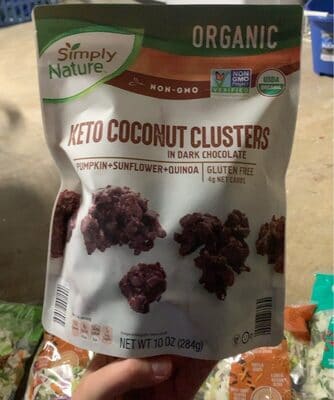
Simply Nature Keto coconut clusters
Score
- Ultra-processed
- High in saturated fat
- Contains added sugars
- Contains sugar alcohols
- Certified organic
- Seed-oil free
- Contains whole grains
Why it scores 38
Simply Nature Keto coconut clusters scores 38 out of 100 (Poor) under GoodSwap’s published rules. What moved the score most:
- minus 20 points Sugar: An added sugar. Strong
- minus 20 points Corn syrup: An added sugar. Strong
- minus 18 points Ultra-processed (NOVA 4): Classified NOVA 4: made with industrial ingredients and additives. Strong
Every line of the math is on The Receipt below, with its evidence tier and sources.
The Receipt
Keto coconut clusters
Ingredients
- Sugar minus 20 points
- Corn syrup minus 20 points
- Chocolate (sweetened, ingredient) minus 7.5 points
- Erythritol minus 2.5 points
Processing
- Ultra-processed (NOVA 4) minus 18 points
- 4 kinds of ultra-processing markers minus 4.5 points
Nutrition per 100 g
- Salt 0.5 g / 100 g minus 1 points
- Fiber 10.7 g / 100 g plus 4 points
- Protein 10.7 g / 100 g plus 2 points
Bonuses
- Certified organic plus 5 points
100 − 62.5 = 37.5 → 38
Can’t score above 79. Contains sugar, an ingredient of high concern. [1][2][3]
Nutrition per 100 g
| Energy | 536 kcal |
|---|---|
| Fat | 46.4 g |
| Saturated fat | 32.1 g |
| Carbohydrates | 32.1 g |
| Sugars | 10.7 g |
| Added sugars | 3.6 g |
| Fiber | 10.7 g |
| Protein | 10.7 g |
| Salt | 0.5 g |
Serving: 1 serving (28 g)
Ingredients
- Coconut
- Dark chocolate (unsweetened chocolate, cane sugar, cocoa butter) (moderate concern)
- Tapioca syrup (high concern)
- Sunflower seeds
- Pumpkin seeds
- Erythritol (moderate concern)
- Quinoa
- Inulin
- Sea salt
- Natural flavor
Label text, as published
Coconut, Dark chocolate (unsweetened chocolate, cane sugar, cocoa butter), Tapioca syrup, Sunflower seeds, Pumpkin seeds, Erythritol, Quinoa, Inulin, Sea salt, Natural flavor
Allergens and diets
Contains: Tree nuts
- Palm-oil-free
Always check the package: recipes change.
More coconuts on GoodSwap

More from Simply Nature




Sources
-
Guideline: sugars intake for adults and children
“In both adults and children, WHO recommends reducing the intake of free sugars to less than 10% of total energy intake”
who.int
-
Dietary Guidelines for Americans, 2025–2030
“Limit foods and beverages that include artificial flavors, petroleum-based dyes, artificial preservatives, and low-calorie non-nutritive sweeteners.”
cdn.realfood.gov
-
Added and free sugars should be as low as possible
“Sugar consumption is a known cause of dental caries.”
efsa.europa.eu
-
The artificial sweetener erythritol and cardiovascular event risk
“Our findings reveal that erythritol is both associated with incident MACE risk and fosters enhanced thrombosis. Studies assessing the long-term safety of erythritol are warranted.”
doi.org
-
Re-evaluation of erythritol (E 968) as a food additive (plain language summary)
“In all groups of people, both acute and chronic exposure to erythritol is above the newly set ADI.”
efsa.europa.eu
-
“For adults, WHO recommends less than 2000 mg/day of sodium (equivalent to less than 5 g/day salt), or just under a teaspoon.”
who.int
-
7 CFR 205.102 Use of the term "organic" (National Organic Program)
“Any agricultural product that is sold, labeled, or represented as “100 percent organic,” “organic,” or “made with organic (specified ingredients or food group(s))” must be: (a) Produced in accordance with the requirements specified in § 205.101 or §§ 205.202 through 205.207”
ecfr.gov
-
“Greater exposure to ultra-processed food was associated with a higher risk of adverse health outcomes, especially cardiometabolic, common mental disorder, and mortality outcomes.”
doi.org
-
“Table 3: Criteria for drinks (per 100ml)”
assets.publishing.service.gov.uk
-
Saturated fatty acid and trans-fatty acid intake for adults and children: WHO guideline
“WHO recommends that adults and children reduce saturated fatty acid intake to 10% of total energy intake (strong recommendation).”
who.int
-
Regulation (EU) No 1169/2011, Annex III point 2.4 (foods with more than 10 % added polyols)
“‘excessive consumption may produce laxative effects’.”
eur-lex.europa.eu