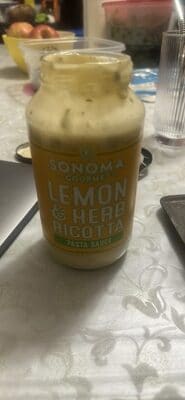
Pasta sauces
Sonoma Gourmet Lemon & Herb Ricotta Pasta Sauce
24.5 oz
Score
- Ultra-processed
- Contains seed oils
Why it scores 69
Sonoma Gourmet Lemon & Herb Ricotta Pasta Sauce scores 69 out of 100 (Good) under GoodSwap’s published rules. What moved the score most:
- minus 18 points Ultra-processed (NOVA 4): Classified NOVA 4: made with industrial ingredients and additives. Strong
- minus 5 points Salt 1.2 g / 100 g: High in salt. Strong
- minus 3 points Saturated fat 4 g / 100 g: High in saturated fat. Strong
Every line of the math is on The Receipt below, with its evidence tier and sources.
Better pasta sauces
-
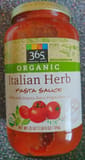 365 Everyday Value, Italian Herb Pasta Sauce 365 Everyday Value · 25 oz (1 lb 9 oz) 709 g Not ultra-processed · No seed oils Score 97 out of 100 , 28 points higher
 -
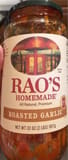 Roasted Garlic Rao's Homemade · 32 oz Not ultra-processed · No seed oils Score 100 out of 100 , 31 points higher
 -
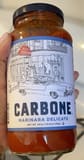 Marinara Delicato Carbone · 24 oz Not ultra-processed · No seed oils Score 100 out of 100 , 31 points higher
 -
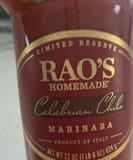 Calabrian Chili Marinara Rao's Homemade · 22 oz Not ultra-processed · No seed oils Score 100 out of 100 , 31 points higher
 -
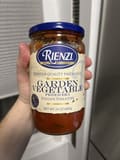 Garden Vegetable Pasta Sauce Rienzi · 24 oz Not ultra-processed · No xanthan gum Score 100 out of 100 , 31 points higher
The same kind of product, at least 10 points higher, sold in the US. Never paid placements.
The Receipt
Lemon & Herb Ricotta Pasta Sauce
Ingredients
- Canola oil minus 2.5 points
- Xanthan gum minus 2.5 points
Processing
- Ultra-processed (NOVA 4) minus 18 points
Nutrition per 100 g
- Saturated fat 4 g / 100 g minus 3 points
- Salt 1.2 g / 100 g minus 5 points
100 − 31 = 69
Nutrition per 100 g
| Energy | 97 kcal |
|---|---|
| Fat | 7.3 g |
| Saturated fat | 4 g |
| Carbohydrates | 4.8 g |
| Sugars | 1.6 g |
| Added sugars | 0 g |
| Protein | 3.2 g |
| Salt | 1.2 g |
Serving: 0.25 cup (62 g)
Ingredients
- ORGANIC VEGETABLE STOCK (WATER, ORGANIC VEGETABLE BROTH CONCENTRATE, SEA SALT, ORGANIC ONION POWDER)
- CREAM
- CULTURED BUTTERMILK (VITS A & D ADDED)
- RICOTTA CHEESE (PASTEURIZED WHOLE MILK, WHEY, VINEGAR, SALT)
- EXPELLER PRESSED CANOLA OIL
- RICE STARCH
- ROMANO CHEESE (PASTEURIZED MILK, CHEESE CULTURE, SALT, ENZYMES)
- GARLIC
- PARSLEY
- LEMON JUICE CONCENTRATE
- SEA SALT
- ONION POWDER
- XANTHAN GUM
- WHITE PEPPER
- LEMON OIL
Label text, as published
ORGANIC VEGETABLE STOCK (WATER, ORGANIC VEGETABLE BROTH CONCENTRATE [ORGANIC CARROT, ORGANIC CELERY, ORGANIC ONION], SEA SALT, ORGANIC ONION POWDER), CREAM, CULTURED BUTTERMILK (VITS A & D ADDED), RICOTTA CHEESE (PASTEURIZED WHOLE MILK, WHEY, VINEGAR, SALT), EXPELLER PRESSED CANOLA OIL, RICE STARCH, ROMANO CHEESE (PASTEURIZED MILK, CHEESE CULTURE, SALT, ENZYMES), GARLIC, PARSLEY, LEMON JUICE CONCENTRATE, SEA SALT, ONION POWDER, XANTHAN GUM, WHITE PEPPER, LEMON OIL.
Allergens and diets
Contains: Milk, Celery
- Not vegan
- Palm-oil-free
Always check the package: recipes change.
More pasta sauces on GoodSwap
-
 Traditional Prego · 45 oz Contains added sugarsContains seed oils Score 64 out of 100 Good
 -
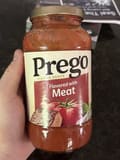 Flavored with Meat Italian Sauce Prego · 24 oz Ultra-processedContains added sugarsSeed-oil free Score 50 out of 100 Okay
 -
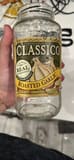 Roasted Garlic Pasta Sauce Classico · 24 oz Seed-oil free Score 87 out of 100 Excellent
 -
 AUTUMNAL HARVEST Creamy PASTA SAUCE Trader Joe's · 25 oz Contains added sugarsSeed-oil free Score 63 out of 100 Good
 -
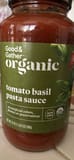 Organic Tomato Basil Pasta Sauce Good & Gather · 24 oz Contains added sugarsCertified organicSeed-oil free Score 71 out of 100 Good
 -
 Three Cheese Italian Sauce Prego · 24 oz Ultra-processedContains added sugarsContains emulsifiers studied for gut effectsContains seed oils Score 45 out of 100 Okay
Sources
-
“replacement of saturated fat in the diet with linoleic acid effectively lowers serum cholesterol but does not support the hypothesis that this translates to a lower risk of death from coronary heart disease or all causes.”
doi.org
-
“These data provide support for current recommendations to replace saturated fat with polyunsaturated fat for primary prevention of CHD.”
doi.org
-
Saturated fatty acid and trans-fatty acid intake for adults and children: WHO guideline
“WHO recommends that adults and children reduce saturated fatty acid intake to 10% of total energy intake (strong recommendation).”
who.int
-
“For adults, WHO recommends less than 2000 mg/day of sodium (equivalent to less than 5 g/day salt), or just under a teaspoon.”
who.int
-
“Greater exposure to ultra-processed food was associated with a higher risk of adverse health outcomes, especially cardiometabolic, common mental disorder, and mortality outcomes.”
doi.org