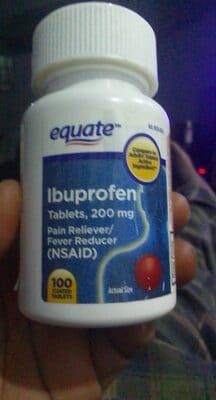
Non food products
Equate Ibuprofen
100 tablets
Score
- Not permitted in some countries
- Contains added sugars
- May contain traces of 1,4-dioxane
- No synthetic dyes
Why it scores 25
Equate Ibuprofen scores 25 out of 100 (Poor) under GoodSwap’s published rules. What moved the score most:
- minus 20 points Lactose: An added sugar. Strong
- minus 20 points Titanium dioxide: EFSA (2021) could not rule out genotoxicity and could not set a safe daily intake, so the EU removed E171 from the list of permitted food additives in 2022. Regulatory
- minus 18 points Ultra-processed (NOVA 4, estimated): No NOVA group on file; estimated from 7 kinds of ultra-processing markers. Strong
Capped at 25: Contains titanium dioxide, which is banned in food in the EU.
Every line of the math is on The Receipt below, with its evidence tier and sources.
The Receipt
Ibuprofen
Ingredients
- Lactose minus 20 points
- Titanium dioxide minus 20 points
- Carnauba wax minus 2.5 points
- Silicon dioxide minus 1.5 points
- Hydroxypropyl methylcellulose minus 1.5 points
- Microcrystalline cellulose minus 1.5 points
- Soluble corn fiber (resistant dextrin) minus 0.5 points
- Polyethylene glycols (PEG) and ethoxylates minus 0.5 points
- Iron oxides minus 0.5 points
Processing
- Ultra-processed (NOVA 4, estimated) minus 18 points
- 7 kinds of ultra-processing markers minus 8 points
Nutrition
- Nutrition facts unavailable no points
100 − 74.5 = 25.5 → 26 → capped at 25
Capped at 25. Contains titanium dioxide, which is banned in food in the EU. [4]
Can’t score above 79. Contains lactose, an ingredient of high concern. [1][2][3][4][5][6][7][8][9][10]
Can’t score above 79. No nutrition facts on file, so we can't confirm excellent.
Ingredients
- inactive ingredients carnauba wax
- colloidal silicon dioxide
- corn starch
- hypromellose
- lactose anhydrous (high concern)
- magnecium stearate (not recognized)
- microcrystalline cellulose
- polydextrose
- polyethylene glycol
- red iron oxide
- sodium starch glycolate
- stearic acid
- titanium dioxide (high concern)
Label text, as published
inactive ingredients carnauba wax, colloidal silicon dioxide, corn starch, hypromellose, lactose anhydrous, magnecium stearate, microcrystalline cellulose, polydextrose, polyethylene glycol, red iron oxide, sodium starch glycolate, stearic acid, titanium dioxide
Allergens and diets
Contains: Milk
- Not vegan
Always check the package: recipes change.
More from Equate
Sources
-
Guideline: sugars intake for adults and children
“In both adults and children, WHO recommends reducing the intake of free sugars to less than 10% of total energy intake”
who.int
-
Dietary Guidelines for Americans, 2025–2030
“Limit foods and beverages that include artificial flavors, petroleum-based dyes, artificial preservatives, and low-calorie non-nutritive sweeteners.”
cdn.realfood.gov
-
Added and free sugars should be as low as possible
“Sugar consumption is a known cause of dental caries.”
efsa.europa.eu
-
“titanium dioxide (E 171) can no longer be considered safe when used as a food additive.”
eur-lex.europa.eu
-
Titanium dioxide: E171 no longer considered safe when used as a food additive
“the Panel concluded that titanium dioxide can no longer be considered safe as a food additive.”
efsa.europa.eu
-
“Considering the very low oral absorption of INS 171, and in the absence of any identifiable hazard associated with INS 171 in the diet, the Committee reaffirmed the ADI “not specified” established at the Thirteenth meeting.”
who.int
-
Titanium dioxide (TiO2) as a food additive: Current science report
“In summary, the Food Directorate's position is that there is no conclusive scientific evidence that the food additive TiO2 is a concern for human health.”
canada.ca
-
Statement on the safety of Titanium Dioxide (E171) as a Food Additive (COT/2024/05)
“The Committee concludes that it is unlikely that there would be a risk to health from exposures of E171 TiO2 from the diet in any of the age groups or scenarios assessed.”
cot.food.gov.uk
-
Titanium Dioxide as a Color Additive in Foods
“Other international regulatory bodies including the United Kingdom’s Food Standards Agency (FSA), Health Canada, and Food Standards Australia New Zealand (FSANZ) have not agreed with EFSA’s assessment.”
fda.gov
-
Agents Classified by the IARC Monographs, Volumes 1–142 (List of Classifications)
monographs.iarc.who.int
-
1,4-Dioxane in Cosmetics: A Manufacturing Byproduct
“1,4-dioxane forms as a byproduct during the manufacturing process of certain cosmetic ingredients.”
fda.gov
-
Revocation of Authorization for Use of Brominated Vegetable Oil in Food (89 FR 55040)
“This action is being taken because there is no longer a reasonable certainty of no harm from the continued use of BVO in food.”
federalregister.gov
-
“This order is effective January 15, 2027, except for amendatory instruction 4, which is effective January 18, 2028.”
federalregister.gov
-
Regulation (EC) No 1223/2009 of 30 November 2009 on cosmetic products
“cosmetic products shall not contain any of the following: (a) prohibited substances — prohibited substances listed in Annex II”
eur-lex.europa.eu