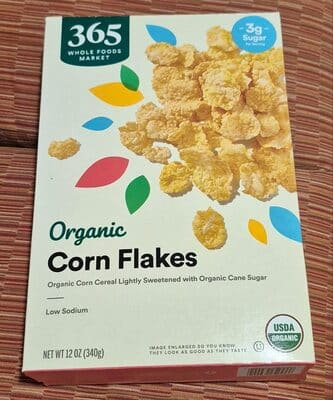
Corn flakes
365 Everyday Value Organic Corn Flakes
340 g
Score
- Contains added sugars
- Certified organic
- No additives
Why it scores 72
365 Everyday Value Organic Corn Flakes scores 72 out of 100 (Good) under GoodSwap’s published rules. What moved the score most:
- minus 20 points Sugar: An added sugar. Strong
- minus 8 points Processed (NOVA 3): Classified NOVA 3: processed with added salt, sugar or oil. Emerging
- plus 5 points Certified organic: Carries a certified-organic label. Info
Every line of the math is on The Receipt below, with its evidence tier and sources.
Better breakfast cereals
-
 Organic Corn Flakes The Real Cereal Co. · 240.0 g No added sugars · No sugar Score 97 out of 100 , 25 points higher
 -
 Oat Flakes, Organic Eden · 16 oz No added sugars · No sugar Score 100 out of 100 , 28 points higher
 -
 Quinoa Flakes Ancient Harvest · 12 oz No added sugars · No sugar Score 100 out of 100 , 28 points higher
 -
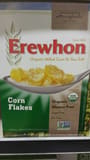 Corn Flakes Erewhon · 9 servings No added sugars · No sugar Score 99 out of 100 , 27 points higher
 -
 Organic Bare Multigrain Cereal With Flax Betteroats · 11.8 oz No added sugars · No sugar Score 100 out of 100 , 28 points higher
The same kind of product, at least 10 points higher, sold in the US. Never paid placements.
The Receipt
Organic Corn Flakes
Ingredients
- Sugar minus 20 points
Processing
- Processed (NOVA 3) minus 8 points
Nutrition per 100 g
- Sugars 7.7 g / 100 g minus 3 points
- Salt 0.7 g / 100 g minus 3 points
- Energy 385 kcal / 100 g minus 2 points
Bonuses
- Certified organic plus 5 points
- No additives plus 3 points
100 − 28 = 72
Can’t score above 79. Contains sugar, an ingredient of high concern. [1][2][3]
Nutrition per 100 g
| Energy | 385 kcal |
|---|---|
| Fat | 0 g |
| Saturated fat | 0 g |
| Trans fat | 0 g |
| Carbohydrates | 87.2 g |
| Sugars | 7.7 g |
| Added sugars | 7.7 g |
| Fiber | 2.6 g |
| Protein | 7.7 g |
| Salt | 0.7 g |
Serving: 39 g
Ingredients
Label text, as published
ORGANIC MILLED CORN, ORGANIC CANE SUGAR, SEA SALT.
Allergens and diets
- Vegan
- Vegetarian
- Gluten-free
- Palm-oil-free
Always check the package: recipes change.
Packaging
Cardboard
Context only: no points in v1.
More corn flakes on GoodSwap
-
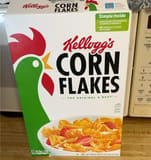 Corn Flakes Kellogg's · 272 g Ultra-processedHigh in saltContains added sugarsNo additives Score 30 out of 100 Poor
 -
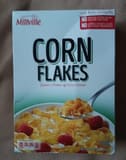 Corn Flakes Millville · 18 oz Contains added sugars Score 40 out of 100 Okay
 -
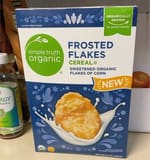 Frosted Flakes cereal Simple Truth · 15 oz High in sugarContains added sugarsNo additives Score 55 out of 100 Okay
 -
 Fruit Juice Corn Flakes Cereal Nature's Path · 750 g Ultra-processedContains added sugarsCertified organicNo additives Score 60 out of 100 Good
 -
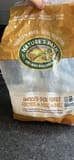 Honey'D Corn Flakes Nature's Path · 750 g Contains added sugarsCertified organicNo additives Score 50 out of 100 Okay
 -
 Frosted Flakes Kellogg's · 34 g Ultra-processedHigh in sugarContains added sugarsNo additives Score 21 out of 100 Poor
More from 365 Everyday Value
-
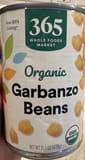 Organic garbanzo beans 365 Everyday Value · 15.5 oz/439 g Score 100 out of 100 Excellent
 -
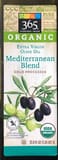 365 Everyday Value, 100% Mediterranean Blend Extra Virgin Olive Oil 365 Everyday Value · 33.8 fl oz/1.05 qt/1 L Score 100 out of 100 Excellent
 - Organic Tofu Firm 365 Everyday Value Score 100 out of 100 Excellent
- Crushed tomatoes with basil 365 Everyday Value · 28 oz/794 g Score 91 out of 100 Excellent
Sources
-
Guideline: sugars intake for adults and children
“In both adults and children, WHO recommends reducing the intake of free sugars to less than 10% of total energy intake”
who.int
-
Dietary Guidelines for Americans, 2025–2030
“Limit foods and beverages that include artificial flavors, petroleum-based dyes, artificial preservatives, and low-calorie non-nutritive sweeteners.”
cdn.realfood.gov
-
Added and free sugars should be as low as possible
“Sugar consumption is a known cause of dental caries.”
efsa.europa.eu
-
“For adults, WHO recommends less than 2000 mg/day of sodium (equivalent to less than 5 g/day salt), or just under a teaspoon.”
who.int
-
7 CFR 205.102 Use of the term "organic" (National Organic Program)
“Any agricultural product that is sold, labeled, or represented as “100 percent organic,” “organic,” or “made with organic (specified ingredients or food group(s))” must be: (a) Produced in accordance with the requirements specified in § 205.101 or §§ 205.202 through 205.207”
ecfr.gov