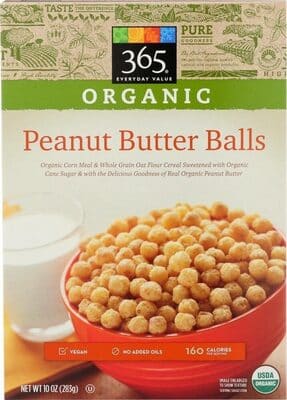
Cereals and their products
365 Peanut Butter Balls
10 oz
Score
- High in sugar
- High in salt
- Contains added sugars
- Certified organic
- Contains whole grains
Why it scores 51
365 Peanut Butter Balls scores 51 out of 100 (Okay) under GoodSwap’s published rules. What moved the score most:
- minus 20 points Sugar: An added sugar. Strong
- minus 11 points Sugars 26.3 g / 100 g: Very high in sugar. Strong
- minus 8 points Processed (NOVA 3): Classified NOVA 3: processed with added salt, sugar or oil. Emerging
Every line of the math is on The Receipt below, with its evidence tier and sources.
The Receipt
Peanut Butter Balls
Ingredients
- Sugar minus 20 points
Processing
- Processed (NOVA 3) minus 8 points
Nutrition per 100 g
- Sugars 26.3 g / 100 g minus 11 points
- Saturated fat 1.3 g / 100 g minus 1 points
- Salt 2 g / 100 g minus 7 points
- Energy 395 kcal / 100 g minus 2 points
100 − 49 = 51
Can’t score above 79. Contains sugar, an ingredient of high concern. [1][2][3]
Can’t score above 79. High in sugars and salt (above the front-of-pack "high" level). [7]
Nutrition per 100 g
| Energy | 395 kcal |
|---|---|
| Fat | 7.9 g |
| Saturated fat | 1.3 g |
| Trans fat | 0 g |
| Carbohydrates | 79 g |
| Sugars | 26.3 g |
| Added sugars | 26.3 g |
| Fiber | 2.6 g |
| Protein | 7.9 g |
| Salt | 2 g |
Serving: 1.0 % cup (38.0 g)
Ingredients
- ORGANIC CORN FLOUR
- ORGANIC CANE SUGAR (high concern)
- ORGANIC PEANUT BUTTER (ORGANIC DRY ROASTED PEANUTS, SALT)
- ORGANIC WHOLE GRAIN OAT FLOUR
- ORGANIC RICE FLOUR
- SEA SALT
- CALCIUM CARBONATE
- BAKING SODA (SODIUM BICARBONATE)
- MIXED TOCOPHEROLS (ADDED TO MAINTAIN FRESHNESS)
Label text, as published
ORGANIC CORN FLOUR, ORGANIC CANE SUGAR, ORGANIC PEANUT BUTTER (ORGANIC DRY ROASTED PEANUTS, SALT), ORGANIC WHOLE GRAIN OAT FLOUR, ORGANIC RICE FLOUR, SEA SALT, CALCIUM CARBONATE, BAKING SODA (SODIUM BICARBONATE), MIXED TOCOPHEROLS (ADDED TO MAINTAIN FRESHNESS).
Allergens and diets
Contains: Peanuts, Gluten
- Vegan
- Vegetarian
- Not gluten-free
- Palm-oil-free
Always check the package: recipes change.
More cereals and their products on GoodSwap
-
 healthy grains granola Dark Chocolate Kind · 11 oz Ultra-processedContains added sugarsContains seed oilsContains whole grains Score 23 out of 100 Poor
 -
 Original Shell Pasta & Cheese Sauce Velveeta · 12 oz (340 g) Ultra-processedHigh in saltContains seed oilsNo synthetic dyes Score 56 out of 100 Okay
 -
 healthy grains granola Peanut Butter Kind · 11 oz Contains added sugarsSeed-oil freeContains whole grains Score 48 out of 100 Okay
 -
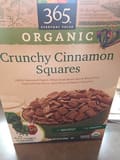 Organic Crunchy Cinnamon Squares 365 Whole Foods Market · 10 oz/283 g High in sugarContains added sugarsCertified organicContains whole grains Score 57 out of 100 Okay
 -
 Butternut squash and caramelized onions ravioli Rana · 32 oz/2 lb/0.91 kg Ultra-processedContains added sugarsSeed-oil free Score 46 out of 100 Okay
 - Kind, 100% healthy whole grains, dark chocolate & cranberry clusters Kind · 10 oz/312 g Ultra-processedHigh in sugarContains added sugarsContains seed oils Score 21 out of 100 Poor
More from 365
Sources
-
Guideline: sugars intake for adults and children
“In both adults and children, WHO recommends reducing the intake of free sugars to less than 10% of total energy intake”
who.int
-
Dietary Guidelines for Americans, 2025–2030
“Limit foods and beverages that include artificial flavors, petroleum-based dyes, artificial preservatives, and low-calorie non-nutritive sweeteners.”
cdn.realfood.gov
-
Added and free sugars should be as low as possible
“Sugar consumption is a known cause of dental caries.”
efsa.europa.eu
-
Saturated fatty acid and trans-fatty acid intake for adults and children: WHO guideline
“WHO recommends that adults and children reduce saturated fatty acid intake to 10% of total energy intake (strong recommendation).”
who.int
-
“For adults, WHO recommends less than 2000 mg/day of sodium (equivalent to less than 5 g/day salt), or just under a teaspoon.”
who.int
-
“Table 3: Criteria for drinks (per 100ml)”
assets.publishing.service.gov.uk