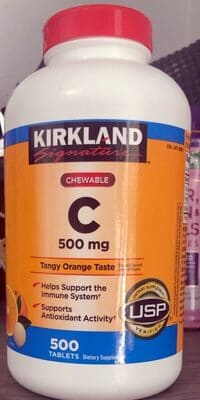
Products without gluten
Kirkland Signature Chewable C Tangy Orange Taste
500 tablets
Score
- Contains non-nutritive sweeteners
- Contains added sugars
- Contains sugar alcohols
- No synthetic dyes
- Third-party tested supplement
Why it scores 89
Kirkland Signature Chewable C Tangy Orange Taste scores 89 out of 100 (Excellent) under GoodSwap’s published rules. What moved the score most:
- minus 12 points Lactose: An added sugar. Strong
- plus 8 points Third-party certified: Independently tested and certified by a third party. Info
- minus 5 points Sucralose: In a 2022 randomized study, sucralose and saccharin altered the gut microbiome and impaired glucose responses in some people; a 2023 lab study raised questions about its by-product sucralose-6-acetate. Strong
Every line of the math is on The Receipt below, with its evidence tier and sources.
The Receipt
Chewable C Tangy Orange Taste
Ingredients
- Lactose minus 12 points
- Sucralose minus 5 points
- Sorbitol minus 1 points
- Natural flavors minus 0.5 points
- Silicon dioxide minus 0.5 points
- Maltodextrin minus 0.5 points
Bonuses
- Third-party certified plus 8 points
100 − 11.5 = 88.5 → 89
Ingredients
- Sorbitol
- Sodium Ascorbate
- Ascorbic Acid
- Corn Starch
- Magnesium Stearate
- Natural Orange Flavor
- Silicon Dioxide
- Sucralose (moderate concern)
- Orange Juice Powder
- Maltodextrin
- Lactose (high concern)
- Annatto Extract (color)
- Potassium Hydroxide
Label text, as published
Sorbitol, Sodium Ascorbate, Ascorbic Acid, Corn Starch, Magnesium Stearate, Natural Orange Flavor, Silicon Dioxide, Sucralose, Orange Juice Powder, Maltodextrin, Lactose, Annatto Extract (color), Potassium Hydroxide.
Allergens and diets
Contains: Milk
- Not vegan
- Palm-oil-free
Always check the package: recipes change.
Packaging
Plastic
Context only: no points in v1.
More products without gluten on GoodSwap
-
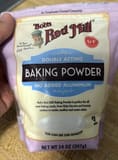 Baking Powder Bob's Red Mill · 14 oz (397 g) Ultra-processedHigh in salt Score 68 out of 100 Good
 -
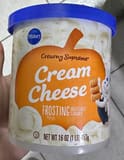 Cream Cheese Frosting Creamy Supreme · 16 oz (1 lb) 453 g Dye with an EU warning labelContains synthetic dyesUltra-processedHigh in sugar Score 1 out of 100 Bad
 -
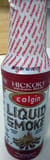 Hickory Liquid Smoke Colgin · 4 fl oz / 118 mL Ultra-processedContains added sugarsNo synthetic dyes Score 37 out of 100 Poor
 -
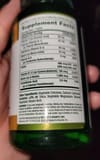 B Complex Nature's Bounty · 125 tablets Score 99 out of 100 Excellent
 -
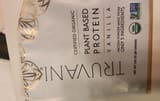 Plant Based Protein Vanilla Truvani Ultra-processedHigh in saltContains non-nutritive sweetenersCertified organic Score 65 out of 100 Good
More from Kirkland Signature
-
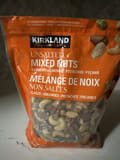 Unsalted Mixed Nuts Kirkland Signature · 1.13 kg Score 100 out of 100 Excellent
 -
 Purified Drinking Water Kirkland Signature · 500 mL Score 100 out of 100 Excellent
 -
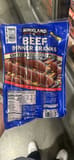 Beef dinner franks Kirkland Signature · 61 oz Score 27 out of 100 Poor
 -
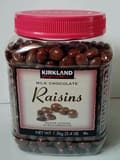 Milk Chocolate Raisins Kirkland Signature · 1.5 kg (3.4 lb) Score 1 out of 100 Bad
Sources
-
Guideline: sugars intake for adults and children
“In both adults and children, WHO recommends reducing the intake of free sugars to less than 10% of total energy intake”
who.int
-
Dietary Guidelines for Americans, 2025–2030
“Limit foods and beverages that include artificial flavors, petroleum-based dyes, artificial preservatives, and low-calorie non-nutritive sweeteners.”
cdn.realfood.gov
-
Added and free sugars should be as low as possible
“Sugar consumption is a known cause of dental caries.”
efsa.europa.eu
-
Personalized microbiome-driven effects of non-nutritive sweeteners on human glucose tolerance
“As groups, each administered NNS distinctly altered stool and oral microbiome and plasma metabolome, whereas saccharin and sucralose significantly impaired glycemic responses.”
doi.org
-
“Sucralose-6-acetate significantly increased the expression of genes associated with inflammation, oxidative stress, and cancer”
doi.org
-
“EFSA’s experts concluded that the sweetener sucralose (E 955) continues to be safe for consumers for its currently authorised uses as a food additive.”
efsa.europa.eu
-
WHO advises not to use non-sugar sweeteners for weight control in newly released guideline
“The recommendation is based on the findings of a systematic review of the available evidence which suggests that use of NSS does not confer any long-term benefit in reducing body fat in adults or children.”
who.int
-
Regulation (EU) No 1169/2011, Annex III point 2.4 (foods with more than 10 % added polyols)
“‘excessive consumption may produce laxative effects’.”
eur-lex.europa.eu
-
21 CFR 101.22 Foods; labeling of spices, flavorings, colorings and chemical preservatives
“whose significant function in food is flavoring rather than nutritional.”
ecfr.gov
-
“The Certified for Sport® certification is the only independent third-party certification program recognized by the United States Anti-Doping Agency (USADA), Major League Baseball, the National Hockey League, and the Canadian Football League.”
nsfsport.com