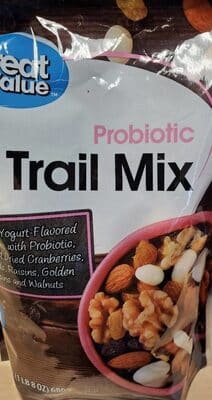
Nuts
Great Value Trail Mix
24 oz/680 g
Score
- Ultra-processed
- High in sugar
- High in saturated fat
- Contains added sugars
- Contains seed oils
Why it scores 28
Great Value Trail Mix scores 28 out of 100 (Poor) under GoodSwap’s published rules. What moved the score most:
- minus 20 points Sugar: An added sugar. Strong
- minus 18 points Ultra-processed (NOVA 4): Classified NOVA 4: made with industrial ingredients and additives. Strong
- minus 14 points Sugars 52.6 g / 100 g: Very high in sugar. Strong
Every line of the math is on The Receipt below, with its evidence tier and sources.
Better trail mix and snack mix
-
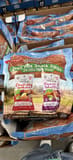 Trail Mix Snack Packs Nature's Garden Not ultra-processed · Less saturated fat Score 79 out of 100 , 51 points higher
 -
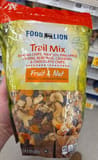 Trail mix Food Lion Not ultra-processed · No added sugars Score 78 out of 100 , 50 points higher
 -
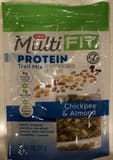 Protein Trail Mix: Chickpea & Almond H-E-B MultiFit · 255 g Not ultra-processed · Less sugar Score 79 out of 100 , 51 points higher
 -
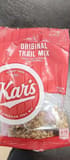 Original Trail Mix Kar's · 2.0 oz/57 g Not ultra-processed · Less saturated fat Score 78 out of 100 , 50 points higher
 -
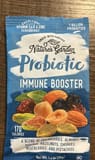 Probiotic Immune Booster Nature's Garden · 1.2 oz Not ultra-processed · Less saturated fat Score 70 out of 100 , 42 points higher
The same kind of product, at least 10 points higher, sold in the US. Never paid placements.
The Receipt
Trail Mix
Ingredients
- Sugar minus 20 points
- Sulfur dioxide minus 7.5 points
- Vegetable oil (unspecified) minus 2.5 points
- Natural flavors minus 1.5 points
- Soy lecithin minus 1.5 points
- Inulin (chicory root fiber) minus 1.5 points
- Sunflower oil minus 0.5 points
- Gum arabic (acacia) minus 0.5 points
- Shellac (confectioner's glaze) minus 0.5 points
Processing
- Ultra-processed (NOVA 4) minus 18 points
- 5 kinds of ultra-processing markers minus 6 points
Nutrition per 100 g
- Sugars 52.6 g / 100 g minus 14 points
- Fiber 5.3 g / 100 g plus 2 points
100 − 72 = 28
Can’t score above 79. Contains sugar, an ingredient of high concern. [1][2][3]
Can’t score above 79. High in sugars (above the front-of-pack "high" level). [13]
Nutrition per 100 g
| Energy | 447 kcal |
|---|---|
| Fat | 18.4 g |
| Saturated fat | 6.6 g |
| Trans fat | 0 g |
| Carbohydrates | 65.8 g |
| Sugars | 52.6 g |
| Added sugars | 34.2 g |
| Fiber | 5.3 g |
| Protein | 5.3 g |
| Salt | 0 g |
Serving: 0.25 cup (38 g)
Ingredients
- YOGURT-FLAVORED CRANBERRIES WITH PROBIOTIC (YOGURT-FLAVORED CONFECTIONERS COATING WITH PROBIOTIC, DRIED SWEETENED CRANBERRIES, GUM ACACIA, SUGAR, CONFECTIONER'S GLAZE)
- DRIED SWEETENED CRANBERRIES (CRANBERRIES, SUGAR, SUNFLOWER OIL)
- ALMONDS
- DARK RAISINS (RAISINS, SUNFLOWER OIL)
- GOLDEN RAISINS (RAISINS, SUNFLOWER OIL, SULFUR DIOXIDE (TO PRESERVE COLOR])
- WALNUTS
Label text, as published
INGREDIENTS: YOGURT-FLAVORED CRANBERRIES WITH PROBIOTIC (YOGURT-FLAVORED CONFECTIONERS COATING WITH PROBIOTIC [SUGAR, VEGETABLE OIL {PALM KERNEL AND PALM}, NONFAT MILK, GREEK YOGURT POWDER {NONFAT MILK, CULTURE, LACTIC ACID, NATURAL FLAVOR}, LACTIC ACID, SOY LECITHIN, NATURAL FLAVOR, INULIN, BACILLUS COAGULANS GBI-30 6086], DRIED SWEETENED CRANBERRIES [CRANBERRIES, SUGAR, SUNFLOWER OIL], GUM ACACIA, SUGAR, CONFECTIONER'S GLAZE), DRIED SWEETENED CRANBERRIES (CRANBERRIES, SUGAR, SUNFLOWER OIL), ALMONDS, DARK RAISINS (RAISINS, SUNFLOWER OIL), GOLDEN RAISINS (RAISINS, SUNFLOWER OIL, SULFUR DIOXIDE (TO PRESERVE COLOR]), WALNUTS.
Allergens and diets
Contains: Milk, Tree nuts, Soy, Sulphites
- Not vegan
- Not palm-oil-free
Always check the package: recipes change.
More nuts on GoodSwap
-
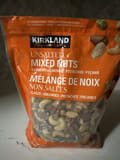 Unsalted Mixed Nuts Kirkland Signature · 1.13 kg High in saturated fatNo additivesSeed-oil free Score 100 out of 100 Excellent
 -
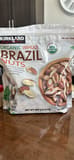 Organic Whole Brazil Nuts Kirkland Signature · 680 g, 1.5 lb High in saturated fatCertified organicNo additives Score 100 out of 100 Excellent
 -
 Trail Mix Great Value · 22 oz Contains added sugarsContains seed oilsNo additives Score 60 out of 100 Good
 -
 Roasted unsalted pistachios Simple Truth · 226 g No additives Score 100 out of 100 Excellent
 -
 Organic roasted chestnuts Gefen · 150 g Certified organicNo additives Score 100 out of 100 Excellent
 -
 Mixed Nuts PLANTERS Deluxe · 15.25 oz/432 g High in saturated fatNo additivesSeed-oil free Score 97 out of 100 Excellent
More from Great Value
-
 Purified Drinking Water Great Value · 16.9 fl oz (500 mL) Score 100 out of 100 Excellent
 -
 Greek Plain Great Value · 907 g Score 100 out of 100 Excellent
 -
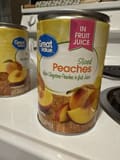 Sliced Peaches Great Value · 15 oz/425 g Score 77 out of 100 Good
 -
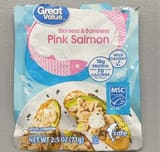 Skinless & Boneless Pink Salmon Great Value · 2.5 oz/71 g Score 100 out of 100 Excellent
Sources
-
Guideline: sugars intake for adults and children
“In both adults and children, WHO recommends reducing the intake of free sugars to less than 10% of total energy intake”
who.int
-
Dietary Guidelines for Americans, 2025–2030
“Limit foods and beverages that include artificial flavors, petroleum-based dyes, artificial preservatives, and low-calorie non-nutritive sweeteners.”
cdn.realfood.gov
-
Added and free sugars should be as low as possible
“Sugar consumption is a known cause of dental caries.”
efsa.europa.eu
-
Regulation (EU) No 1169/2011 of 25 October 2011 on the provision of food information to consumers
“ANNEX II SUBSTANCES OR PRODUCTS CAUSING ALLERGIES OR INTOLERANCES 1. Cereals containing gluten, namely: wheat, rye, barley, oats, spelt, kamut or their hybridised strains”
eur-lex.europa.eu
-
“1. Cereals containing gluten, namely: wheat (such as spelt and khorasan wheat), rye, barley, oats or their hybridised strains, and products thereof”
legislation.gov.uk
-
“replacement of saturated fat in the diet with linoleic acid effectively lowers serum cholesterol but does not support the hypothesis that this translates to a lower risk of death from coronary heart disease or all causes.”
doi.org
-
“These data provide support for current recommendations to replace saturated fat with polyunsaturated fat for primary prevention of CHD.”
doi.org
-
21 CFR 101.22 Foods; labeling of spices, flavorings, colorings and chemical preservatives
“whose significant function in food is flavoring rather than nutritional.”
ecfr.gov
-
“Table 3: Criteria for drinks (per 100ml)”
assets.publishing.service.gov.uk
-
“Greater exposure to ultra-processed food was associated with a higher risk of adverse health outcomes, especially cardiometabolic, common mental disorder, and mortality outcomes.”
doi.org
-
Saturated fatty acid and trans-fatty acid intake for adults and children: WHO guideline
“WHO recommends that adults and children reduce saturated fatty acid intake to 10% of total energy intake (strong recommendation).”
who.int