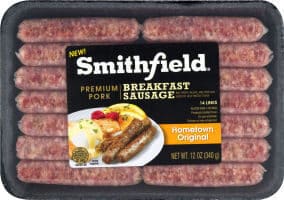
Pork sausages
Smithfield Breakfast Sausage Hometown Original
Score
- Ultra-processed
- High in salt
- High in saturated fat
- Contains added sugars
Why it scores 17
Smithfield Breakfast Sausage Hometown Original scores 17 out of 100 (Bad) under GoodSwap’s published rules. What moved the score most:
- minus 20 points Corn syrup solids: An added sugar. Strong
- minus 20 points Dextrose: An added sugar. Strong
- minus 18 points Ultra-processed (NOVA 4): Classified NOVA 4: made with industrial ingredients and additives. Strong
Every line of the math is on The Receipt below, with its evidence tier and sources.
Better sausages
-
 Breakfast Sausage Plant-Based Patties Original Beyond · 7.4 oz/210 g Less salt · No added sugars Score 61 out of 100 , 44 points higher
 -
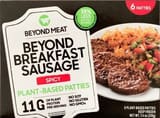 Beyond Breakfast Sausage Plant-Based Patties Spicy Beyond Meat · 7.4 oz Less salt · No added sugars Score 57 out of 100 , 40 points higher
 -
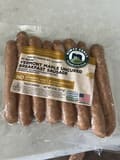 Vermont Maple Uncured Breakfast Sausage Niman Ranch · 8 oz Not ultra-processed · No corn syrup solids Score 57 out of 100 , 40 points higher
 -
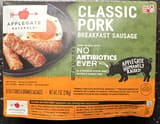 Classic Pork Breakfast Sausage Applegate Naturals · 59 g Not ultra-processed · No corn syrup solids Score 63 out of 100 , 46 points higher
 -
 Original breakfast sausage Giant Eagle · 16 oz/1 lb/453 g Not ultra-processed · No added sugars Score 79 out of 100 , 62 points higher
The same kind of product, at least 10 points higher, sold in the US. Never paid placements.
The Receipt
Breakfast Sausage Hometown Original
Ingredients
- Corn syrup solids minus 20 points
- Dextrose minus 20 points
- BHA (butylated hydroxyanisole) minus 10 points
Processing
- Ultra-processed (NOVA 4) minus 18 points
- 3 kinds of ultra-processing markers minus 3 points
Nutrition per 100 g
- Saturated fat 9.1 g / 100 g minus 7 points
- Salt 2 g / 100 g minus 7 points
- Energy 321 kcal / 100 g minus 2 points
- Protein 18.2 g / 100 g plus 4 points
100 − 83 = 17
Can’t score above 79. Contains corn syrup solids, an ingredient of high concern. [1][2][3][4][5][6][7][8]
Can’t score above 79. High in fat, saturated fat and salt (above the front-of-pack "high" level). [12]
Nutrition per 100 g
| Energy | 321 kcal |
|---|---|
| Fat | 25.5 g |
| Saturated fat | 9.1 g |
| Carbohydrates | 3.6 g |
| Sugars | 1.8 g |
| Protein | 18.2 g |
| Salt | 2 g |
Serving: 3 cooked links (55 g)
Ingredients
- pork
- corn syrup solids (high concern)
- salt
- dextrose (high concern)
- natural flavorings
- water
- vinegar
- potassium lactate
- bha (high concern)
- propyl gallate
- citric acid
- calcium alginate casing. t 130
Label text, as published
pork, corn syrup solids. less than 2% of the following: salt, dextrose, natural flavorings, water, vinegar, potassium lactate, bha, propyl gallate, citric acid, calcium alginate casing. t 130
Allergens and diets
- Not vegan
- Not vegetarian
- Palm-oil-free
Always check the package: recipes change.
More pork sausages on GoodSwap
More from Smithfield
Sources
-
Guideline: sugars intake for adults and children
“In both adults and children, WHO recommends reducing the intake of free sugars to less than 10% of total energy intake”
who.int
-
Dietary Guidelines for Americans, 2025–2030
“Limit foods and beverages that include artificial flavors, petroleum-based dyes, artificial preservatives, and low-calorie non-nutritive sweeteners.”
cdn.realfood.gov
-
Added and free sugars should be as low as possible
“Sugar consumption is a known cause of dental caries.”
efsa.europa.eu
-
Agents Classified by the IARC Monographs, Volumes 1–142 (List of Classifications)
monographs.iarc.who.int
-
Proposition 65 List of Chemicals Known to the State to Cause Cancer or Reproductive Toxicity
“The date refers to the initial appearance of the chemical on the list.”
oehha.ca.gov
-
Report on Carcinogens, 15th Edition: Butylated Hydroxyanisole
“Butylated hydroxyanisole (BHA) is reasonably anticipated to be a human carcinogen based on sufficient evidence of carcinogenicity from studies in experimental animals.”
ntp.niehs.nih.gov
-
List of Select Chemicals in the Food Supply Under FDA Review
“The table below includes select food ingredients (including food and color additives), food contact substances, and contaminants under FDA review as of May 12, 2026 .”
fda.gov
-
“The Panel concluded that exposure to BHA from its use as food additive based on new exposure estimates does not exceed the ADI of 1 mg/kg bw/day at the mean”
doi.org
-
Saturated fatty acid and trans-fatty acid intake for adults and children: WHO guideline
“WHO recommends that adults and children reduce saturated fatty acid intake to 10% of total energy intake (strong recommendation).”
who.int
-
“For adults, WHO recommends less than 2000 mg/day of sodium (equivalent to less than 5 g/day salt), or just under a teaspoon.”
who.int
-
“Table 3: Criteria for drinks (per 100ml)”
assets.publishing.service.gov.uk
-
“Greater exposure to ultra-processed food was associated with a higher risk of adverse health outcomes, especially cardiometabolic, common mental disorder, and mortality outcomes.”
doi.org