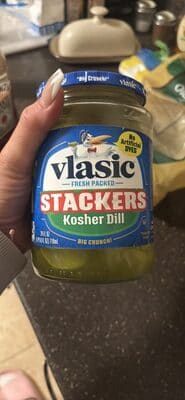
Vegetables based foods
Vlasic Stackers Kosher Dill
24 fl oz
Score
- Ultra-processed
- High in salt
- Contains emulsifiers studied for gut effects
- May contain traces of 1,4-dioxane
- No synthetic dyes
Why it scores 52
Vlasic Stackers Kosher Dill scores 52 out of 100 (Okay) under GoodSwap’s published rules. What moved the score most:
- minus 18 points Ultra-processed (NOVA 4): Classified NOVA 4: made with industrial ingredients and additives. Strong
- minus 7.5 points Sodium benzoate: Benzoates can form small amounts of benzene in drinks that also contain ascorbic acid (vitamin C), especially with heat or light. Strong
- minus 7.5 points Polysorbate 80: In mice, polysorbate 80 altered the gut microbiota and promoted low-grade inflammation and metabolic syndrome; human evidence is limited. Strong
Every line of the math is on The Receipt below, with its evidence tier and sources.
Better pickles
-
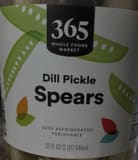 Dill Pickle Spears 365 Whole Foods · 946 mL Not ultra-processed · Less salt Score 99 out of 100 , 47 points higher
 -
 Kosher Dill Pickles Bubbies · 28 g Not ultra-processed · No gut-studied emulsifiers Score 79 out of 100 , 27 points higher
 -
 Deli Style Kosher Baby Dills Majestic Picklery · 24 fl oz/710 mL Not ultra-processed · No gut-studied emulsifiers Score 79 out of 100 , 27 points higher
 -
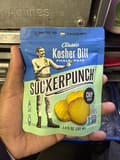 Classic Kosher Dill Pickle Pack Chip Cut Suckerpunch · 3.4 oz 101 mL Not ultra-processed · Less salt Score 85 out of 100 , 33 points higher
 -
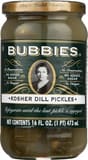 Baby Kosher Dill Pickles Bubbies · 28 g Not ultra-processed · No gut-studied emulsifiers Score 79 out of 100 , 27 points higher
The same kind of product, at least 10 points higher, sold in the US. Never paid placements.
The Receipt
Stackers Kosher Dill
Ingredients
- Sodium benzoate minus 7.5 points
- Polysorbate 80 minus 7.5 points
- Calcium chloride minus 2.5 points
- Natural flavors minus 1.5 points
Processing
- Ultra-processed (NOVA 4) minus 18 points
- 4 kinds of ultra-processing markers minus 4.5 points
Nutrition per 100 g
- Salt 1.9 g / 100 g minus 7 points
100 − 48.5 = 51.5 → 52
Can’t score above 79. High in salt (above the front-of-pack "high" level). [9]
Nutrition per 100 g
| Energy | 0 kcal |
|---|---|
| Fat | 0 g |
| Saturated fat | 0 g |
| Trans fat | 0 g |
| Carbohydrates | 3.6 g |
| Sugars | 0 g |
| Added sugars | 0 g |
| Fiber | 0 g |
| Protein | 0 g |
| Salt | 1.9 g |
Serving: 1 ONZ (28 g)
Recipe changed
- Synthetic dyes removed
Compared with an older list (Open Food Facts). The current list is from March 2026.
Ingredients
- Cucumbers
- Water
- Distilled Vinegar
- Salt
- Calcium Chloride
- Sodium Benzoate (Preservative) (moderate concern)
- Polysorbate 80 (moderate concern)
- Natural Flavor
- Turmeric Extract (Color)
Label text, as published
Cucumbers, Water, Distilled Vinegar, Less than 2% of: Salt, Calcium Chloride, Sodium Benzoate (Preservative), Polysorbate 80, Natural Flavor, Turmeric Extract (Color)
Allergens and diets
- Palm-oil-free
Always check the package: recipes change.
More vegetables based foods on GoodSwap
-
 Minced California Garlic Kirkland · 1.36 kg Score 100 out of 100 Excellent
 -
 Cream Cheese Spread Philadelphia · 16 oz Ultra-processedHigh in saturated fat Score 60 out of 100 Good
 -
 Minced Garlic Spice World · 8 oz Score 100 out of 100 Excellent
 -
 Mild Banana Pepper Rings Mezzetta Family Co. · 16 fl oz/473 mL Dye with an EU warning labelContains synthetic dyesUltra-processedHigh in salt Score 39 out of 100 Poor
 - Organic Garbanzo Beans Eden · 130 g Certified organicNo additives Score 100 out of 100 Excellent
-
 Minced Garlic Spice World · 32 oz Score 100 out of 100 Excellent
More from Vlasic
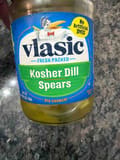
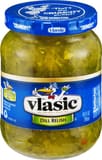
Sources
-
“Artificial colours or a sodium benzoate preservative (or both) in the diet result in increased hyperactivity in 3-year-old and 8/9-year-old children in the general population.”
doi.org
-
Re-evaluation of benzyl alcohol (E 1519) as food additive (records the 2016 benzoate re-evaluation)
“derived a group ADI of 5 mg/kg bw per day (expressed as benzoic acid) in accordance with the ADI previously derived by SCF and JECFA”
doi.org
-
Dietary emulsifiers impact the mouse gut microbiota promoting colitis and metabolic syndrome
“carboxymethylcellulose and polysorbate-80, induced low-grade inflammation and obesity/metabolic syndrome in wild-type hosts and promoted robust colitis in mice predisposed to this disorder.”
doi.org
-
Scientific Opinion on the re-evaluation of polysorbates (E 432–436) as food additives
“There is no concern regarding genotoxicity, carcinogenicity or developmental toxicity.”
doi.org
-
21 CFR 101.22 Foods; labeling of spices, flavorings, colorings and chemical preservatives
“whose significant function in food is flavoring rather than nutritional.”
ecfr.gov
-
“For adults, WHO recommends less than 2000 mg/day of sodium (equivalent to less than 5 g/day salt), or just under a teaspoon.”
who.int
-
“Table 3: Criteria for drinks (per 100ml)”
assets.publishing.service.gov.uk
-
“Greater exposure to ultra-processed food was associated with a higher risk of adverse health outcomes, especially cardiometabolic, common mental disorder, and mortality outcomes.”
doi.org
-
Dietary Guidelines for Americans, 2025–2030
“Limit foods and beverages that include artificial flavors, petroleum-based dyes, artificial preservatives, and low-calorie non-nutritive sweeteners.”
cdn.realfood.gov
-
“Relative to control subjects, CMC consumption modestly increased postprandial abdominal discomfort and perturbed gut microbiota composition in a way that reduced its diversity.”
doi.org
-
“This study found positive associations between risk of CVD and intake of five individual and two groups of food additive emulsifiers widely used in industrial foods.”
doi.org
-
1,4-Dioxane in Cosmetics: A Manufacturing Byproduct
“1,4-dioxane forms as a byproduct during the manufacturing process of certain cosmetic ingredients.”
fda.gov
-
Agents Classified by the IARC Monographs, Volumes 1–142 (List of Classifications)
monographs.iarc.who.int