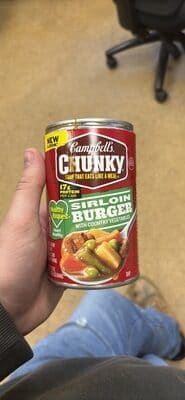
Soups
Campbell's Chunky Sirloin Burger with Country Vegetables
18.8 oz (1 lb 2.8 oz) 533 g
Score
- Ultra-processed
- No synthetic dyes
Why it scores 50
Campbell's Chunky Sirloin Burger with Country Vegetables scores 50 out of 100 (Okay) under GoodSwap’s published rules. What moved the score most:
- minus 20 points Caramel color: The FDA says classes III and IV, which can contain 4-MEI, are the most commonly used food color additives by volume. Regulatory
- minus 18 points Ultra-processed (NOVA 4): Classified NOVA 4: made with industrial ingredients and additives. Strong
- minus 4.5 points 4 kinds of ultra-processing markers: Industrial additive classes found: color (added), flavor enhancer, flavoring and modified starch. Emerging
Every line of the math is on The Receipt below, with its evidence tier and sources.
Better soups
-
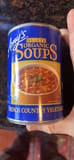 French Country Vegetable Amy's · 14.4 oz, 408 g Not ultra-processed · No caramel color Score 97 out of 100 , 47 points higher
 -
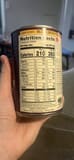 Black Bean Vegetable Amy's · 14.5 oz Not ultra-processed · No caramel color Score 94 out of 100 , 44 points higher
 -
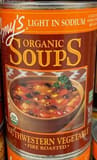 Southwestern Vegetable Soup Amy's Kitchen · 14.3 oz/405 g Not ultra-processed · No caramel color Score 99 out of 100 , 49 points higher
 -
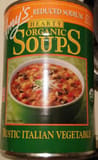 Hearty rustic italian vegetable soups Amy's Kitchen · 14 oz/397 g Not ultra-processed · No caramel color Score 94 out of 100 , 44 points higher
 -
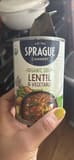 Organic Soup Lentil & Vegetable Sprague Cannery · 15 oz/425 g Not ultra-processed · No caramel color Score 100 out of 100 , 50 points higher
The same kind of product, at least 10 points higher, sold in the US. Never paid placements.
The Receipt
Sirloin Burger with Country Vegetables
Ingredients
- Caramel color minus 20 points
- Modified starch minus 2.5 points
- Yeast extract minus 2.5 points
- Natural flavors minus 1.5 points
Processing
- Ultra-processed (NOVA 4) minus 18 points
- 4 kinds of ultra-processing markers minus 4.5 points
Nutrition per 100 g
- Salt 0.4 g / 100 g minus 1 points
100 − 50 = 50
Can’t score above 79. Contains caramel color, an ingredient of high concern. [1][2][3][4]
Nutrition per 100 g
| Energy | 49 kcal |
|---|---|
| Fat | 0.8 g |
| Saturated fat | 0.4 g |
| Trans fat | 0 g |
| Carbohydrates | 7.4 g |
| Sugars | 1.2 g |
| Added sugars | 0 g |
| Fiber | 1.2 g |
| Protein | 3.3 g |
| Salt | 0.4 g |
Serving: 1 can (533 g)
Ingredients
- BEEF STOCK (WATER, DRIED BEEF STOCK)
- POTATOES
- CARROTS
- SEASONED BEEF SIRLOIN BURGERS WITH POTATOES AND ONIONS (SIRLOIN BEEF, POTATOES, POTATO EXTRACT, POTASSIUM SALT, RECONSTITUTED ONIONS, SALT, SPICE)
- TOMATO PUREE (WATER, TOMATO PASTE)
- GREEN BEANS
- PEAS
- MODIFIED CORNSTARCH
- WHEAT FLOUR
- YEAST EXTRACT
- SALT
- POTASSIUM SALT
- FLAVORING
- CARAMEL COLOR (high concern)
- LACTIC ACID
- SPICES
Label text, as published
INGREDIENTS: BEEF STOCK (WATER, DRIED BEEF STOCK), POTATOES, CARROTS, SEASONED BEEF SIRLOIN BURGERS WITH POTATOES AND ONIONS (SIRLOIN BEEF, POTATOES, POTATO EXTRACT, POTASSIUM SALT, RECONSTITUTED ONIONS, SALT, SPICE), TOMATO PUREE (WATER, TOMATO PASTE), GREEN BEANS, PEAS, CONTAINS LESS THAN 2% OF: MODIFIED CORNSTARCH, WHEAT FLOUR, YEAST EXTRACT, SALT, POTASSIUM SALT, FLAVORING, CARAMEL COLOR, LACTIC ACID, SPICES. CONTAINS: WHEAT
Allergens and diets
Contains: Wheat, Gluten
- Not vegan
- Not vegetarian
- Not gluten-free
- Palm-oil-free
Always check the package: recipes change.
Packaging
Paper, Aluminium
Context only: no points in v1.
More soups on GoodSwap
-
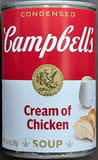 Cream of Chicken Soup Campbell's · 10.5 oz (298 g) Ultra-processedHigh in saltContains seed oilsNo synthetic dyes Score 55 out of 100 Okay
 -
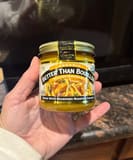 Organic roasted chicken base Better Than Bouillon · 8 oz Ultra-processedHigh in saltContains added sugarsCertified organic Score 35 out of 100 Poor
 -
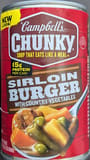 Sirloin Burger with Country Vegetables Soup Campbell's Chunky · 533 g Ultra-processedNo synthetic dyes Score 47 out of 100 Okay
 -
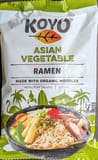 Asian Vegetable Ramen Made With Organic Noodles Koyo · 2.1 oz/60 g High in saltContains added sugarsCertified organicNo additives Score 65 out of 100 Good
 -
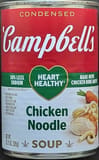 Condensed Soup, Chicken Noodle Campbell's · 3 Ultra-processedSeed-oil free Score 67 out of 100 Good
 -
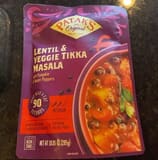 Lentil and veggie masala Patak's · 285gm Contains seed oilsNo additives Score 89 out of 100 Excellent
More from Campbell's Chunky
Sources
-
Questions & Answers About 4-MEI
“Based on current science, the FDA has no reason to believe that there are any immediate or short-term health risks presented by 4-MEI at the levels expected in food.”
fda.gov
-
Agents Classified by the IARC Monographs, Volumes 1–142 (List of Classifications)
monographs.iarc.who.int
-
Proposition 65 List of Chemicals Known to the State to Cause Cancer or Reproductive Toxicity
“The date refers to the initial appearance of the chemical on the list.”
oehha.ca.gov
-
21 CFR 101.22 Foods; labeling of spices, flavorings, colorings and chemical preservatives
“whose significant function in food is flavoring rather than nutritional.”
ecfr.gov
-
“For adults, WHO recommends less than 2000 mg/day of sodium (equivalent to less than 5 g/day salt), or just under a teaspoon.”
who.int
-
“Greater exposure to ultra-processed food was associated with a higher risk of adverse health outcomes, especially cardiometabolic, common mental disorder, and mortality outcomes.”
doi.org