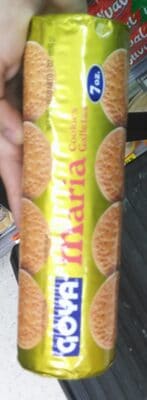
Cookies
Goya Maria Cookies
30 g
Score
- Ultra-processed
- Contains fragrance
- Contains added sugars
- Seed-oil free
Why it scores 8
Goya Maria Cookies scores 8 out of 100 (Bad) under GoodSwap’s published rules. What moved the score most:
- minus 20 points Sugar: An added sugar. Strong
- minus 20 points Corn syrup: An added sugar. Strong
- minus 18 points Ultra-processed (NOVA 4): Classified NOVA 4: made with industrial ingredients and additives. Strong
Every line of the math is on The Receipt below, with its evidence tier and sources.
Better cookies
-
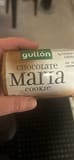 Chocolate Maria Cookie Gullón No fragrance · No sodium bisulfite Score 29 out of 100 , 21 points higher
 -
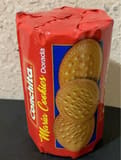 Maria Cookies Dorada Conchita · 3.53 oz Not ultra-processed · No fragrance Score 28 out of 100 , 20 points higher
The same kind of product, at least 10 points higher, sold in the US. Never paid placements.
The Receipt
Maria Cookies
Ingredients
- Sugar minus 20 points
- Corn syrup minus 20 points
- Fragrance (parfum) minus 7.5 points
- Sodium bisulfite minus 2.5 points
Processing
- Ultra-processed (NOVA 4) minus 18 points
- 3 kinds of ultra-processing markers minus 3 points
Nutrition per 100 g
- Sugars 20 g / 100 g minus 11 points
- Saturated fat 5 g / 100 g minus 5 points
- Salt 0.8 g / 100 g minus 3 points
- Energy 433 kcal / 100 g minus 2 points
100 − 92 = 8
Can’t score above 79. Contains sugar, an ingredient of high concern. [1][2][3]
Nutrition per 100 g
| Energy | 433 kcal |
|---|---|
| Fat | 10 g |
| Saturated fat | 5 g |
| Trans fat | 0 g |
| Carbohydrates | 80 g |
| Sugars | 20 g |
| Added sugars | 25 g |
| Fiber | 0 g |
| Protein | 6.7 g |
| Salt | 0.8 g |
Serving: 6 cookies (32 g)
Ingredients
- WHEAT FLOUR
- SUGAR (high concern)
- VEGETABLE FAT
- GLUCOSE SYRUP (high concern)
- SALT
- GASIFIERS (SODIUM BICARBONATE AND AMMONIA BICARBONATE) (not recognized)
- EMULSIFIER (SOYA LECITHIN) (not recognized)
- POWDERED WHEY
- SCENTS (moderate concern)
- ANTIOXIDANTS (SODIUM BISULPHITE AND NATURAL TOCOPHEROL EXTRACTS) (not recognized)
Label text, as published
WHEAT FLOUR, SUGAR, VEGETABLE FAT, GLUCOSE SYRUP, SALT, GASIFIERS (SODIUM BICARBONATE AND AMMONIA BICARBONATE), EMULSIFIER (SOYA LECITHIN), POWDERED WHEY, SCENTS, ANTIOXIDANTS (SODIUM BISULPHITE AND NATURAL TOCOPHEROL EXTRACTS).
Allergens and diets
Contains: Milk, Soy, Wheat, Gluten, Sulphites
- Not vegan
- Not gluten-free
Always check the package: recipes change.
More cookies on GoodSwap
-
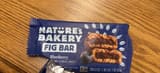 Fig Bar Blueberry Nature's Bakery · 2 oz Ultra-processedHigh in sugarContains added sugarsContains seed oils Score 14 out of 100 Bad
 -
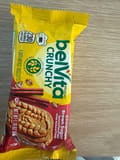 Crunchy Breakfast Biscuits Belvita · 1.76 oz Ultra-processedContains added sugarsContains emulsifiers studied for gut effectsContains seed oils Score 15 out of 100 Bad
 -
 belVita Crunchy Blueberry Breakfast Biscuits Belvita · 1.76 oz Ultra-processedHigh in sugarContains added sugarsContains emulsifiers studied for gut effects Score 15 out of 100 Bad
 -
 Toast Chee Peanut Butter Sandwich Crackers Lance · 15.1 oz Dye with an EU warning labelContains synthetic dyesUltra-processedHigh in salt Score 11 out of 100 Bad
 -
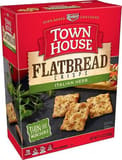 Keebler town house flatbread crisps crackers italian herb Town House · 9.5 oz Ultra-processedHigh in saltContains added sugarsContains seed oils Score 37 out of 100 Poor
 -
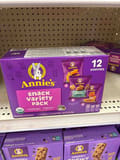 Snack Variety Pack Annie's · 11 oz Ultra-processedHigh in saltContains added sugarsContains seed oils Score 21 out of 100 Poor
More from Goya
Sources
-
Guideline: sugars intake for adults and children
“In both adults and children, WHO recommends reducing the intake of free sugars to less than 10% of total energy intake”
who.int
-
Dietary Guidelines for Americans, 2025–2030
“Limit foods and beverages that include artificial flavors, petroleum-based dyes, artificial preservatives, and low-calorie non-nutritive sweeteners.”
cdn.realfood.gov
-
Added and free sugars should be as low as possible
“Sugar consumption is a known cause of dental caries.”
efsa.europa.eu
-
“when their concentration exceeds 0,001 % in leave-on products and 0,01 % in rinse-off products.”
eur-lex.europa.eu
-
Regulation (EC) No 1223/2009 of 30 November 2009 on cosmetic products
“cosmetic products shall not contain any of the following: (a) prohibited substances — prohibited substances listed in Annex II”
eur-lex.europa.eu
-
fda.gov
-
Regulation (EU) No 1169/2011 of 25 October 2011 on the provision of food information to consumers
“ANNEX II SUBSTANCES OR PRODUCTS CAUSING ALLERGIES OR INTOLERANCES 1. Cereals containing gluten, namely: wheat, rye, barley, oats, spelt, kamut or their hybridised strains”
eur-lex.europa.eu
-
“1. Cereals containing gluten, namely: wheat (such as spelt and khorasan wheat), rye, barley, oats or their hybridised strains, and products thereof”
legislation.gov.uk
-
Saturated fatty acid and trans-fatty acid intake for adults and children: WHO guideline
“WHO recommends that adults and children reduce saturated fatty acid intake to 10% of total energy intake (strong recommendation).”
who.int
-
“For adults, WHO recommends less than 2000 mg/day of sodium (equivalent to less than 5 g/day salt), or just under a teaspoon.”
who.int
-
“Greater exposure to ultra-processed food was associated with a higher risk of adverse health outcomes, especially cardiometabolic, common mental disorder, and mortality outcomes.”
doi.org