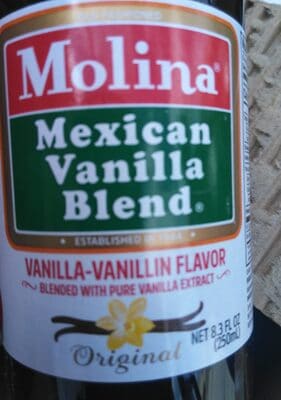
Condiments
Molina Mexican Vanilla Blend
8.3 fl oz/250 mL
Score
- Ultra-processed
- Contains artificial flavors
- No synthetic dyes
Why it scores 51
Molina Mexican Vanilla Blend scores 51 out of 100 (Okay) under GoodSwap’s published rules. What moved the score most:
- minus 20 points Caramel color: The FDA says classes III and IV, which can contain 4-MEI, are the most commonly used food color additives by volume. Regulatory
- minus 18 points Ultra-processed (NOVA 4): Classified NOVA 4: made with industrial ingredients and additives. Strong
- minus 3 points 3 kinds of ultra-processing markers: Industrial additive classes found: color (added), flavoring and humectant. Emerging
Every line of the math is on The Receipt below, with its evidence tier and sources.
The Receipt
Mexican Vanilla Blend
Ingredients
- Caramel color minus 20 points
- Alcohol (ethanol) minus 2.5 points
- Propylene glycol minus 2.5 points
- Artificial flavors minus 1.5 points
- Potassium sorbate minus 1.5 points
Processing
- Ultra-processed (NOVA 4) minus 18 points
- 3 kinds of ultra-processing markers minus 3 points
100 − 49 = 51
Can’t score above 79. Contains caramel color, an ingredient of high concern. [1][2][3][4]
Nutrition per 100 g
| Energy | 0 kcal |
|---|---|
| Fat | 0 g |
| Saturated fat | 0 g |
| Trans fat | 0 g |
| Carbohydrates | 0 g |
| Sugars | 0 g |
| Added sugars | 0 g |
| Fiber | 0 g |
| Protein | 0 g |
| Salt | 0 g |
Serving: 0.5 serving (2.5 g)
Ingredients
- WATER
- 1.8% ETHYL ALCOHOL
- PROPYLENE GLYCOL
- VANILLIN
- PURE VANILLA EXTRACT
- CARAMEL COLOR (high concern)
- ETHYL VANILLIN
- POTASSIUM SORBATE (AS PRESERVATIVE)
- POTASSIUM HYDROXIDE (ACIDITY REGULATOR)
Label text, as published
WATER, 1.8% ETHYL ALCOHOL, PROPYLENE GLYCOL, VANILLIN, PURE VANILLA EXTRACT, CARAMEL COLOR, ETHYL VANILLIN, POTASSIUM SORBATE (AS PRESERVATIVE), POTASSIUM HYDROXIDE (ACIDITY REGULATOR).
Allergens and diets
- Vegan
- Vegetarian
- Gluten-free
- Palm-oil-free
Always check the package: recipes change.
Packaging
Pp 5 polypropylene, Pet 1 polyethylene terephthalate
Context only: no points in v1.
More condiments on GoodSwap
-
 Original Creole Seasoning Tony Chachere's · 227 g Score 87 out of 100 Excellent
 -
 Baking Powder Clabber Girl · 8.1 oz (230 g) High in salt Score 79 out of 100 Good
 -
 Roasted Beef Base Better Than Bouillon · 8 oz Ultra-processedHigh in saltContains added sugarsContains seed oils Score 8 out of 100 Bad
 -
 Butter Popcorn seasoning imp Kernel Season's Llc · 80 Ultra-processedContains added sugarsSeed-oil freeNo synthetic dyes Score 50 out of 100 Okay
 -
 BONE BROTH Beef College Inn · 32 oz Contains added sugarsContains seed oils Score 73 out of 100 Good
 -
 Zhoug Sauce Trader Joe's · 8 oz Contains seed oilsNo additives Score 79 out of 100 Good
Sources
-
Questions & Answers About 4-MEI
“Based on current science, the FDA has no reason to believe that there are any immediate or short-term health risks presented by 4-MEI at the levels expected in food.”
fda.gov
-
Agents Classified by the IARC Monographs, Volumes 1–142 (List of Classifications)
monographs.iarc.who.int
-
Proposition 65 List of Chemicals Known to the State to Cause Cancer or Reproductive Toxicity
“The date refers to the initial appearance of the chemical on the list.”
oehha.ca.gov
-
About Alcohol Use During Pregnancy
“There is no known safe amount of alcohol use during pregnancy.”
cdc.gov
-
Dietary Guidelines for Americans, 2025–2030
“Limit foods and beverages that include artificial flavors, petroleum-based dyes, artificial preservatives, and low-calorie non-nutritive sweeteners.”
cdn.realfood.gov
-
“By applying a default uncertainty factor of 100, the Panel established a group ADI expressed as 11 mg sorbic acid/kg bw per day for sorbic acid (E 200) and its potassium salt (E 202).”
doi.org
-
21 CFR 182.3640 Potassium sorbate
ecfr.gov
-
“Greater exposure to ultra-processed food was associated with a higher risk of adverse health outcomes, especially cardiometabolic, common mental disorder, and mortality outcomes.”
doi.org