Simple syrups
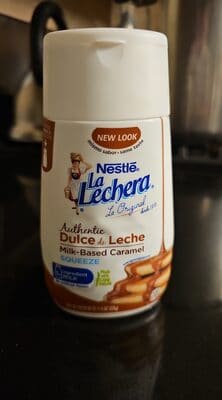
Nestlé Dulce de leche
Score
- Contains added sugars
- Seed-oil free
Why it scores 54
Nestlé Dulce de leche scores 54 out of 100 (Okay) under GoodSwap’s published rules. What moved the score most:
- minus 20 points Sugar: An added sugar. Strong
- minus 11 points Sugars 21 g / 100 g: Very high in sugar. Strong
- minus 8 points Processed (NOVA 3): Classified NOVA 3: processed with added salt, sugar or oil. Emerging
Every line of the math is on The Receipt below, with its evidence tier and sources.
The Receipt
Dulce de leche
Ingredients
- Sugar minus 20 points
- Potassium sorbate minus 2.5 points
- Sodium phosphate minus 2.5 points
Processing
- Processed (NOVA 3) minus 8 points
Nutrition per 100 g
- Sugars 21 g / 100 g minus 11 points
- Saturated fat 2 g / 100 g minus 1 points
- Energy 316 kcal / 100 g minus 1 points
100 − 46 = 54
Can’t score above 79. Contains sugar, an ingredient of high concern. [1][2][3]
Nutrition per 100 g
| Energy | 316 kcal |
|---|---|
| Fat | 3 g |
| Saturated fat | 2 g |
| Trans fat | 0 g |
| Carbohydrates | 21 g |
| Sugars | 21 g |
| Added sugars | 44.7 g |
| Protein | 2 g |
| Salt | 0.2 g |
Serving: 2 Tbsp (38 g)
Ingredients
Label text, as published
Sugar, Nonfat Milk, Milkfat, Potassium Sorbate, Salt, Baking Soda, Sodium Phosphate, Lactase.
Allergens and diets
Contains: Milk
- Not vegan
- Palm-oil-free
Always check the package: recipes change.
More simple syrups on GoodSwap
-
 Sugar Free Syrup Great Value · 2 tbs Ultra-processedContains non-nutritive sweetenersContains sugar alcoholsContains emulsifiers studied for gut effects Score 30 out of 100 Poor
 -
 All Natural Table Syrup Pinnacle Foods Group Llc · 22 fl oz/650 mL Ultra-processedHigh in sugarContains added sugars Score 17 out of 100 Bad
 -
 Original Lite Syrup Pearl Milling Company · 710 mL Ultra-processedHigh in sugarContains added sugarsContains emulsifiers studied for gut effects Score 11 out of 100 Bad
 -
 Classic Caramel Torani · 12.7 fl oz Ultra-processedContains non-nutritive sweeteners Score 52 out of 100 Okay
 -
 Original Syrup Mrs. Butterworth's · 36 fl oz/1.06 L Ultra-processedHigh in sugarContains added sugarsContains emulsifiers studied for gut effects Score 6 out of 100 Bad
 -
 Pancake Syrup Walden Farms · 12 fl oz Ultra-processedContains non-nutritive sweetenersContains emulsifiers studied for gut effectsNo synthetic dyes Score 34 out of 100 Poor
More from Nestlé

Sources
-
Guideline: sugars intake for adults and children
“In both adults and children, WHO recommends reducing the intake of free sugars to less than 10% of total energy intake”
who.int
-
Dietary Guidelines for Americans, 2025–2030
“Limit foods and beverages that include artificial flavors, petroleum-based dyes, artificial preservatives, and low-calorie non-nutritive sweeteners.”
cdn.realfood.gov
-
Added and free sugars should be as low as possible
“Sugar consumption is a known cause of dental caries.”
efsa.europa.eu
-
“By applying a default uncertainty factor of 100, the Panel established a group ADI expressed as 11 mg sorbic acid/kg bw per day for sorbic acid (E 200) and its potassium salt (E 202).”
doi.org
-
21 CFR 182.3640 Potassium sorbate
ecfr.gov
-
EFSA issues new advice on phosphates
“We estimated that dietary exposure to phosphates may exceed the new ADI for infants, toddlers and children with average consumption of phosphates in their diet.”
efsa.europa.eu
-
Saturated fatty acid and trans-fatty acid intake for adults and children: WHO guideline
“WHO recommends that adults and children reduce saturated fatty acid intake to 10% of total energy intake (strong recommendation).”
who.int