Fruit juices
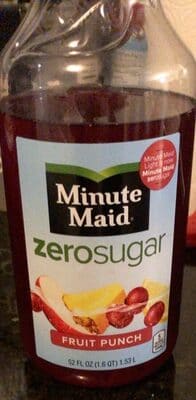
Minute Maid Fruit Punch - Zero Sugar
52 fl oz
Score
- Ultra-processed
- Contains non-nutritive sweeteners
- No synthetic dyes
Why it scores 48
Minute Maid Fruit Punch - Zero Sugar scores 48 out of 100 (Okay) under GoodSwap’s published rules. What moved the score most:
- minus 20 points Aspartame: Labels must warn people with phenylketonuria (PKU) because aspartame contains phenylalanine (US and EU). Regulatory
- minus 18 points Ultra-processed (NOVA 4): Classified NOVA 4: made with industrial ingredients and additives. Strong
- minus 7.5 points Acesulfame potassium (Ace-K): In the NutriNet-Santé cohort, acesulfame-K intake was associated with higher cancer risk; cause and effect is not established. Strong
Every line of the math is on The Receipt below, with its evidence tier and sources.
Better juices and juice drinks
-
 Reduced sugar fruit punch Caprisun Not ultra-processed · No non-nutritive sweeteners Score 96 out of 100 , 48 points higher
 -
 2 Day Detox Fruit Juice beverage Arden's Garden Not ultra-processed · No non-nutritive sweeteners Score 100 out of 100 , 52 points higher
 -
 Zero Sugar Cranberry Juice Ocean Spray · 64 oz No aspartame · No acesulfame potassium (Ace-K) Score 75 out of 100 , 27 points higher
 -
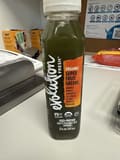 Organic Super Fruit Greens Cold-Pressed Fruit & Vegetable Juice Smoothie Evolution Fresh · 11 fl oz (325 mL) Not ultra-processed · No non-nutritive sweeteners Score 90 out of 100 , 42 points higher
 -
 Fruit Punch Simply Nature No non-nutritive sweeteners · No aspartame Score 85 out of 100 , 37 points higher
The same kind of product, at least 10 points higher, sold in the US. Never paid placements.
The Receipt
Fruit Punch - Zero Sugar
Ingredients
- Aspartame minus 20 points
- Acesulfame potassium (Ace-K) minus 7.5 points
- Natural flavors minus 2.5 points
Processing
- Ultra-processed (NOVA 4) minus 18 points
- 3 kinds of ultra-processing markers minus 3 points
Nutrition per 100 ml
- Energy 2 kcal / 100 ml minus 1 points
100 − 52 = 48
Can’t score above 79. Contains aspartame, an ingredient of high concern. [1][2][3][4][5][6][7][8][9]
Nutrition per 100 ml
| Energy | 2 kcal |
|---|---|
| Fat | 0 g |
| Carbohydrates | 0.4 g |
| Sugars | 0 g |
| Added sugars | 0 g |
| Protein | 0 g |
| Salt | 0 g |
Serving: 1 portion (240 ml)
Ingredients
- pure filtered water
- lemon juice from concentrate
- grape and pineapple juices from concentrate
- apple puree from concentrate
- natural flavors
- citric acid (provides tartness)
- vitamin c (ascorbic acid)
- aspartame (high concern)
- acesulfame potassium (moderate concern)
- grape skin extract** (for color)
Label text, as published
pure filtered water, lemon juice from concentrate**, less than 2% of: grape and pineapple juices from concentrate**, apple puree from concentrate**, natural flavors, citric acid (provides tartness), vitamin c (ascorbic acid), aspartame, acesulfame potassium, grape skin extract** (for color). **adds a negligible amount of sugar.
Allergens and diets
- Palm-oil-free
Always check the package: recipes change.
More fruit juices on GoodSwap
-
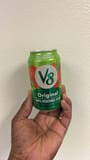 Original 100% Vegetable Juice V8 · 11.5 fl oz (340 mL) Ultra-processedNo synthetic dyes Score 67 out of 100 Good
 -
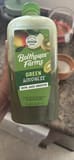 Green Goodness 100% Juice Smoothie Bolthouse Farms · 1540 g Ultra-processedContains added sugarsContains whole grains Score 44 out of 100 Okay
 -
 Coconut Juice 520 ml Foco · 1.12 - 2.10 Contains added sugars Score 58 out of 100 Okay
 -
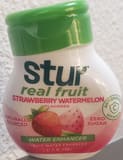 Real Fruit Strawberry Watermelon Stur · 48 mL Ultra-processedContains non-nutritive sweetenersNo synthetic dyes Score 74 out of 100 Good
 -
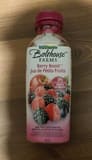 Berry Boost Bolthouse Farms · 450 mL Ultra-processedContains added sugarsNo additives Score 43 out of 100 Okay
 -
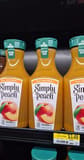 Simply Peach Juice Drink Simply Orange · 52.0 fl oz Ultra-processedContains added sugarsNo additives Score 46 out of 100 Okay
More from Minute Maid
-
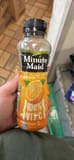 100% Orange Juice Minute Maid · 12 oz Score 87 out of 100 Excellent
 -
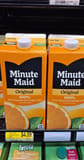 Original Low Pulp Orange Juice Minute Maid · 59 fl oz/1.8 Quart/1.75 L Score 85 out of 100 Excellent
 -
 Zero Sugar Mango Passion Flavored Fruit Drink Minute Maid · 1.53 L Score 29 out of 100 Poor
 -
 Fruit punch Minute Maid · 59 fl oz/1.8 Quart/1.75 L Score 31 out of 100 Poor
Sources
-
Regulation (EU) No 1169/2011, Annex III point 2.3 (aspartame)
“‘contains a source of phenylalanine’ shall appear on the label in cases where aspartame/aspartame-acesulfame salt is designated in the list of ingredients by its specific name.”
eur-lex.europa.eu
-
Aspartame hazard and risk assessment results released (IARC, WHO and FAO joint news release)
“Citing “limited evidence” for carcinogenicity in humans, IARC classified aspartame as possibly carcinogenic to humans (IARC Group 2B) and JECFA reaffirmed the acceptable daily intake of 40 mg/kg body weight.”
who.int
-
Aspartame and Other Sweeteners in Food
“The FDA disagrees with IARC’s conclusion that these studies support classifying aspartame as a possible carcinogen to humans.”
fda.gov
-
“Aspartame and its breakdown products are safe for human consumption at current levels of exposure”
efsa.europa.eu
-
Artificial sweeteners and cancer risk: Results from the NutriNet-Santé population-based cohort study
“In this large cohort study, artificial sweeteners (especially aspartame and acesulfame-K), which are used in many food and beverage brands worldwide, were associated with increased cancer risk.”
doi.org
-
WHO advises not to use non-sugar sweeteners for weight control in newly released guideline
“The recommendation is based on the findings of a systematic review of the available evidence which suggests that use of NSS does not confer any long-term benefit in reducing body fat in adults or children.”
who.int
-
Dietary Guidelines for Americans, 2025–2030
“Limit foods and beverages that include artificial flavors, petroleum-based dyes, artificial preservatives, and low-calorie non-nutritive sweeteners.”
cdn.realfood.gov
-
Re-evaluation of acesulfame K (E 950) as food additive (plain language summary)
“The acceptable daily intake (ADI) considered safe for all population groups was set at 15 mg/kg body weight (bw) per day.”
efsa.europa.eu
-
21 CFR 101.22 Foods; labeling of spices, flavorings, colorings and chemical preservatives
“whose significant function in food is flavoring rather than nutritional.”
ecfr.gov
-
“Greater exposure to ultra-processed food was associated with a higher risk of adverse health outcomes, especially cardiometabolic, common mental disorder, and mortality outcomes.”
doi.org