Fresh cheeses
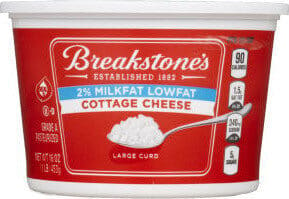
Breakstone's 2% Milkfat Lowfat Cottage Cheese Large Curd
16 oz/1 lb/453 g
Score
- Ultra-processed
- No additives
Why it scores 84
Breakstone's 2% Milkfat Lowfat Cottage Cheese Large Curd scores 84 out of 100 (Excellent) under GoodSwap’s published rules. What moved the score most:
- minus 18 points Ultra-processed (NOVA 4): Classified NOVA 4: made with industrial ingredients and additives. Strong
- minus 3 points Salt 0.8 g / 100 g: High in salt. Strong
- plus 3 points No additives: No food additives in the ingredient list. Info
Every line of the math is on The Receipt below, with its evidence tier and sources.
Better cottage cheese
-
 Cottage Cheese Small Curd 4% Milkfat Breakstone's · 24 oz Not ultra-processed Score 100 out of 100 , 16 points higher
 -
 Organic Lowfat Milk Cottage Cheese Kalona Super Natural · 16 oz Not ultra-processed Score 100 out of 100 , 16 points higher
 -
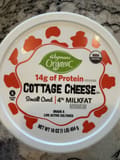 Organic Cottage Cheese Small Curd Wegmans · 16 oz Not ultra-processed Score 100 out of 100 , 16 points higher
 -
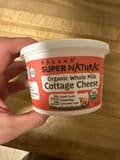 Organic Whole Milk Cottage Cheese Kalona Super Natural · 16 oz/454 g Not ultra-processed Score 100 out of 100 , 16 points higher
 -
 Cottage Cheese Good Culture · 16 oz Not ultra-processed Score 100 out of 100 , 16 points higher
The same kind of product, at least 10 points higher, sold in the US. Never paid placements.
The Receipt
2% Milkfat Lowfat Cottage Cheese Large Curd
Processing
- Ultra-processed (NOVA 4) minus 18 points
Nutrition per 100 g
- Saturated fat 1.3 g / 100 g minus 0.5 points
- Salt 0.8 g / 100 g minus 3 points
- Protein 11 g / 100 g plus 2 points
Bonuses
- No additives plus 3 points
100 − 16.5 = 83.5 → 84
Nutrition per 100 g
| Energy | 85 kcal |
|---|---|
| Fat | 2.1 g |
| Saturated fat | 1.3 g |
| Trans fat | 0 g |
| Carbohydrates | 5.9 g |
| Sugars | 4.2 g |
| Added sugars | 2.6 g |
| Fiber | 0 g |
| Protein | 11 g |
| Salt | 0.8 g |
Serving: 0.5 cup (117 g)
Ingredients
Label text, as published
CULTURED PASTEURIZED SKIM MILK AND CREAM, TAPIOCA STARCH, SALT, VITAMIN A PALMITATE.
Allergens and diets
Contains: Milk
- Not vegan
- Vegetarian
- Gluten-free
- Palm-oil-free
Always check the package: recipes change.
More fresh cheeses on GoodSwap
-
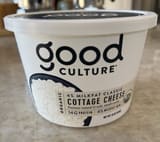 4% Milkfat Classic Cottage Cheese Good Culture · 16 oz Certified organic Score 95 out of 100 Excellent
 -
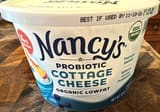 Probiotic Cottage Cheese Nancy's · 16 oz Certified organic Score 96 out of 100 Excellent
 -
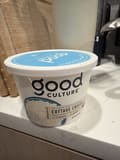 2% Low-Fat Classic Good Culture · 16 oz Certified organic Score 96 out of 100 Excellent
 -
 2% Low-Fat Classic Cottage Cheese Good Culture · 5 oz Certified organic Score 96 out of 100 Excellent
 -
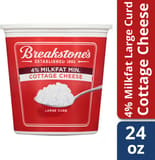 Cottage Cheese Large Curd Breakstone's · 118 g Ultra-processedNo additives Score 83 out of 100 Excellent
 -
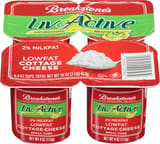 Cottage Cheese Breakstone's · 16 oz Ultra-processedNo additives Score 83 out of 100 Excellent
More from Breakstone's
Sources
-
Saturated fatty acid and trans-fatty acid intake for adults and children: WHO guideline
“WHO recommends that adults and children reduce saturated fatty acid intake to 10% of total energy intake (strong recommendation).”
who.int
-
“For adults, WHO recommends less than 2000 mg/day of sodium (equivalent to less than 5 g/day salt), or just under a teaspoon.”
who.int
-
Dietary Guidelines for Americans, 2025–2030
“Limit foods and beverages that include artificial flavors, petroleum-based dyes, artificial preservatives, and low-calorie non-nutritive sweeteners.”
cdn.realfood.gov
-
“Greater exposure to ultra-processed food was associated with a higher risk of adverse health outcomes, especially cardiometabolic, common mental disorder, and mortality outcomes.”
doi.org