
Popcorn
Kroger Microwave Popcorn
18 oz
Score
- Not permitted in some countries
- Ultra-processed
- High in salt
- High in saturated fat
- Contains artificial flavors
- Seed-oil free
- No synthetic dyes
Why it scores 25
Kroger Microwave Popcorn scores 25 out of 100 (Poor) under GoodSwap’s published rules. What moved the score most:
- minus 25 points Partially hydrogenated oil: Industrial trans fat raises LDL cholesterol and heart disease risk. Regulatory
- minus 18 points Ultra-processed (NOVA 4): Classified NOVA 4: made with industrial ingredients and additives. Strong
- minus 9 points Saturated fat 13.3 g / 100 g: Very high in saturated fat. Strong
Capped at 25: Contains partially hydrogenated oil, whose use in food has been revoked in the US.
Every line of the math is on The Receipt below, with its evidence tier and sources.
Better microwave popcorn and kernels
-
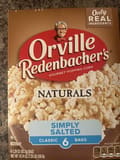 Naturals Simply Salted Gourmet Popping Corn Orville Redenbacher's · 559 g No banned ingredients · Not ultra-processed Score 73 out of 100 , 48 points higher
 -
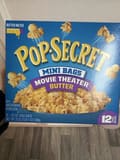 Movie Theater Butter Pop-Secret · 12 × 1.75 oz No banned ingredients · Less salt Score 65 out of 100 , 40 points higher
 -
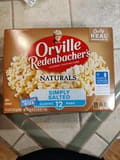 ORVILLE REDENBACHERS Naturals Simply Salted Classic Bag, 39.49 OZ Orville Redenbacher's · 3.29 oz No banned ingredients · Not ultra-processed Score 76 out of 100 , 51 points higher
 -
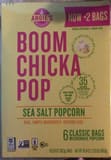 Sea Salt Microwave Popcorn Angie's · 19.74 oz/1.23 lb/559.8 g No banned ingredients · Not ultra-processed Score 79 out of 100 , 54 points higher
 -
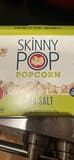 SkinnyPop Sea Salt Microwave Popcorn Skinny Pop · 16.8 oz/476 g No banned ingredients · Not ultra-processed Score 77 out of 100 , 52 points higher
The same kind of product, at least 10 points higher, sold in the US. Never paid placements.
The Receipt
Microwave Popcorn
Ingredients
- Partially hydrogenated oil minus 25 points
- Natural and artificial flavors minus 2.5 points
Processing
- Ultra-processed (NOVA 4) minus 18 points
- 3 kinds of ultra-processing markers minus 3 points
Nutrition per 100 g
- Saturated fat 13.3 g / 100 g minus 9 points
- Salt 2.6 g / 100 g minus 9 points
- Energy 500 kcal / 100 g minus 3 points
- Fiber 9.1 g / 100 g plus 4 points
100 − 65.5 = 34.5 → 35 → capped at 25
Capped at 25. Contains partially hydrogenated oil, whose use in food has been revoked in the US. [2][10]
Can’t score above 49. Contains partially hydrogenated oil, an ingredient of very high concern. [1][2][3][4]
Can’t score above 79. High in fat, saturated fat and salt (above the front-of-pack "high" level). [11]
Nutrition per 100 g
| Energy | 500 kcal |
|---|---|
| Fat | 30 g |
| Saturated fat | 13.3 g |
| Trans fat | 10.6 g |
| Carbohydrates | 53.3 g |
| Sugars | 0 g |
| Added sugars | 0 g |
| Fiber | 9.1 g |
| Protein | 6.7 g |
| Salt | 2.6 g |
Serving: 33 g (2 Tbsp)
Ingredients
- popcorn
- partially hydrogenated soybean oil (very high concern)
- salt
- natural and artificial flavor
- color (annatto extract) (not recognized)
Label text, as published
popcorn, partially hydrogenated soybean oil, salt, less than 2% of the following: natural and artificial flavor, color (annatto extract),
Allergens and diets
Contains: Soy
- Palm-oil-free
Always check the package: recipes change.
More popcorn on GoodSwap
-
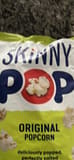 Original Popcorn Skinny Pop · 4.4 oz Contains seed oilsNo additives Score 79 out of 100 Good
 -
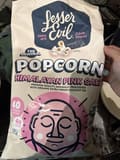 Popcorn Himalayan Pink Salt Lesser Evil · 5 oz High in saltHigh in saturated fatCertified organicNo additives Score 79 out of 100 Good
 -
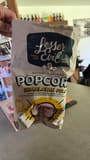 POPcorn HIMALAYAN GOLD Lesser Evil · 4.6 oz/130 g Ultra-processedHigh in saltHigh in saturated fatCertified organic Score 68 out of 100 Good
 -
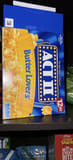 Butter Lovers Microwave Popcorn Act II · 12 bags * 78 g Ultra-processedHigh in saltHigh in saturated fatContains palm oil Score 59 out of 100 Okay
 -
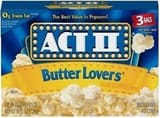 Butter lovers microwave popcorn boxes Act II · 8.25 oz Ultra-processedHigh in saltHigh in saturated fatContains palm oil Score 60 out of 100 Good
 -
 Popcorn Himalayan Gold Lesser Evil · 0.88 oz/25 g High in saturated fatCertified organicNo additivesSeed-oil free Score 79 out of 100 Good
More from Kroger


Sources
-
“In 2015, the FDA took the significant step of determining that PHOs, then the major source of artificial trans fat in the food supply, are no longer “Generally Recognized as Safe,” or GRAS.”
fda.gov
-
Revocation of Uses of Partially Hydrogenated Oils in Foods (88 FR 53764)
“in light of our determination that PHOs are no longer generally recognized as safe (GRAS).”
federalregister.gov
-
“Maximum 2 grams per 100 grams of fat in food intended for the final consumer and food intended for supply to retail”
eur-lex.europa.eu
-
“WHO’s recommendation for adults is to limit consumption of trans fat to less than 1% of total energy intake, which is less than 2.2 g per day for a 2000-calorie diet.”
who.int
-
21 CFR 101.22 Foods; labeling of spices, flavorings, colorings and chemical preservatives
“whose significant function in food is flavoring rather than nutritional.”
ecfr.gov
-
Dietary Guidelines for Americans, 2025–2030
“Limit foods and beverages that include artificial flavors, petroleum-based dyes, artificial preservatives, and low-calorie non-nutritive sweeteners.”
cdn.realfood.gov
-
Saturated fatty acid and trans-fatty acid intake for adults and children: WHO guideline
“WHO recommends that adults and children reduce saturated fatty acid intake to 10% of total energy intake (strong recommendation).”
who.int
-
“For adults, WHO recommends less than 2000 mg/day of sodium (equivalent to less than 5 g/day salt), or just under a teaspoon.”
who.int
-
Notice of Modification: Prohibiting the Use of Partially Hydrogenated Oils in Foods
“On September 17, 2018, partially hydrogenated oils (PHOs) were banned by adding them to Part 1 of the List of Contaminants and other Adulterating Substances in Foods.”
canada.ca
-
“Table 3: Criteria for drinks (per 100ml)”
assets.publishing.service.gov.uk
-
“titanium dioxide (E 171) can no longer be considered safe when used as a food additive.”
eur-lex.europa.eu
-
Revocation of Authorization for Use of Brominated Vegetable Oil in Food (89 FR 55040)
“This action is being taken because there is no longer a reasonable certainty of no harm from the continued use of BVO in food.”
federalregister.gov
-
“This order is effective January 15, 2027, except for amendatory instruction 4, which is effective January 18, 2028.”
federalregister.gov
-
Regulation (EC) No 1223/2009 of 30 November 2009 on cosmetic products
“cosmetic products shall not contain any of the following: (a) prohibited substances — prohibited substances listed in Annex II”
eur-lex.europa.eu
-
“Greater exposure to ultra-processed food was associated with a higher risk of adverse health outcomes, especially cardiometabolic, common mental disorder, and mortality outcomes.”
doi.org