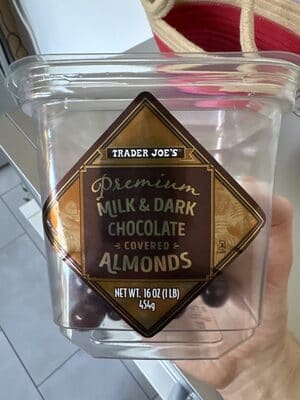
Chocolate covered nuts
Trader Joe's Premium Milk & Dark Chocolate Covered Almonds
16 oz
Score
- Ultra-processed
- High in sugar
- High in saturated fat
- Contains added sugars
- Seed-oil free
Why it scores 4
Trader Joe's Premium Milk & Dark Chocolate Covered Almonds scores 4 out of 100 (Bad) under GoodSwap’s published rules. What moved the score most:
- minus 20 points Sugar: An added sugar. Strong
- minus 20 points Corn syrup: An added sugar. Strong
- minus 18 points Ultra-processed (NOVA 4): Classified NOVA 4: made with industrial ingredients and additives. Strong
Every line of the math is on The Receipt below, with its evidence tier and sources.
Better chocolate candy
-
 Dark Chocolate Covered Almonds Unreal · 4.0 oz Not ultra-processed · Less sugar Score 49 out of 100 , 45 points higher
 -
 Individually packed dark and milk chocolate bars - plain and with honey almond nougat, caramel sea salt, hazelnut and almond sea salt Tony's Chocolonely · 10.16 oz (288 g) No sugar · No corn syrup Score 46 out of 100 , 42 points higher
 -
 Lily's dark chocolate covered almonds Lily's · 3.5 oz/99 g Less sugar · No added sugars Score 53 out of 100 , 49 points higher
 -
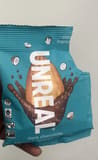 Dark chocolate coconut covered almonds Unreal · 1 oz Not ultra-processed · Less sugar Score 46 out of 100 , 42 points higher
 -
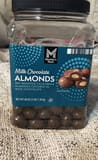 Milk Chocolate Almonds Member's Mark · 48 oz Not ultra-processed · No corn syrup Score 48 out of 100 , 44 points higher
The same kind of product, at least 10 points higher, sold in the US. Never paid placements.
The Receipt
Premium Milk & Dark Chocolate Covered Almonds
Ingredients
- Sugar minus 20 points
- Corn syrup minus 20 points
- Chocolate (sweetened, ingredient) minus 7.5 points
- Milk chocolate (ingredient) minus 2.5 points
Processing
- Ultra-processed (NOVA 4) minus 18 points
- 5 kinds of ultra-processing markers minus 6 points
Nutrition per 100 g
- Sugars 36.7 g / 100 g minus 14 points
- Saturated fat 13.3 g / 100 g minus 9 points
- Energy 533 kcal / 100 g minus 3 points
- Fiber 6.7 g / 100 g plus 4 points
100 − 96 = 4
Can’t score above 79. Contains sugar, an ingredient of high concern. [1][2][3]
Can’t score above 79. High in fat, saturated fat and sugars (above the front-of-pack "high" level). [6]
Nutrition per 100 g
| Energy | 533 kcal |
|---|---|
| Fat | 36.7 g |
| Saturated fat | 13.3 g |
| Carbohydrates | 46.7 g |
| Sugars | 36.7 g |
| Added sugars | 33.3 g |
| Fiber | 6.7 g |
| Protein | 10 g |
| Salt | 0 g |
Serving: 8 pieces (30 g)
Ingredients
- DARK CHOCOLATE (UNSWEETENED CHOCOLATE, SUGAR, COCOA BUTTER, MILKFAT, SOY LECITHIN [EMULSIFIER], NATURAL VANILLA FLAVOR) (moderate concern)
- MILK CHOCOLATE (SUGAR, COCOA BUTTER, UNSWEETENED CHOCOLATE, WHOLE MILK POWDER, SOY LECITHIN (EMULSIFIER], NATURAL VANILLA FLAVOR) (moderate concern)
- ALMONDS CONFECTIONER'S GLAZE
- GUM ARABIC
- CANE SUGAR (high concern)
- TAPIOCA SYRUP (high concern)
Label text, as published
DARK CHOCOLATE (UNSWEETENED CHOCOLATE, SUGAR, COCOA BUTTER, MILKFAT, SOY LECITHIN [EMULSIFIER], NATURAL VANILLA FLAVOR), MILK CHOCOLATE (SUGAR, COCOA BUTTER, UNSWEETENED CHOCOLATE, WHOLE MILK POWDER, SOY LECITHIN (EMULSIFIER], NATURAL VANILLA FLAVOR), ALMONDS CONFECTIONER'S GLAZE, GUM ARABIC, CANE SUGAR, TAPIOCA SYRUP
Allergens and diets
Contains: Milk, Tree nuts, Soy
May contain: Peanuts, Gluten
- Not vegan
- Palm-oil-free
Always check the package: recipes change.
Packaging
Pet 1 polyethylene terephthalate
Context only: no points in v1.
More chocolate covered nuts on GoodSwap
-
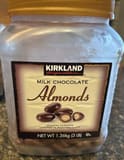 Milk Chocolate Almonds Kirkland Signature · 1.36 kg (3 lb) Ultra-processedHigh in sugarHigh in saturated fatContains added sugars Score 4 out of 100 Bad
 -
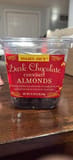 Dark Chocolate covered Almonds Trader Joe's · 16 oz Ultra-processedHigh in sugarHigh in saturated fatContains added sugars Score 33 out of 100 Poor
 -
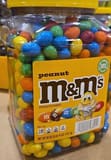 Peanut M&M's Chocolate Candies M&M's · 62.0 oz/1757.7 g Dye with an EU warning labelContains synthetic dyesUltra-processedHigh in sugar Score 0 out of 100 Bad
 -
 Dark Chocolate covered Coconut almonds Choceur · 10 oz Ultra-processedHigh in sugarHigh in saturated fatContains added sugars Score 21 out of 100 Poor
 -
 Dark Chocolate covered ALMONDS Trader Joe's · 25 oz Ultra-processedHigh in sugarHigh in saturated fatContains added sugars Score 21 out of 100 Poor
 -
 Peanut Butter M&M's Chocolate Candies M&M's · 2.83 oz/80.2 g Dye with an EU warning labelContains synthetic dyesUltra-processedHigh in sugar Score 1 out of 100 Bad
More from Trader Joe's
Sources
-
Guideline: sugars intake for adults and children
“In both adults and children, WHO recommends reducing the intake of free sugars to less than 10% of total energy intake”
who.int
-
Dietary Guidelines for Americans, 2025–2030
“Limit foods and beverages that include artificial flavors, petroleum-based dyes, artificial preservatives, and low-calorie non-nutritive sweeteners.”
cdn.realfood.gov
-
Added and free sugars should be as low as possible
“Sugar consumption is a known cause of dental caries.”
efsa.europa.eu
-
Saturated fatty acid and trans-fatty acid intake for adults and children: WHO guideline
“WHO recommends that adults and children reduce saturated fatty acid intake to 10% of total energy intake (strong recommendation).”
who.int
-
“Table 3: Criteria for drinks (per 100ml)”
assets.publishing.service.gov.uk
-
“Greater exposure to ultra-processed food was associated with a higher risk of adverse health outcomes, especially cardiometabolic, common mental disorder, and mortality outcomes.”
doi.org