Milk chocolate cookies
Trader Giotto's Linguine with Pesto & Tomatoes
290 g e
Score
- Ultra-processed
- Contains added sugars
- Contains emulsifiers studied for gut effects
- Contains seed oils
- Contains palm oil
- Contains whole grains
Why it scores 21
Trader Giotto's Linguine with Pesto & Tomatoes scores 21 out of 100 (Poor) under GoodSwap’s published rules. What moved the score most:
- minus 20 points Sugar: An added sugar. Strong
- minus 20 points Corn syrup: An added sugar. Strong
- minus 18 points Ultra-processed (NOVA 4): Classified NOVA 4: made with industrial ingredients and additives. Strong
Every line of the math is on The Receipt below, with its evidence tier and sources.
The Receipt
Linguine with Pesto & Tomatoes
Ingredients
- Sugar minus 20 points
- Corn syrup minus 20 points
- Invert sugar minus 10 points
Processing
- Ultra-processed (NOVA 4) minus 18 points
- 5 kinds of ultra-processing markers minus 6 points
Nutrition per 100 g
- Saturated fat 1.6 g / 100 g minus 1 points
- Salt 0.7 g / 100 g minus 3 points
- Energy 161 kcal / 100 g minus 1 points
100 − 79 = 21
Can’t score above 79. Contains sugar, an ingredient of high concern. [1][2][3]
Nutrition per 100 g
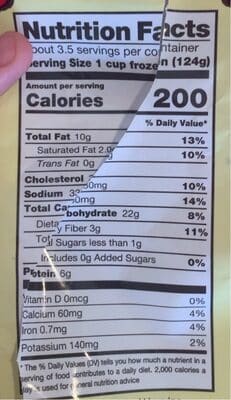
| Energy | 161 kcal |
|---|---|
| Fat | 8.1 g |
| Saturated fat | 1.6 g |
| Carbohydrates | 17.7 g |
| Sugars | 0.8 g |
| Added sugars | 0 g |
| Fiber | 2.4 g |
| Protein | 4.8 g |
| Salt | 0.7 g |
Serving: 1 serving (124 g)
Ingredients
- Sucre (high concern)
- Sirop de glucose (high concern)
- Sirop de sucre inverti (high concern)
- Riz soufflé (Riz - Sucre, Sel, Extrait de malt d'orge (contient Gluten), Émulsifiant : E471, Fer, Niacine, Acide pantothénique Riboflavine, Vitamine B6, Thiamine, Acide folique, Vitamine D, Vitamine B12) (not recognized)
- Lait concentre sucré
- Farine de blé contient Gluten (avec Farine de blé, Carbonate de calcium, Fer, Niacine, Thiamine)
- Huile de palme
- Masse de cacao
- Beurre de cacao
- Lait en poudre entier
- Humectant:Glycérol Beurre (Lait )
- Farine complète de blé (contient Gluten) Golden Syrup (Sirop de sucre inverti) (high concern)
- Huile de colza Sel - Poudre à lever : Bicarbonate de soude
- E503
- Acide tartrique Émulsifiant :Lécithine de soja
- E491 - Lait en poudre écrémé
- Sirop de malt d'orge (contient Gluten)
- Sirop de sucre (high concern)
- Gluten de blé
- Extrait de malt d'orge (contient Gluten)
- Arôme
Label text, as published
Sucre, Sirop de glucose, Sirop de sucre inverti, Riz soufflé (Riz - Sucre, Sel, Extrait de malt d'orge (contient Gluten), Émulsifiant : E471, Fer, Niacine, Acide pantothénique Riboflavine, Vitamine B6, Thiamine, Acide folique, Vitamine D, Vitamine B12), Lait concentre sucré, Farine de blé contient Gluten(avec Farine de blé, Carbonate de calcium, Fer, Niacine,Thiamine), Huile de palme, Masse de cacao, Beurre de cacao, Lait en poudre entier, Humectant:Glycérol Beurre (Lait ), Farine complète de blé (contient Gluten) Golden Syrup (Sirop de sucre inverti), Huile de colza Sel - Poudre à lever : Bicarbonate de soude, E503, Acide tartrique Émulsifiant :Lécithine de soja, E491 - Lait en poudre écrémé, Sirop de malt d'orge (contient Gluten), Sirop de sucre, Gluten de blé, Extrait de malt d'orge (contient Gluten), Arôme.
Allergens and diets
Contains: Milk, Soy, Wheat, Gluten
May contain: Peanuts, Tree nuts
- Not vegan
- Vegetarian
- Not gluten-free
- Not palm-oil-free
Always check the package: recipes change.
Packaging
Plastic
Context only: no points in v1.
More from Trader Giotto's
-
 Organic Extra Virgin Olive Oil Trader Giotto's · 15 mL Score 100 out of 100 Excellent
 -
 Marinara Sauce Trader Giotto's · 25 oz Score 87 out of 100 Excellent
 -
 Imported Olive Oil Trader Giotto's · 15 mL Score 100 out of 100 Excellent
 -
 Meatballs Italian Style Trader Giotto's · 16 oz (1 lb) 454 g Score 50 out of 100 Okay
Sources
-
Guideline: sugars intake for adults and children
“In both adults and children, WHO recommends reducing the intake of free sugars to less than 10% of total energy intake”
who.int
-
Dietary Guidelines for Americans, 2025–2030
“Limit foods and beverages that include artificial flavors, petroleum-based dyes, artificial preservatives, and low-calorie non-nutritive sweeteners.”
cdn.realfood.gov
-
Added and free sugars should be as low as possible
“Sugar consumption is a known cause of dental caries.”
efsa.europa.eu
-
Saturated fatty acid and trans-fatty acid intake for adults and children: WHO guideline
“WHO recommends that adults and children reduce saturated fatty acid intake to 10% of total energy intake (strong recommendation).”
who.int
-
“For adults, WHO recommends less than 2000 mg/day of sodium (equivalent to less than 5 g/day salt), or just under a teaspoon.”
who.int
-
“Greater exposure to ultra-processed food was associated with a higher risk of adverse health outcomes, especially cardiometabolic, common mental disorder, and mortality outcomes.”
doi.org
-
Dietary emulsifiers impact the mouse gut microbiota promoting colitis and metabolic syndrome
“carboxymethylcellulose and polysorbate-80, induced low-grade inflammation and obesity/metabolic syndrome in wild-type hosts and promoted robust colitis in mice predisposed to this disorder.”
doi.org
-
“Relative to control subjects, CMC consumption modestly increased postprandial abdominal discomfort and perturbed gut microbiota composition in a way that reduced its diversity.”
doi.org
-
“This study found positive associations between risk of CVD and intake of five individual and two groups of food additive emulsifiers widely used in industrial foods.”
doi.org
-
“replacement of saturated fat in the diet with linoleic acid effectively lowers serum cholesterol but does not support the hypothesis that this translates to a lower risk of death from coronary heart disease or all causes.”
doi.org
-
“These data provide support for current recommendations to replace saturated fat with polyunsaturated fat for primary prevention of CHD.”
doi.org
-
“Glycidyl fatty acid esters, expressed as glycidol”
eur-lex.europa.eu