Breads
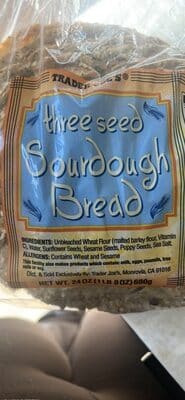
Trader Joe's three seed Sourdough Bread
24 oz
Score
Why it scores 100
Trader Joe's three seed Sourdough Bread scores 100 out of 100 (Excellent) under GoodSwap’s published rules. What moved the score most:
- plus 2 points Fiber 5.7 g / 100 g: A good source of fiber. Strong
- plus 2 points Protein 9.4 g / 100 g: A good source of protein. Info
- minus 1 points Saturated fat 1.4 g / 100 g: Contains some saturated fat. Strong
Every line of the math is on The Receipt below, with its evidence tier and sources.
The Receipt
three seed Sourdough Bread
Nutrition per 100 g
- Saturated fat 1.4 g / 100 g minus 1 points
- Energy 310 kcal / 100 g minus 1 points
- Fiber 5.7 g / 100 g plus 2 points
- Protein 9.4 g / 100 g plus 2 points
100 + 2 = 100
Nutrition per 100 g
| Energy | 310 kcal |
|---|---|
| Fat | 11.3 g |
| Saturated fat | 1.4 g |
| Carbohydrates | 39.9 g |
| Sugars | 1.3 g |
| Added sugars | 0 g |
| Fiber | 5.7 g |
| Protein | 9.4 g |
| Salt | 0 g |
Serving: 1 slice (43 g)
Ingredients
- Unbleached Wheat Flour (malted barley flour, Vitamin C)
- Water
- Sunflower Seeds
- Sesame Seeds
- Poppy Seeds
- Sea Salt ALLERGENS: Contains Wheat and Sesame This facility also makes products which contain: milk (not recognized)
- eggs
- peanuts
- tres nuts or soy
Label text, as published
Unbleached Wheat Flour (malted barley flour, Vitamin C), Water, Sunflower Seeds, Sesame Seeds, Poppy Seeds, Sea Salt ALLERGENS: Contains Wheat and Sesame This facility also makes products which contain: milk, eggs, peanuts, tres nuts or soy
Allergens and diets
Contains: Milk, Peanuts, Tree nuts, Wheat, Gluten, Egg, Sesame
- Not vegan
- Not gluten-free
- Palm-oil-free
Always check the package: recipes change.
More breads on GoodSwap
-
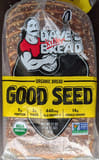 Organic Bread Good Seed Dave's Killer Bread · 27 oz Ultra-processedContains added sugarsCertified organicContains whole grains Score 42 out of 100 Okay
 -
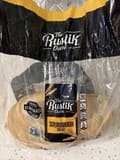 Sourdough Bread The Rustik Oven · 1 lb/454 g Ultra-processedSeed-oil free Score 73 out of 100 Good
 -
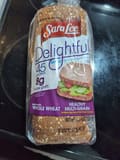 Delightful Bread Sara Lee · 567 g Ultra-processedContains non-nutritive sweetenersContains added sugarsContains emulsifiers studied for gut effects Score 23 out of 100 Poor
 -
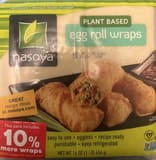 Egg Roll Wraps Nasoya · 16 oz Ultra-processedNo additives Score 76 out of 100 Good
 -
 Reduced Calorie Italian Bread Freihofer's · 12 g Ultra-processedContains added sugarsContains emulsifiers studied for gut effectsContains seed oils Score 42 out of 100 Okay
 -
 100% Sprouted Whole Wheat Old Tyme · 24 oz Ultra-processedContains non-nutritive sweetenersContains added sugarsContains emulsifiers studied for gut effects Score 23 out of 100 Poor
More from Trader Joe's
Also popular on GoodSwap
Sources
-
Saturated fatty acid and trans-fatty acid intake for adults and children: WHO guideline
“WHO recommends that adults and children reduce saturated fatty acid intake to 10% of total energy intake (strong recommendation).”
who.int
-
Dietary Guidelines for Americans, 2025–2030
“Limit foods and beverages that include artificial flavors, petroleum-based dyes, artificial preservatives, and low-calorie non-nutritive sweeteners.”
cdn.realfood.gov