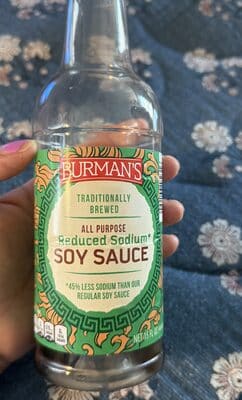
Soy sauces
Burman's Reduced Sodium Soy Sauce
15 oz
Score
- High in salt
Why it scores 76
Burman's Reduced Sodium Soy Sauce scores 76 out of 100 (Good) under GoodSwap’s published rules. What moved the score most:
- minus 9 points Salt 9.5 g / 100 g: Very high in salt. Strong
- minus 8 points Processed (NOVA 3): Classified NOVA 3: processed with added salt, sugar or oil. Emerging
- minus 7.5 points Sodium benzoate: Benzoates can form small amounts of benzene in drinks that also contain ascorbic acid (vitamin C), especially with heat or light. Strong
Every line of the math is on The Receipt below, with its evidence tier and sources.
Better soy sauce and aminos
-
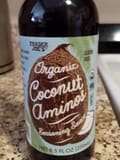 Coconut Aminos Trader Joe's Less salt · No sodium benzoate Score 100 out of 100 , 24 points higher
 -
 Soy sauce Taste Of Inspirations · 296 mL Less salt Score 89 out of 100 , 13 points higher
The same kind of product, at least 10 points higher, sold in the US. Never paid placements.
The Receipt
Reduced Sodium Soy Sauce
Ingredients
- Sodium benzoate minus 7.5 points
Processing
- Processed (NOVA 3) minus 8 points
Nutrition per 100 g
- Salt 9.5 g / 100 g minus 9 points
100 − 24.5 = 75.5 → 76
Can’t score above 79. High in salt (above the front-of-pack "high" level). [6]
Nutrition per 100 g
| Energy | 33 kcal |
|---|---|
| Fat | 0 g |
| Saturated fat | 0 g |
| Carbohydrates | 6.7 g |
| Sugars | 0 g |
| Added sugars | 0 g |
| Fiber | 0 g |
| Protein | 6.7 g |
| Salt | 9.5 g |
Serving: 15mL
Ingredients
Label text, as published
WATER, WHEAT, SOYBEANS, SALT, LACTIC ACID, SODIUM BENZOATE. CONTAINS: WHEAT, SOY.
Allergens and diets
Contains: Soy, Wheat, Gluten
- Vegan
- Vegetarian
- Not gluten-free
- Palm-oil-free
Always check the package: recipes change.
More soy sauces on GoodSwap
-
 Liquid Aminos Bragg · 16 fl oz (1 pt) 473 mL High in saltNo additives Score 79 out of 100 Good
 - Soy Sauce Kikkoman · 296 mL High in saltNo additives Score 79 out of 100 Good
-
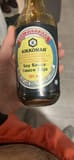 Soy Sauce Kikkoman · 20 fl oz (591 mL) High in saltNo additives Score 79 out of 100 Good
 -
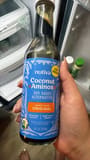 Coconut Secret coconut aminos ORIGINAL Sweet & Savory Nutiva · 237 mL High in saltCertified organicNo additives Score 79 out of 100 Good
 -
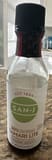 Tamari Lite brewed soy sauce San-J · 10 fl oz/296 mL High in salt Score 79 out of 100 Good
 -
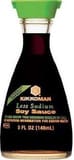 Sauce Soja réduite en sel Kikkoman · 5 fl oz/148 mL High in salt Score 76 out of 100 Good
More from Burman's
Sources
-
“Artificial colours or a sodium benzoate preservative (or both) in the diet result in increased hyperactivity in 3-year-old and 8/9-year-old children in the general population.”
doi.org
-
Re-evaluation of benzyl alcohol (E 1519) as food additive (records the 2016 benzoate re-evaluation)
“derived a group ADI of 5 mg/kg bw per day (expressed as benzoic acid) in accordance with the ADI previously derived by SCF and JECFA”
doi.org
-
“For adults, WHO recommends less than 2000 mg/day of sodium (equivalent to less than 5 g/day salt), or just under a teaspoon.”
who.int
-
“Table 3: Criteria for drinks (per 100ml)”
assets.publishing.service.gov.uk
-
Dietary Guidelines for Americans, 2025–2030
“Limit foods and beverages that include artificial flavors, petroleum-based dyes, artificial preservatives, and low-calorie non-nutritive sweeteners.”
cdn.realfood.gov