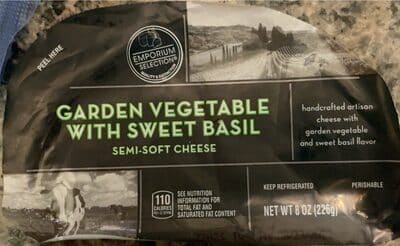
Cheeses
Aldi Garden vegetable with sweet basil semi soft cheese
8 g
Score
- High in salt
- High in saturated fat
Why it scores 68
Aldi Garden vegetable with sweet basil semi soft cheese scores 68 out of 100 (Good) under GoodSwap’s published rules. What moved the score most:
- minus 8 points Processed (NOVA 3): Classified NOVA 3: processed with added salt, sugar or oil. Emerging
- minus 7.5 points Sodium benzoate: Benzoates can form small amounts of benzene in drinks that also contain ascorbic acid (vitamin C), especially with heat or light. Strong
- minus 7.5 points Sodium metabisulfite: Sulfites must be declared above 10 mg/kg in the EU and UK and at 10 ppm or more in the US because some people, especially people with asthma, react to them. Regulatory
Every line of the math is on The Receipt below, with its evidence tier and sources.
Better cheese
-
 Premium cultured soft cheese Lifeway · 16 oz Less salt · Less saturated fat Score 100 out of 100 , 32 points higher
 -
 Jarlsberg Original Semi-Soft Part-Skim Cheese Jarlsberg Less salt · Less saturated fat Score 89 out of 100 , 21 points higher
 -
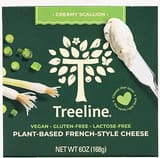 Scallion French-Style Soft Cheese Treeline · 6 oz Less salt · Less saturated fat Score 92 out of 100 , 24 points higher
 -
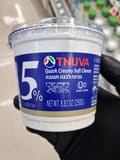 TNUVA Creamy Soft Cheese 5% Tnuva · 8.82 oz/250 g Less salt · Less saturated fat Score 100 out of 100 , 32 points higher
 -
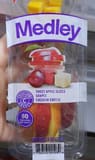 Sweet Apples, Grapes, Cheddar Cheese Medley Lunch Pack · 2.8 oz/79 g Less salt · Less saturated fat Score 87 out of 100 , 19 points higher
The same kind of product, at least 10 points higher, sold in the US. Never paid placements.
The Receipt
Garden vegetable with sweet basil semi soft cheese
Ingredients
- Sodium benzoate minus 7.5 points
- Sodium metabisulfite minus 7.5 points
- Calcium chloride minus 2.5 points
Processing
- Processed (NOVA 3) minus 8 points
Nutrition per 100 g
- Saturated fat 21.4 g / 100 g minus 4.5 points
- Salt 1.8 g / 100 g minus 5 points
- Energy 393 kcal / 100 g minus 1 points
- Protein 25 g / 100 g plus 4 points
100 − 32 = 68
Can’t score above 79. High in fat, saturated fat and salt (above the front-of-pack "high" level). [11]
Nutrition per 100 g
| Energy | 393 kcal |
|---|---|
| Fat | 32.1 g |
| Saturated fat | 21.4 g |
| Carbohydrates | 3.6 g |
| Sugars | 0 g |
| Added sugars | 0 g |
| Fiber | 0 g |
| Protein | 25 g |
| Salt | 1.8 g |
Serving: 28 g
Ingredients
- PASTEURIZED MILK
- VEGETABLE MIX (RED BELL PEPPERS, GREEN BELL PEPPERS, ONION, CELERY, CARROTS, CUCUMBERS, CAULIFLOWER, WATER, DISTILLED VINEGAR SALT, LESS THAN 1/10 OF 1% SODIUM BENZOATE, CALCIUM CHLORIDE, SODIUM METABISULFITE)
- SALT
- SWEET BASIL
- CHEESE CULTURE
- MICROBIAL ENZYMES
- PARSLEY
Label text, as published
PASTEURIZED MILK, VEGETABLE MIX (RED BELL PEPPERS, GREEN BELL PEPPERS, ONION, CELERY, CARROTS, CUCUMBERS, CAULIFLOWER, WATER, DISTILLED VINEGAR SALT, LESS THAN 1/10 OF 1% SODIUM BENZOATE, CALCIUM CHLORIDE, AND SODIUM METABISULFITE), SALT, SWEET BASIL, CHEESE CULTURE, MICROBIAL ENZYMES, AND PARSLEY. CONTAINS: MILK.
Allergens and diets
Contains: Milk, Celery, Sulphites
- Not vegan
- Palm-oil-free
Always check the package: recipes change.
More cheeses on GoodSwap
-
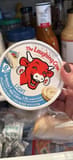 Light Laughing Cow Cheese Wedges The Laughing Cow · 8 × 19 g Ultra-processedHigh in saltHigh in saturated fat Score 66 out of 100 Good
 -
 Low Fat Cottage Cheese Darigold · 113 g Ultra-processedContains emulsifiers studied for gut effectsMay contain traces of 1,4-dioxane Score 57 out of 100 Okay
 -
 String Cheese Frigo Cheese Heads · 28 g High in saltHigh in saturated fat Score 79 out of 100 Good
 -
 Cream Cheese Great Value · 8 oz Ultra-processedHigh in saturated fat Score 69 out of 100 Good
 -
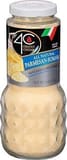 Parmesan Romano Grated Cheese 4c · 6 oz High in saltHigh in saturated fat Score 79 out of 100 Good
 -
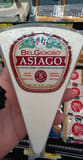 Asiago Cheese Belgioioso · 28 g High in saltHigh in saturated fat Score 79 out of 100 Good
More from Aldi
Sources
-
“Artificial colours or a sodium benzoate preservative (or both) in the diet result in increased hyperactivity in 3-year-old and 8/9-year-old children in the general population.”
doi.org
-
Re-evaluation of benzyl alcohol (E 1519) as food additive (records the 2016 benzoate re-evaluation)
“derived a group ADI of 5 mg/kg bw per day (expressed as benzoic acid) in accordance with the ADI previously derived by SCF and JECFA”
doi.org
-
Regulation (EU) No 1169/2011 of 25 October 2011 on the provision of food information to consumers
“ANNEX II SUBSTANCES OR PRODUCTS CAUSING ALLERGIES OR INTOLERANCES 1. Cereals containing gluten, namely: wheat, rye, barley, oats, spelt, kamut or their hybridised strains”
eur-lex.europa.eu
-
“1. Cereals containing gluten, namely: wheat (such as spelt and khorasan wheat), rye, barley, oats or their hybridised strains, and products thereof”
legislation.gov.uk
-
Saturated fatty acid and trans-fatty acid intake for adults and children: WHO guideline
“WHO recommends that adults and children reduce saturated fatty acid intake to 10% of total energy intake (strong recommendation).”
who.int
-
“For adults, WHO recommends less than 2000 mg/day of sodium (equivalent to less than 5 g/day salt), or just under a teaspoon.”
who.int
-
Dietary Guidelines for Americans, 2025–2030
“Limit foods and beverages that include artificial flavors, petroleum-based dyes, artificial preservatives, and low-calorie non-nutritive sweeteners.”
cdn.realfood.gov
-
“Table 3: Criteria for drinks (per 100ml)”
assets.publishing.service.gov.uk