Dehydrated beverages
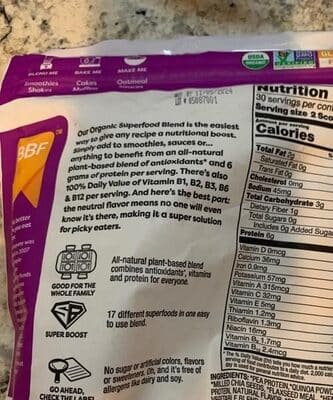
Better Body Foods Organic Superfood Blend
360 g
Score
- Contains caffeine
- Certified organic
- Contains whole grains
Why it scores 100
Better Body Foods Organic Superfood Blend scores 100 out of 100 (Excellent) under GoodSwap’s published rules. What moved the score most:
- plus 5 points Certified organic: Carries a certified-organic label. Info
- plus 4 points Fiber 8.3 g / 100 g: A good source of fiber. Strong
- minus 3 points Salt 0.9 g / 100 g: High in salt. Strong
Every line of the math is on The Receipt below, with its evidence tier and sources.
The Receipt
Organic Superfood Blend
Ingredients
- Pea protein minus 2.5 points
- Natural flavors minus 2.5 points
Nutrition per 100 g
- Salt 0.9 g / 100 g minus 3 points
- Energy 417 kcal / 100 g minus 2 points
- Fiber 8.3 g / 100 g plus 4 points
- Protein 50 g / 100 g plus 2 points
Bonuses
- Certified organic plus 5 points
100 + 1 = 100
Nutrition per 100 g
| Energy | 417 kcal |
|---|---|
| Fat | 16.7 g |
| Saturated fat | 0 g |
| Trans fat | 0 g |
| Carbohydrates | 25 g |
| Sugars | 0 g |
| Added sugars | 0 g |
| Fiber | 8.3 g |
| Protein | 50 g |
| Salt | 0.9 g |
Serving: 2 Tbsp (12 g)
Ingredients
- PEA PROTEIN
- QUINOA POWDER
- MILLED CHIA SEEDS
- FLAXSEED MEAL
- HEMP PROTEIN
- NATURAL FLAVOR
- GREEN TEA
- FRUIT & VEGETABLE BLEND (CARROT, BEET, SPINACH, TOMATO, BROCCOLI, ORANGE, APPLE, SHIITAKE MUSHROOM, CHERRY, CRANBERRY, BLUEBERRY, STRAWBERRY)
- VITAMIN C
- NIACIN
- VITAMIN E
- VITAMIN B6
- RIBOFLAVIN
- THIAMIN
- VITAMIN A
- VITAMIN B12
Label text, as published
*PEA PROTEIN, *QUINOA POWDER, *MILLED CHIA SEEDS, *FLAXSEED MEAL, *HEMP PROTEIN, NATURAL FLAVOR, *GREEN TEA, *FRUIT & VEGETABLE BLEND (*CARROT, *BEET, *SPINACH, *TOMATO, *BROCCOLI, *ORANGE, *APPLE, *SHIITAKE MUSHROOM, *CHERRY, *CRANBERRY, *BLUEBERRY, *STRAWBERRY), VITAMIN C, NIACIN, VITAMIN E, VITAMIN B6, RIBOFLAVIN, THIAMIN, VITAMIN A, VITAMIN B12.
Allergens and diets
- Palm-oil-free
Always check the package: recipes change.
More dehydrated beverages on GoodSwap
-
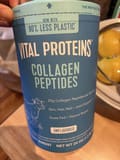 Collagen Peptides Vital Proteins · 24 oz No additives Score 100 out of 100 Excellent
 -
 Milk Chocolate Flavor Swiss Miss · 8.28 oz Ultra-processedHigh in sugarHigh in saturated fatContains added sugars Score 7 out of 100 Bad
 -
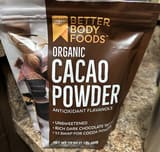 Organic Cacao Powder Better Body Foods · 16 oz Certified organicNo additives Score 100 out of 100 Excellent
 -
 Electrolyte Drink Mix LMNT Ultra-processedHigh in saltContains non-nutritive sweeteners Score 66 out of 100 Good
 -
 Propel powder packets grape with electrolytes Gatorade · 10 packets Ultra-processedHigh in saltContains non-nutritive sweeteners Score 43 out of 100 Okay
 -
 Hot cocoa mix Nestlé · 208 g Ultra-processedHigh in sugarHigh in saltContains non-nutritive sweeteners Score 16 out of 100 Bad
More from Better Body Foods
-
 Organic Chia Seeds Better Body Foods · 2 lb Score 100 out of 100 Excellent
 -
 Avocado Oil Mayo Original Better Body Foods · 15 fl oz/444 mL Score 62 out of 100 Good
 -
 Organic Super Seeds Better Body Foods · 16 oz Score 79 out of 100 Good
 -
 Organic Coconut Aminos Soy Sauce Replacement Better Body Foods · 16.9 fl oz/500 mL Score 68 out of 100 Good
Sources
-
21 CFR 101.22 Foods; labeling of spices, flavorings, colorings and chemical preservatives
“whose significant function in food is flavoring rather than nutritional.”
ecfr.gov
-
“For adults, WHO recommends less than 2000 mg/day of sodium (equivalent to less than 5 g/day salt), or just under a teaspoon.”
who.int
-
Dietary Guidelines for Americans, 2025–2030
“Limit foods and beverages that include artificial flavors, petroleum-based dyes, artificial preservatives, and low-calorie non-nutritive sweeteners.”
cdn.realfood.gov
-
7 CFR 205.102 Use of the term "organic" (National Organic Program)
“Any agricultural product that is sold, labeled, or represented as “100 percent organic,” “organic,” or “made with organic (specified ingredients or food group(s))” must be: (a) Produced in accordance with the requirements specified in § 205.101 or §§ 205.202 through 205.207”
ecfr.gov
-
Spilling the Beans: How Much Caffeine is Too Much?
“For most adults, the FDA has cited 400 milligrams* a day — that's about two to three 12-fluid-ounce cups of coffee — as an amount not generally associated with negative effects.”
fda.gov
-
Regulation (EU) No 1169/2011, Annex III point 4.1 (beverages with high caffeine content)
“‘High caffeine content. Not recommended for children or pregnant or breast-feeding women’”
eur-lex.europa.eu