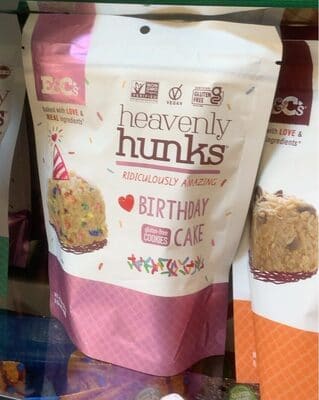
Cookies
E&c's Heavenly Hunks
6 oz/170 g
Score
- Ultra-processed
- High in saturated fat
- Contains added sugars
- Contains emulsifiers studied for gut effects
- Contains palm oil
- Seed-oil free
- No synthetic dyes
- Contains whole grains
Why it scores 4
E&c's Heavenly Hunks scores 4 out of 100 (Bad) under GoodSwap’s published rules. What moved the score most:
- minus 20 points Corn syrup: An added sugar. Strong
- minus 20 points Sugar: An added sugar. Strong
- minus 18 points Ultra-processed (NOVA 4): Classified NOVA 4: made with industrial ingredients and additives. Strong
Every line of the math is on The Receipt below, with its evidence tier and sources.
The Receipt
Heavenly Hunks
Ingredients
- Corn syrup minus 20 points
- Sugar minus 20 points
- Cellulose gum (carboxymethylcellulose) minus 7.5 points
- Palm oil minus 1.5 points
- Sunflower lecithin minus 1 points
Processing
- Ultra-processed (NOVA 4) minus 18 points
- 6 kinds of ultra-processing markers minus 7.5 points
Nutrition per 100 g
- Sugars 21.4 g / 100 g minus 11 points
- Saturated fat 14.3 g / 100 g minus 9 points
- Salt 0.3 g / 100 g minus 1 points
- Energy 464 kcal / 100 g minus 2 points
- Fiber 3.6 g / 100 g plus 2 points
100 − 96.5 = 3.5 → 4
Can’t score above 79. Contains corn syrup, an ingredient of high concern. [1][2][3]
Can’t score above 79. High in fat and saturated fat (above the front-of-pack "high" level). [13]
Nutrition per 100 g
| Energy | 464 kcal |
|---|---|
| Fat | 21.4 g |
| Saturated fat | 14.3 g |
| Trans fat | 0 g |
| Carbohydrates | 64.3 g |
| Sugars | 21.4 g |
| Added sugars | 10.7 g |
| Fiber | 3.6 g |
| Protein | 7.1 g |
| Salt | 0.3 g |
Serving: 1 hunk (28 g)
Ingredients
- GLUTEN FREE ROLLED OATS
- BROWN RICE SYRUP (high concern)
- SPRINKLES (SUGAR, PALM KERNEL & PALM OIL, CORN STARCH, COLORED WITH BEET JUICE, VEGETABLE JUICE, ANNATTO EXTRACT, SPIRULINA EXTRACT, TURMERIC, BETA-CAROTENE, PAPRIKA OLEORESIN, SUNFLOWER LECITHIN, MALTODEXTRIN, CARNAUBA WAX, CELLULOSE GUM) (not recognized)
- PALM OIL (SUSTAINABLY SOURCED)
- COCONUT SHREDS
- SORGHUM FLOUR
- TAPIOCA FLOUR
- POTATO STARCH
- CANE SUGAR (high concern)
- NATURAL FLAVORS
- SEA SALT
Label text, as published
GLUTEN FREE ROLLED OATS, BROWN RICE SYRUP, SPRINKLES (SUGAR, PALM KERNEL & PALM OIL, CORN STARCH, (COLORED WITH BEET JUICE, VEGETABLE JUICE, ANNATTO EXTRACT, SPIRULINA EXTRACT, TURMERIC, BETA-CAROTENE, PAPRIKA OLEORESIN), SUNFLOWER LECITHIN, MALTODEXTRIN, CARNAUBA WAX, CELLULOSE GUM), PALM OIL (SUSTAINABLY SOURCED), COCONUT SHREDS, SORGHUM FLOUR, TAPIOCA FLOUR, POTATO STARCH, CANE SUGAR, NATURAL FLAVORS, SEA SALT.
Allergens and diets
Contains: Tree nuts, Soy, Gluten
- Vegan
- Vegetarian
- Not gluten-free
- Not palm-oil-free
Always check the package: recipes change.
More cookies on GoodSwap
-
 Fig Bar Blueberry Nature's Bakery · 2 oz Ultra-processedHigh in sugarContains added sugarsContains seed oils Score 14 out of 100 Bad
 -
 Crunchy Breakfast Biscuits Belvita · 1.76 oz Ultra-processedContains added sugarsContains emulsifiers studied for gut effectsContains seed oils Score 15 out of 100 Bad
 -
 belVita Crunchy Blueberry Breakfast Biscuits Belvita · 1.76 oz Ultra-processedHigh in sugarContains added sugarsContains emulsifiers studied for gut effects Score 15 out of 100 Bad
 -
 The Complete Cookie Lenny & Larry's · 4 oz Contains added sugarsContains palm oilSeed-oil free Score 27 out of 100 Poor
 -
 Baked Graham Cracker Snacks Cinnamon Scooby-Doo! · 11 oz Ultra-processedHigh in sugarContains added sugarsContains seed oils Score 10 out of 100 Bad
 -
 Pepperidge farm cookies Pepperidge Farm · 191 g Ultra-processedHigh in sugarHigh in saturated fatContains added sugars Score 4 out of 100 Bad
Sources
-
Guideline: sugars intake for adults and children
“In both adults and children, WHO recommends reducing the intake of free sugars to less than 10% of total energy intake”
who.int
-
Dietary Guidelines for Americans, 2025–2030
“Limit foods and beverages that include artificial flavors, petroleum-based dyes, artificial preservatives, and low-calorie non-nutritive sweeteners.”
cdn.realfood.gov
-
Added and free sugars should be as low as possible
“Sugar consumption is a known cause of dental caries.”
efsa.europa.eu
-
“Relative to control subjects, CMC consumption modestly increased postprandial abdominal discomfort and perturbed gut microbiota composition in a way that reduced its diversity.”
doi.org
-
Dietary emulsifiers impact the mouse gut microbiota promoting colitis and metabolic syndrome
“carboxymethylcellulose and polysorbate-80, induced low-grade inflammation and obesity/metabolic syndrome in wild-type hosts and promoted robust colitis in mice predisposed to this disorder.”
doi.org
-
“This study found positive associations between risk of CVD and intake of five individual and two groups of food additive emulsifiers widely used in industrial foods.”
doi.org
-
“The Panel concluded that there was no need for a numerical ADI and that there would be no safety concern at the reported uses and use levels for the unmodified and modified celluloses”
doi.org
-
Saturated fatty acid and trans-fatty acid intake for adults and children: WHO guideline
“WHO recommends that adults and children reduce saturated fatty acid intake to 10% of total energy intake (strong recommendation).”
who.int
-
Process contaminants in vegetable oils and foods
“The highest levels of GE, as well as 3-MCPD and 2-MCPD (including esters) were found in palm oils and palm fats, followed by other oils and fats.”
efsa.europa.eu
-
“Glycidyl fatty acid esters, expressed as glycidol”
eur-lex.europa.eu
-
“For adults, WHO recommends less than 2000 mg/day of sodium (equivalent to less than 5 g/day salt), or just under a teaspoon.”
who.int
-
“Table 3: Criteria for drinks (per 100ml)”
assets.publishing.service.gov.uk
-
“Greater exposure to ultra-processed food was associated with a higher risk of adverse health outcomes, especially cardiometabolic, common mental disorder, and mortality outcomes.”
doi.org