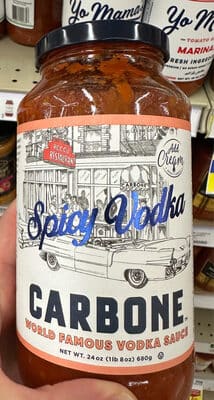
Pastas
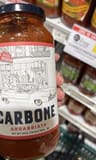
Carbone Spicy Vodka Carbone Sauce
24 oz
Score
- High in salt
- Contains added sugars
- Contains seed oils
- No additives
Why it scores 67
Carbone Spicy Vodka Carbone Sauce scores 67 out of 100 (Good) under GoodSwap’s published rules. What moved the score most:
- minus 20 points Sugar: An added sugar. Strong
- minus 5 points Salt 1.6 g / 100 g: High in salt. Strong
- minus 3 points Sugars 5.3 g / 100 g: Contains some sugar. Strong
Every line of the math is on The Receipt below, with its evidence tier and sources.
Better pasta sauces
-
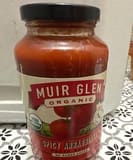 Spicy Arrabbiata Pasta Sauce Muir Glen · 23.5 oz Less salt · No added sugars Score 100 out of 100 , 33 points higher
 -
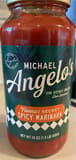 Spicy marinara Michael Angelo's · 24 oz Less salt · No added sugars Score 100 out of 100 , 33 points higher
 -
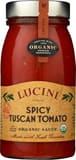 Organic Sauce spicy tuscan Lucini · 24 oz Less salt · No added sugars Score 99 out of 100 , 32 points higher
 -
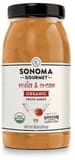 Organic Pasta Sauce Vodka & Cream Sonoma Gourmet · 25 oz Less salt · No added sugars Score 96 out of 100 , 29 points higher
 -
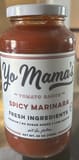 Spicy Marinara Yo Mama’s Tomato Sauce · 25 oz Less salt · No added sugars Score 93 out of 100 , 26 points higher
The same kind of product, at least 10 points higher, sold in the US. Never paid placements.
The Receipt
Spicy Vodka Carbone Sauce
Ingredients
- Sugar minus 20 points
- Sunflower oil minus 2.5 points
- Spirits minus 2.5 points
Nutrition per 100 g
- Sugars 5.3 g / 100 g minus 3 points
- Salt 1.6 g / 100 g minus 5 points
100 − 33 = 67
Can’t score above 79. Contains sugar, an ingredient of high concern. [1][2][3]
Can’t score above 79. High in salt (above the front-of-pack "high" level). [11]
Nutrition per 100 g
| Energy | 53 kcal |
|---|---|
| Fat | 1.8 g |
| Saturated fat | 0 g |
| Trans fat | 0 g |
| Carbohydrates | 7.1 g |
| Sugars | 5.3 g |
| Added sugars | 1.8 g |
| Fiber | 0.9 g |
| Protein | 1.8 g |
| Salt | 1.6 g |
Serving: 1 serving (113 g)
Ingredients
- IMPORTED ITALIAN TOMATOES (WHOLE PEELED TOMATOES, TOMATO PUREE, BASIL, SALT)
- ONIONS
- SUGAR (high concern)
- CALABRIAN PEPPER SPREAD (PEPPERS, SUNFLOWER OIL, VINEGAR, SALT)
- SEA SALT
- OLIVE OIL
- GARLIC
- VODKA
- BLACK PEPPER
Label text, as published
IMPORTED ITALIAN TOMATOES (WHOLE PEELED TOMATOES, TOMATO PUREE, BASIL, SALT), ONIONS, SUGAR, CALABRIAN PEPPER SPREAD (PEPPERS, SUNFLOWER OIL, VINEGAR, SALT), SEA SALT, OLIVE OIL, GARLIC, VODKA, BLACK PEPPER
Allergens and diets
- Vegan
- Vegetarian
- Palm-oil-free
Always check the package: recipes change.
More pastas on GoodSwap
-
 Mac & Cheese Kraft · 7.25 oz (206 g) Ultra-processedHigh in saltSeed-oil freeNo synthetic dyes Score 57 out of 100 Okay
 -
 Tomato & Basil Bertolli · 2040 g Contains added sugarsSeed-oil free Score 61 out of 100 Good
 -
 Beef Merlot Healthy Choice · 9.5 oz Ultra-processedContains added sugarsContains seed oilsNo synthetic dyes Score 25 out of 100 Poor
 -
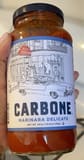 Marinara Delicato Carbone · 24 oz No additivesSeed-oil free Score 100 out of 100 Excellent
 -
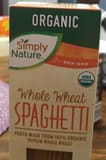 Whole Wheat Spaghetti Simply Nature No additivesContains whole grains Score 100 out of 100 Excellent
 -
 mac’n cheese Bold and cheesy Flavor Cheetos · 2.32 oz/66 g Dye with an EU warning labelContains synthetic dyesHigh in saltContains added sugars Score 9 out of 100 Bad
More from Carbone
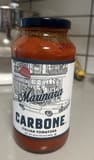
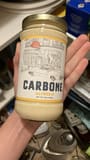
Sources
-
Guideline: sugars intake for adults and children
“In both adults and children, WHO recommends reducing the intake of free sugars to less than 10% of total energy intake”
who.int
-
Dietary Guidelines for Americans, 2025–2030
“Limit foods and beverages that include artificial flavors, petroleum-based dyes, artificial preservatives, and low-calorie non-nutritive sweeteners.”
cdn.realfood.gov
-
Added and free sugars should be as low as possible
“Sugar consumption is a known cause of dental caries.”
efsa.europa.eu
-
“replacement of saturated fat in the diet with linoleic acid effectively lowers serum cholesterol but does not support the hypothesis that this translates to a lower risk of death from coronary heart disease or all causes.”
doi.org
-
“These data provide support for current recommendations to replace saturated fat with polyunsaturated fat for primary prevention of CHD.”
doi.org
-
About Alcohol Use During Pregnancy
“There is no known safe amount of alcohol use during pregnancy.”
cdc.gov
-
Agents Classified by the IARC Monographs, Volumes 1–142 (List of Classifications)
monographs.iarc.who.int
-
“For adults, WHO recommends less than 2000 mg/day of sodium (equivalent to less than 5 g/day salt), or just under a teaspoon.”
who.int
-
“Table 3: Criteria for drinks (per 100ml)”
assets.publishing.service.gov.uk