Cheeses
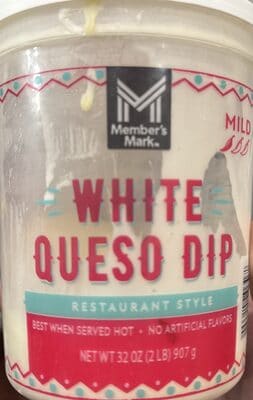
Member's Mark White Queso Dip
32 oz
Score
- Ultra-processed
Why it scores 64
Member's Mark White Queso Dip scores 64 out of 100 (Good) under GoodSwap’s published rules. What moved the score most:
- minus 18 points Ultra-processed (NOVA 4): Classified NOVA 4: made with industrial ingredients and additives. Strong
- minus 7.5 points Sodium benzoate: Benzoates can form small amounts of benzene in drinks that also contain ascorbic acid (vitamin C), especially with heat or light. Strong
- minus 2.5 points Sodium phosphate: EFSA (2019) set a group ADI for phosphates of 40 mg/kg body weight (as phosphorus) and noted that infants, toddlers and children may exceed it. Strong
Every line of the math is on The Receipt below, with its evidence tier and sources.
Better dips and spreads
-
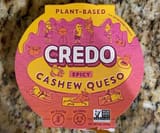 Cashew Queso Original Spicy Credo Foods · 9 oz Not ultra-processed · No sodium benzoate Score 92 out of 100 , 28 points higher
 -
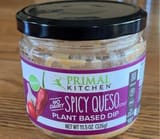 Plant Based Spicy Queso Primal Kitchen · 11.5 oz/326 g Not ultra-processed · No sodium benzoate Score 87 out of 100 , 23 points higher
 -
 No dairy queso Primal Kitchen · 11.5 oz/326 g Not ultra-processed · No sodium benzoate Score 87 out of 100 , 23 points higher
 -
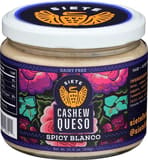 Spicy blanco cashew queso Not ultra-processed · No sodium benzoate Score 96 out of 100 , 32 points higher
 -
 Tropical, Queso Blanco, White Cheese Tropical Cheese Industries Inc. · 12 × 16 oz Not ultra-processed · No sodium benzoate Score 79 out of 100 , 15 points higher
The same kind of product, at least 10 points higher, sold in the US. Never paid placements.
The Receipt
White Queso Dip
Ingredients
- Sodium benzoate minus 7.5 points
- Sodium phosphate minus 2.5 points
- Sorbic acid minus 2.5 points
- Calcium chloride minus 1.5 points
- Modified starch minus 1.5 points
- Potassium sorbate minus 1.5 points
Processing
- Ultra-processed (NOVA 4) minus 18 points
- 2 kinds of ultra-processing markers minus 1.5 points
Nutrition
- Nutrition facts unavailable no points
100 − 36.5 = 63.5 → 64
Can’t score above 79. No nutrition facts on file, so we can't confirm excellent.
Ingredients
- PASTEURIZED PROCESS AMERICAN CHEESE (cultured milk, water, cream, salt, sodium phosphate, sodium citrate, lactic acid, sorbic acid preservative, enzymes)
- water
- jalapeños (jalapeño peppers, water, salt, citric acid, calcium chloride)
- whole milk powder
- modified corn starch
- salt
- onion powder
- garlic powder
- cumin
- potassium sorbate (preservative)
- sodium benzoate (preservative) (moderate concern)
Label text, as published
PASTEURIZED PROCESS AMERICAN CHEESE (cultured milk, water, cream, salt, sodium phosphate, sodium citrate, lactic acid, sorbic acid preservative, enzymes), water, jalapeños (jalapeño peppers, water, salt, citric acid, calcium chloride), whole milk powder, modified corn starch, salt, onion powder, garlic powder, cumin, potassium sorbate (preservative), sodium benzoate (preservative)
Allergens and diets
Contains: Milk
- Not vegan
- Palm-oil-free
Always check the package: recipes change.
More cheeses on GoodSwap
-
 Light Laughing Cow Cheese Wedges The Laughing Cow · 8 × 19 g Ultra-processedHigh in saltHigh in saturated fat Score 66 out of 100 Good
 -
 Low Fat Cottage Cheese Darigold · 113 g Ultra-processedContains emulsifiers studied for gut effectsMay contain traces of 1,4-dioxane Score 57 out of 100 Okay
 -
 String Cheese Frigo Cheese Heads · 28 g High in saltHigh in saturated fat Score 79 out of 100 Good
 -
 Grated Parmigiano Reggiano Trader Joe's · 5 oz High in saltHigh in saturated fat Score 78 out of 100 Good
 -
 Sharp Cheddar Sargento · 6.84 oz/193 g Ultra-processedHigh in saltHigh in saturated fatNo synthetic dyes Score 76 out of 100 Good
 -
 Baby Swiss Cheese Member's Mark · 32 oz High in saturated fat Score 79 out of 100 Good
More from Member's Mark
Sources
-
“Artificial colours or a sodium benzoate preservative (or both) in the diet result in increased hyperactivity in 3-year-old and 8/9-year-old children in the general population.”
doi.org
-
Re-evaluation of benzyl alcohol (E 1519) as food additive (records the 2016 benzoate re-evaluation)
“derived a group ADI of 5 mg/kg bw per day (expressed as benzoic acid) in accordance with the ADI previously derived by SCF and JECFA”
doi.org
-
EFSA issues new advice on phosphates
“We estimated that dietary exposure to phosphates may exceed the new ADI for infants, toddlers and children with average consumption of phosphates in their diet.”
efsa.europa.eu
-
“By applying a default uncertainty factor of 100, the Panel established a group ADI expressed as 11 mg sorbic acid/kg bw per day for sorbic acid (E 200) and its potassium salt (E 202).”
doi.org
-
21 CFR 182.3640 Potassium sorbate
ecfr.gov
-
“Greater exposure to ultra-processed food was associated with a higher risk of adverse health outcomes, especially cardiometabolic, common mental disorder, and mortality outcomes.”
doi.org