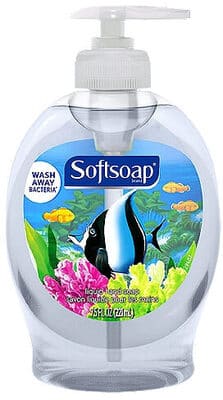
Hand soap sanitizers
Softsoap Liquid Hand Soap Pump, Aquarium Series
7.5 fl oz
Score
- Contains fragrance
- Contains sulfate surfactants
- May contain traces of 1,4-dioxane
- Contains ethanolamines (MEA/DEA/TEA)
Why it scores 86
Softsoap Liquid Hand Soap Pump, Aquarium Series scores 86 out of 100 (Excellent) under GoodSwap’s published rules. What moved the score most:
- minus 5 points Fragrance (parfum): A single label term covers an undisclosed mixture. Regulatory
- minus 5 points Salicylic acid: Classified in the EU as a CMR substance of category 2; allowed up to 0.5% as a preservative and 2–3% for other uses, and not for children under 3 (except shampoos). Regulatory
- minus 1 points Sodium laureth sulfate (SLES): Ethoxylated ingredients can contain trace 1,4-dioxane, a manufacturing by-product (IARC Group 2B). Strong
Every line of the math is on The Receipt below, with its evidence tier and sources.
Better body wash and soap
-
 All-One Peppermint Pure-Castile Bar Soap Dr. Bronner's No fragrance · No sulfate surfactants Score 100 out of 100 , 14 points higher
 -
 18-in-1 Lavender Pure-Castile Soap Dr Bonner’s Liquid Castile Soap / Savon · 946 mL No fragrance · No sulfate surfactants Score 100 out of 100 , 14 points higher
 -
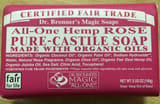 All-One Rose Pure-Castile Bar Soap Dr. Bronner's · 5 oz (140 g) No sulfate surfactants · No ethoxylated ingredients Score 100 out of 100 , 14 points higher
 -
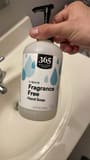 Liquid Fragrance Free Hand Soap 365 Whole Foods Market No fragrance · No sulfate surfactants Score 98 out of 100 , 12 points higher
 -
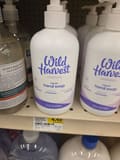 Lavender Liquid Hand Soap Wild Harvest No fragrance · No sulfate surfactants Score 97 out of 100 , 11 points higher
The same kind of product, at least 10 points higher, sold in the US. Never paid placements.
The Receipt
Liquid Hand Soap Pump, Aquarium Series
Ingredients
- Fragrance (parfum) minus 5 points
- Salicylic acid minus 5 points
- Sodium laureth sulfate (SLES) minus 1 points
- Cocamidopropyl betaine minus 0.5 points
- Propylene glycol minus 0.5 points
- Monoethanolamine (MEA) minus 0.5 points
- Sodium benzoate (cosmetic) minus 0.5 points
- BHT (butylated hydroxytoluene) minus 0.5 points
- Polyethylene glycols (PEG) and ethoxylates minus 0.5 points
- Violet 2 (CI 60725) minus 0.5 points
100 − 14.5 = 85.5 → 86
Ingredients
- Aqua/Water
- Sodium C12-13 Pareth Sulfate
- Cocamidopropyl Betaine
- Sodium Chloride
- Propylene Glycol
- Fragrance (moderate concern)
- Cocamide MEA
- Sodium Salicylate (moderate concern)
- Sodium Benzoate
- Citric Acid
- Sodium Sulfate
- Tetrasodium EDTA
- BHT
- Polyquaternium-7
- PEG-18 Glyceryl Oleate/Cocoate
- PEG-7 Glyceryl Cocoate
- Poloxamer 124 (not recognized)
- Ext (not recognized)
- Violet 2
Label text, as published
Aqua/Water, Sodium C12-13 Pareth Sulfate, Cocamidopropyl Betaine, Sodium Chloride, Propylene Glycol, Fragrance, Cocamide MEA, Sodium Salicylate, Sodium Benzoate, Citric Acid, Sodium Sulfate, Tetrasodium EDTA, BHT, Polyquaternium-7, PEG-18 Glyceryl Oleate/Cocoate, PEG-7 Glyceryl Cocoate, Poloxamer 124, Ext. Violet 2
Allergens and diets
- Palm-oil-free
Always check the package: recipes change.
Sources
-
“when their concentration exceeds 0,001 % in leave-on products and 0,01 % in rinse-off products.”
eur-lex.europa.eu
-
Regulation (EC) No 1223/2009 of 30 November 2009 on cosmetic products
“cosmetic products shall not contain any of the following: (a) prohibited substances — prohibited substances listed in Annex II”
eur-lex.europa.eu
-
fda.gov
-
“the substance is safe for consumers when used as a preservative in cosmetic products in a concentration of up to 0,5 % (acid)”
eur-lex.europa.eu
-
1,4-Dioxane in Cosmetics: A Manufacturing Byproduct
“1,4-dioxane forms as a byproduct during the manufacturing process of certain cosmetic ingredients.”
fda.gov
-
Agents Classified by the IARC Monographs, Volumes 1–142 (List of Classifications)
monographs.iarc.who.int
-
Occupational contact allergy to cocamidopropyl betaine and its impurities
“Contact allergy to cocamidopropyl betaine has been attributed to its impurities dimethylaminopropylamine and cocamidopropyl dimethylamine.”
doi.org
-
“Allergic and irritant contact dermatitis and systemic cutaneous reactions to PG, which has become an increasingly common ingredient, have been documented.”
doi.org
-
“the use of Homosalate should be restricted to face products (non-spray and pump spray products) only, up to a maximum concentration of 7,34 %.”
eur-lex.europa.eu
-
“The NTP study did not establish a link between DEA and the risk of cancer in humans.”
fda.gov