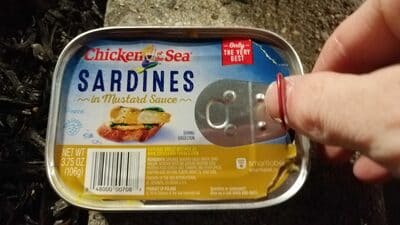
Canned sardines
Chicken Of The Sea Sardines in mustard sauce
3.75 oz (106 g)
Score
- Ultra-processed
- No synthetic dyes
Why it scores 62
Chicken Of The Sea Sardines in mustard sauce scores 62 out of 100 (Good) under GoodSwap’s published rules. What moved the score most:
- minus 18 points Ultra-processed (NOVA 4): Classified NOVA 4: made with industrial ingredients and additives. Strong
- minus 6 points 5 kinds of ultra-processing markers: Industrial additive classes found: color (added), flavor enhancer, industrial sugar or starch hydrolysate, modified starch and thickener, stabilizer or gelling agent. Emerging
- minus 3 points Saturated fat 3.3 g / 100 g: High in saturated fat. Strong
Every line of the math is on The Receipt below, with its evidence tier and sources.
The Receipt
Sardines in mustard sauce
Ingredients
- Maltodextrin minus 2.5 points
- Modified starch minus 2.5 points
- Guar gum minus 2.5 points
- Monosodium glutamate (MSG) minus 1.5 points
- Xanthan gum minus 1.5 points
Processing
- Ultra-processed (NOVA 4) minus 18 points
- 5 kinds of ultra-processing markers minus 6 points
Nutrition per 100 g
- Saturated fat 3.3 g / 100 g minus 3 points
- Salt 1 g / 100 g minus 3 points
- Protein 13.2 g / 100 g plus 2 points
100 − 38.5 = 61.5 → 62
Nutrition per 100 g
| Energy | 160 kcal |
|---|---|
| Fat | 11.3 g |
| Saturated fat | 3.3 g |
| Carbohydrates | 1.9 g |
| Protein | 13.2 g |
| Salt | 1 g |
Serving: 1 portion (106 g)
Ingredients
- sardines
- mustard sauce (water, mustard powder, vinegar, maltodextrin, modified starch, citric acid, guar gum, spices, monosodium glutamate, turmeric oleoresin, xanthan gum, chili powder)
- salt
Label text, as published
sardines , mustard sauce (water, mustard powder, vinegar, maltodextrin, modified starch, citric acid, guar gum, spices, monosodium glutamate, turmeric oleoresin, xanthan gum, chili powder), salt
Allergens and diets
Contains: Fish, Mustard
- Not vegan
- Not vegetarian
- Palm-oil-free
Always check the package: recipes change.
Packaging
Metal
Context only: no points in v1.
More canned sardines on GoodSwap
-
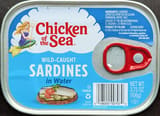 Wild-Caught Sardines in Water Chicken Of The Sea · 3.75 oz (106 g) No additives Score 87 out of 100 Excellent
 -
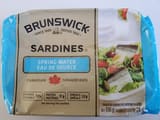 Boneless Butterflied Sardine Fillets Brunswick · 106 Gr No additives Score 100 out of 100 Excellent
 -
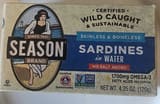 Season skinless and boneless sardines in water Season · 4.25 oz/120 g No additives Score 100 out of 100 Excellent
 -
 Sardines in spring water Aldi No additives Score 95 out of 100 Excellent
 -
 Wild Sardines Wild Planet · 4.4 oz No additives Score 100 out of 100 Excellent
 -
 Sardines in Mustard Sauce Great Value · 3.75 oz (106 g) Contains seed oils Score 88 out of 100 Excellent
More from Chicken Of The Sea
-
 Chunk Light Tuna Chicken Of The Sea · 7 oz Score 96 out of 100 Excellent
 -
 Chunk Light Tuna Chicken Of The Sea · 56 g Score 96 out of 100 Excellent
 -
 Alaskan Pink Salmon in Spring Water Chicken Of The Sea · 56 g Score 96 out of 100 Excellent
 -
 Chunk Light Tuna Chicken Of The Sea · 56 g Score 94 out of 100 Excellent
Sources
-
Questions and Answers on Monosodium glutamate (MSG)
“FDA considers the addition of MSG to foods to be “generally recognized as safe” (GRAS).”
fda.gov
-
EFSA reviews safety of glutamates added to food
“EFSA re-assessed the safety of glutamates used as food additives and derived a group acceptable daily intake (ADI) of 30 mg/kg body weight per day for all six of these additives.”
efsa.europa.eu
-
Saturated fatty acid and trans-fatty acid intake for adults and children: WHO guideline
“WHO recommends that adults and children reduce saturated fatty acid intake to 10% of total energy intake (strong recommendation).”
who.int
-
“For adults, WHO recommends less than 2000 mg/day of sodium (equivalent to less than 5 g/day salt), or just under a teaspoon.”
who.int
-
Dietary Guidelines for Americans, 2025–2030
“Limit foods and beverages that include artificial flavors, petroleum-based dyes, artificial preservatives, and low-calorie non-nutritive sweeteners.”
cdn.realfood.gov
-
“Greater exposure to ultra-processed food was associated with a higher risk of adverse health outcomes, especially cardiometabolic, common mental disorder, and mortality outcomes.”
doi.org