Food
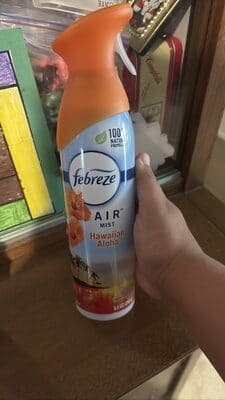
Febreze Air Mist Hawaiian Aloha
Score
- Ultra-processed
- High in sugar
- High in saturated fat
- Contains fragrance
- Contains a common skin-allergen preservative
- May contain traces of 1,4-dioxane
Why it scores 44
Febreze Air Mist Hawaiian Aloha scores 44 out of 100 (Okay) under GoodSwap’s published rules. What moved the score most:
- minus 18 points Ultra-processed (NOVA 4): Classified NOVA 4: made with industrial ingredients and additives. Strong
- minus 14 points Sugars 84 g / 100 g: Very high in sugar. Strong
- minus 9 points Saturated fat 15 g / 100 g: Very high in saturated fat. Strong
Every line of the math is on The Receipt below, with its evidence tier and sources.
The Receipt
Air Mist Hawaiian Aloha
Ingredients
- Fragrance (parfum) minus 7.5 points
- Polyethylene glycols (PEG) and ethoxylates minus 2.5 points
- Benzisothiazolinone (BIT) minus 2.5 points
Processing
- Ultra-processed (NOVA 4) minus 18 points
Nutrition per 100 g
- Sugars 84 g / 100 g minus 14 points
- Saturated fat 15 g / 100 g minus 9 points
- Energy 630 kcal / 100 g minus 3 points
100 − 56.5 = 43.5 → 44
Can’t score above 79. High in fat, saturated fat and sugars (above the front-of-pack "high" level). [11]
Nutrition per 100 g
| Energy | 630 kcal |
|---|---|
| Fat | 25 g |
| Saturated fat | 15 g |
| Carbohydrates | 90 g |
| Sugars | 84 g |
| Added sugars | 0 g |
| Fiber | 1 g |
| Protein | 13 g |
Serving: 100.0g
Ingredients
- water
- alcohol denat
- peg-60 hydrogenated castor oil
- fragrances (moderate concern)
- sodium citrate
- hydroxypropyl cyclodextrin (not recognized)
- citric acid
- sodium sulfate
- sodium sulfocinchoninate
- benzisothiazolinone
- nitrogen
Label text, as published
water, alcohol denat., peg-60 hydrogenated castor oil, fragrances, sodium citrate, hydroxypropyl cyclodextrin, citric acid, sodium sulfate, sodium sulfocinchoninate, benzisothiazolinone, nitrogen
More from Febreze
Sources
-
“when their concentration exceeds 0,001 % in leave-on products and 0,01 % in rinse-off products.”
eur-lex.europa.eu
-
Regulation (EC) No 1223/2009 of 30 November 2009 on cosmetic products
“cosmetic products shall not contain any of the following: (a) prohibited substances — prohibited substances listed in Annex II”
eur-lex.europa.eu
-
fda.gov
-
1,4-Dioxane in Cosmetics: A Manufacturing Byproduct
“1,4-dioxane forms as a byproduct during the manufacturing process of certain cosmetic ingredients.”
fda.gov
-
Agents Classified by the IARC Monographs, Volumes 1–142 (List of Classifications)
monographs.iarc.who.int
-
Isothiazolinone derivatives and allergic contact dermatitis: a review and update
“Moreover, sensitization to newer and lesser known isothiazolinones has been reported.”
doi.org
-
Guideline: sugars intake for adults and children
“In both adults and children, WHO recommends reducing the intake of free sugars to less than 10% of total energy intake”
who.int
-
Saturated fatty acid and trans-fatty acid intake for adults and children: WHO guideline
“WHO recommends that adults and children reduce saturated fatty acid intake to 10% of total energy intake (strong recommendation).”
who.int
-
Dietary Guidelines for Americans, 2025–2030
“Limit foods and beverages that include artificial flavors, petroleum-based dyes, artificial preservatives, and low-calorie non-nutritive sweeteners.”
cdn.realfood.gov
-
“Table 3: Criteria for drinks (per 100ml)”
assets.publishing.service.gov.uk
-
“Greater exposure to ultra-processed food was associated with a higher risk of adverse health outcomes, especially cardiometabolic, common mental disorder, and mortality outcomes.”
doi.org
-
“this substance should therefore be banned in leave-on products.”
eur-lex.europa.eu
-
“up to a maximum authorised concentration of 0,0015 % in rinse-off cosmetic products, apart from its skin sensitising potential.”
eur-lex.europa.eu
-
“a concentration up to 0,0015 % (15 ppm) Methylisothiazolinone is considered safe for the consumer from the point of view of induction of contact allergy.”
eur-lex.europa.eu