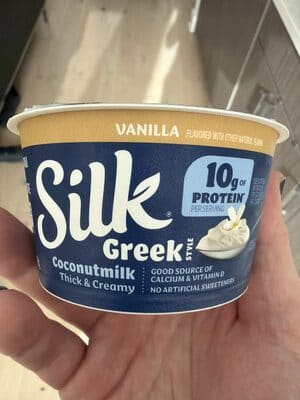
Coconutmilk yogurts
Silk Coconutmilk Thick & Creamy Greek Style
5.3 oz (150 g)
Score
- High in saturated fat
- Contains added sugars
Why it scores 57
Silk Coconutmilk Thick & Creamy Greek Style scores 57 out of 100 (Okay) under GoodSwap’s published rules. What moved the score most:
- minus 20 points Sugar: An added sugar. Strong
- minus 8 points Processed (NOVA 3): Classified NOVA 3: processed with added salt, sugar or oil. Emerging
- minus 7 points Saturated fat 6.7 g / 100 g: Very high in saturated fat. Strong
Every line of the math is on The Receipt below, with its evidence tier and sources.
The Receipt
Coconutmilk Thick & Creamy Greek Style
Ingredients
- Sugar minus 20 points
- Natural flavors minus 2.5 points
- Calcium phosphate minus 2.5 points
Processing
- Processed (NOVA 3) minus 8 points
Nutrition per 100 g
- Sugars 6 g / 100 g minus 3 points
- Saturated fat 6.7 g / 100 g minus 7 points
100 − 43 = 57
Can’t score above 79. Contains sugar, an ingredient of high concern. [1][2][3]
Can’t score above 79. High in saturated fat (above the front-of-pack "high" level). [8]
Nutrition per 100 g
| Energy | 127 kcal |
|---|---|
| Fat | 7.3 g |
| Saturated fat | 6.7 g |
| Trans fat | 0 g |
| Carbohydrates | 8.7 g |
| Sugars | 6 g |
| Added sugars | 4.7 g |
| Fiber | 0.7 g |
| Protein | 6.7 g |
| Salt | 0.1 g |
Serving: 1 container (150 g)
Ingredients
- coconutmilk (filtered water, coconut cream) (not recognized)
- water pe protein
- cane sugar (high concern)
- natural flavors
- pectin calcium phosphate
- cinnamon
- salt
- live and active cultures
- vitamin d2 contains coconut
Label text, as published
coconutmilk (filtered water, coconut cream), water pe protein, cane sugar, contains 2% or less of: natural flavors, pectin calcium phosphate, cinnamon, salt, live and active cultures, vitamin d2 contains coconut.
Allergens and diets
Contains: Tree nuts
- Palm-oil-free
Always check the package: recipes change.
More coconutmilk yogurts on GoodSwap
-
 Coconut Yogurt Alternative So Delicious · 24 oz Ultra-processed Score 68 out of 100 Good
 -
 Plant-Based Coconut Blend Vanilla & Cinnamon Siggi's · 5.3 oz Ultra-processedHigh in saturated fatContains added sugarsSeed-oil free Score 48 out of 100 Okay
 -
 Unsweetened Plain Organic Cultured Coconut Harmless Harvest · 24 oz Contains added sugarsCertified organic Score 77 out of 100 Good
More from Silk
Sources
-
Guideline: sugars intake for adults and children
“In both adults and children, WHO recommends reducing the intake of free sugars to less than 10% of total energy intake”
who.int
-
Dietary Guidelines for Americans, 2025–2030
“Limit foods and beverages that include artificial flavors, petroleum-based dyes, artificial preservatives, and low-calorie non-nutritive sweeteners.”
cdn.realfood.gov
-
Added and free sugars should be as low as possible
“Sugar consumption is a known cause of dental caries.”
efsa.europa.eu
-
21 CFR 101.22 Foods; labeling of spices, flavorings, colorings and chemical preservatives
“whose significant function in food is flavoring rather than nutritional.”
ecfr.gov
-
EFSA issues new advice on phosphates
“We estimated that dietary exposure to phosphates may exceed the new ADI for infants, toddlers and children with average consumption of phosphates in their diet.”
efsa.europa.eu
-
Saturated fatty acid and trans-fatty acid intake for adults and children: WHO guideline
“WHO recommends that adults and children reduce saturated fatty acid intake to 10% of total energy intake (strong recommendation).”
who.int
-
“Table 3: Criteria for drinks (per 100ml)”
assets.publishing.service.gov.uk